


Listen to the article
Taiwan’s military issued a stern warning Tuesday about a surge in Chinese disinformation circulating online during Beijing’s large-scale military exercises around the island, calling on the public to remain vigilant against false claims designed to undermine morale.
At a Tuesday evening news conference, Major General Chu Hui-fang, who heads psychological warfare operations at Taiwan’s Ministry of National Defense (MND), revealed that authorities had identified 46 pieces of disinformation since China began its military exercises.
“The disinformation primarily focuses on attacking our policies, slandering our armed forces, and eroding trust in the United States,” Chu said. She highlighted specific examples, including claims published by Chinese state-run media outlet Global Times falsely asserting that China Coast Guard vessels had quarantined the ports of Keelung, Tainan, Kaohsiung, and Hualien.
Another fabricated claim that circulated in online videos alleged that People’s Liberation Army (PLA) forces had advanced to within nine kilometers of Taiwan’s southern shores. The MND has been actively tracking such disinformation and issuing clarifications as needed.
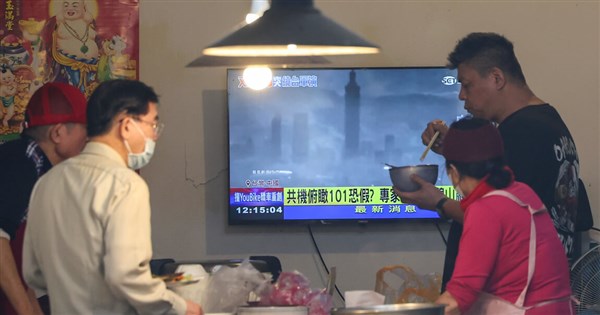
Lieutenant General Hsieh Jih-sheng, deputy chief of the general staff for intelligence at the MND, firmly denied these claims, stating that no Chinese warplanes or warships detected near Taiwan have entered the island’s territorial waters. He also dismissed footage released Monday by China’s state broadcaster CCTV that appeared to show drone imagery of the iconic Taipei 101 skyscraper with captions suggesting aircraft had flown close to the landmark.
“Although drone activity was detected during the exercise, none entered Taiwan’s contiguous zone, which extends 24 nautical miles from our coastline,” Hsieh emphasized.
The disinformation campaign represents a familiar pattern in China’s approach to military exercises targeting Taiwan. MND spokesperson Sun Li-fang noted that every major PLA exercise since August 2022 has combined military maneuvers with non-military actions designed to influence public opinion in Taiwan, neighboring countries, and nations friendly to Taiwan.
This hybrid warfare approach reflects China’s evolving strategy toward Taiwan, which increasingly incorporates information warfare alongside traditional military pressure. The timing of these exercises and accompanying disinformation comes amid heightened cross-strait tensions following the January 2024 election of President Lai Ching-te, whom Beijing has labeled as a “separatist.”
Earlier on Tuesday, President Lai addressed the situation in a social media post, urging the public to exercise caution regarding disinformation accompanying the Chinese exercises. “At this critical moment, unity between the military and civilians in countering misinformation and disinformation constitutes the strongest defense of our democratic homeland,” he wrote.
The current wave of disinformation highlights the complex security challenges facing Taiwan beyond conventional military threats. Information warfare has become an increasingly significant component of China’s pressure campaign against the self-governing island, which Beijing claims as its territory despite Taiwan’s democratic governance and de facto independence for over seven decades.
Security analysts note that such disinformation campaigns are designed to create confusion, sow doubt among Taiwan’s population about their government’s capabilities, and test the island’s response mechanisms. The campaigns also serve to gauge international reactions to China’s assertions of authority over Taiwan.
Taiwan has strengthened its counter-disinformation capabilities in recent years, establishing dedicated units within government agencies to monitor and respond to false information. The MND’s prompt identification and public rebuttal of these claims demonstrates Taiwan’s growing sophistication in combating information warfare tactics.
As China continues its military exercises around Taiwan, authorities on the island remain on high alert for both military provocations and accompanying information warfare designed to undermine Taiwan’s security and social cohesion.
Fact Checker
Verify the accuracy of this article using The Disinformation Commission analysis and real-time sources.

10 Comments
China’s use of disinformation is concerning, but Taiwan’s proactive response to identify and debunk false claims is reassuring. Maintaining public trust is vital during these heightened military exercises.
Yes, kudos to Taiwan’s defense ministry for promptly addressing the disinformation. Calling out specific falsehoods helps counter the narrative that China is trying to push.
It’s disturbing to see the lengths China will go to spread disinformation and sow discord. Taiwan’s efforts to identify and refute these false narratives are critical for preserving factual understanding.
Definitely. Maintaining transparency and public trust is especially vital when military tensions are high. Taiwan’s response sets a good example for handling China’s information warfare tactics.
The Taiwanese military’s vigilance in tracking and dispelling Chinese disinformation during these military exercises is commendable. Maintaining public trust is crucial in times of heightened tensions.
Agreed. Taiwan’s proactive approach to addressing false claims head-on, rather than letting them spread unchecked, is an effective strategy to counter China’s information manipulation.
This underscores the importance of media literacy and critical thinking when consuming information, especially around geopolitical events involving China. Fact-checking is key to avoid falling for propaganda.
Absolutely. Taiwan’s transparency in identifying the disinformation tactics is a good model for other countries facing similar challenges from China’s information warfare.
Interesting to see Taiwan’s military actively monitoring and addressing Chinese disinformation campaigns. It’s critical to stay vigilant against false claims intended to undermine morale and sow confusion.
Agreed. The examples of fabricated reports about Chinese military advances and port quarantines highlight the need for transparent, fact-based communication during sensitive geopolitical situations.