


Listen to the article
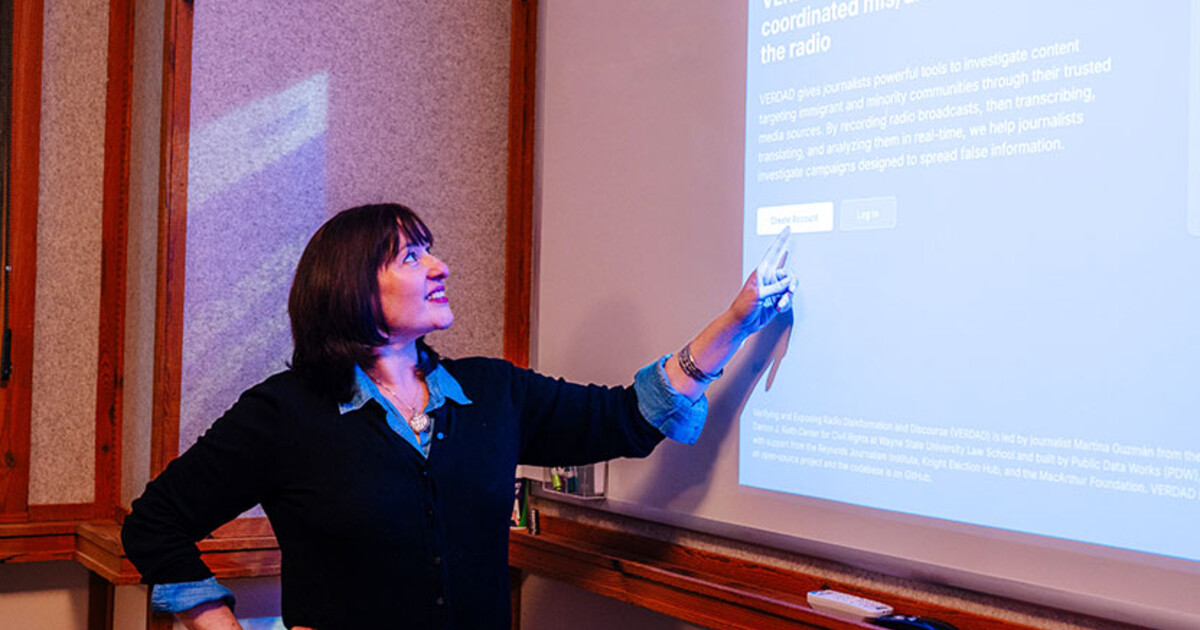
In a groundbreaking effort to combat foreign-language misinformation, journalist Martina Guzmán has created an innovative tool that harnesses artificial intelligence to monitor Spanish-language radio broadcasts across the United States.
Guzmán, a 2008 Columbia Journalism School graduate and Detroit-based independent journalist, launched Verdad—Spanish for “truth”—in 2024. The free application employs AI technology to continuously monitor dozens of Spanish-language radio stations throughout the country, operating around the clock to identify potentially misleading or false information.
“The problem of disinformation on Spanish radio has been an absolute blind spot for journalists,” says Guzmán, who also serves as founder and director of the Race and Justice Reporting Initiative at Wayne State University Law School’s Damon J. Keith Center for Civil Rights.
The platform addresses a significant gap in media monitoring efforts. While tools exist to track misinformation across social media platforms and messaging services like WhatsApp, radio—despite its outsized influence in immigrant communities—has remained largely unscrutinized until now.
“People underestimate radio’s impact among Latinos,” Guzmán explains. “It’s how many of them get basic information, how they hear music from their home countries, and how they connect culturally to the greater diaspora. It informs how they look at issues and how they vote.”
This influence makes radio broadcasts particularly significant during election cycles and public health crises when accurate information is crucial. During recent years, Spanish-language radio has become a vector for conspiracy theories related to vaccines, immigration policies, and international conflicts.
Verdad’s technology automatically transcribes broadcasts and translates them into English, making this content accessible to researchers and journalists who might not speak Spanish. The platform archives these transcriptions, preserving what would otherwise be ephemeral content that “disappears immediately” once aired, according to Guzmán.
The application offers sophisticated filtering capabilities, allowing users to search historical broadcasts by multiple parameters including station, geographic region, language, subject matter, and political bias. This functionality enables researchers to identify patterns in messaging and track the spread of specific narratives across different radio networks.
Primarily designed for investigative journalists and academic researchers studying disinformation trends, Verdad represents a significant advance in media literacy tools focused on immigrant communities. By making Spanish-language radio content searchable and analyzable, the platform helps create greater transparency around the information ecosystem that shapes Latino public opinion in the United States.
The timing of Verdad’s launch is particularly relevant as the United States enters another contentious election cycle. Spanish-speaking voters represent a significant and growing demographic that both major political parties are actively courting. Understanding the information these voters receive through trusted community media sources provides valuable context for political analysts and campaign strategists alike.
Guzmán is currently working to expand Verdad’s capabilities, with plans to monitor additional stations and geographic regions while refining the AI’s transcription accuracy and precision. As disinformation becomes increasingly sophisticated and targeted toward specific language communities, tools like Verdad may prove essential in maintaining media integrity.
This project highlights the evolving role of artificial intelligence in journalism—not just as a content creation tool, but as a means of enhancing media accountability and transparency across language barriers. By focusing AI capabilities on monitoring rather than generating content, Guzmán demonstrates how technology can strengthen rather than undermine journalistic values.
“Verdad is meant to help reporters and academics get a clearer picture of what immigrant communities are actually hearing,” Guzmán says, underscoring the platform’s mission to illuminate previously overlooked channels of information and misinformation in America’s diverse media landscape.
Fact Checker
Verify the accuracy of this article using The Disinformation Commission analysis and real-time sources.

12 Comments
Combatting disinformation on Spanish-language radio is a vital but often overlooked challenge. This AI-powered monitoring tool could make a real difference in immigrant communities that rely heavily on radio for news and information.
It’s great to see innovative solutions emerging to address this problem. Proactive steps like this are crucial for maintaining media integrity and trust.
This is an important issue that deserves more attention. I’m glad to see journalists taking a proactive approach to monitoring and addressing disinformation on Spanish radio.
Continuous AI-powered monitoring is a smart way to stay on top of this challenge. I hope this tool proves effective and serves as a model for other language media as well.
As someone who listens to Spanish-language radio, I’m really interested in this initiative. Identifying misleading or false information is so important, especially for vulnerable communities.
I agree, radio remains a powerful and influential medium that needs closer attention when it comes to combating disinformation. This tool seems like a positive step forward.
This is a much-needed development. Radio’s influence in immigrant communities is often overlooked, so having a tool to identify and address misinformation is crucial.
I hope this application gains widespread adoption and helps to elevate truth and accuracy in Spanish-language media.
Disinformation is a serious problem that can have real-world consequences, especially for vulnerable populations. This AI-powered monitoring system seems like a promising solution.
It’s great to see proactive steps being taken to combat this issue. Maintaining the integrity of media sources, even in smaller or niche markets, is vital for a healthy democracy.
As a member of the Hispanic/Latino community, I’m really encouraged to see this initiative. Disinformation on Spanish radio has been a real concern for a long time.
Kudos to the journalist behind this project. Tackling disinformation head-on like this takes courage and commitment.