


Listen to the article
Russia Targets Foreign Volunteers with Coordinated Disinformation Campaign
The Kremlin has intensified its disinformation efforts aimed at discouraging foreign soldiers from joining Ukraine’s military forces, with Colombian volunteers becoming a primary target of these campaigns.
Since Russia’s invasion of Ukraine began in February 2022, President Volodymyr Zelensky’s government has actively recruited foreign volunteers. According to Ukrainian authorities, Latin Americans now constitute 40% of foreign recruits in Ukraine’s Ground Forces, with Colombians making up a significant portion. By late 2024, more than 500 Colombian volunteer soldiers had joined the Ukrainian side.
Ukraine’s Recruitment Center for Foreigners frequently publishes testimonials from international fighters to encourage enlistment. One such account comes from “Piccolo,” a Colombian who has served in the Ukrainian Armed Forces for two years after being recruited through a friend already serving on the front lines.
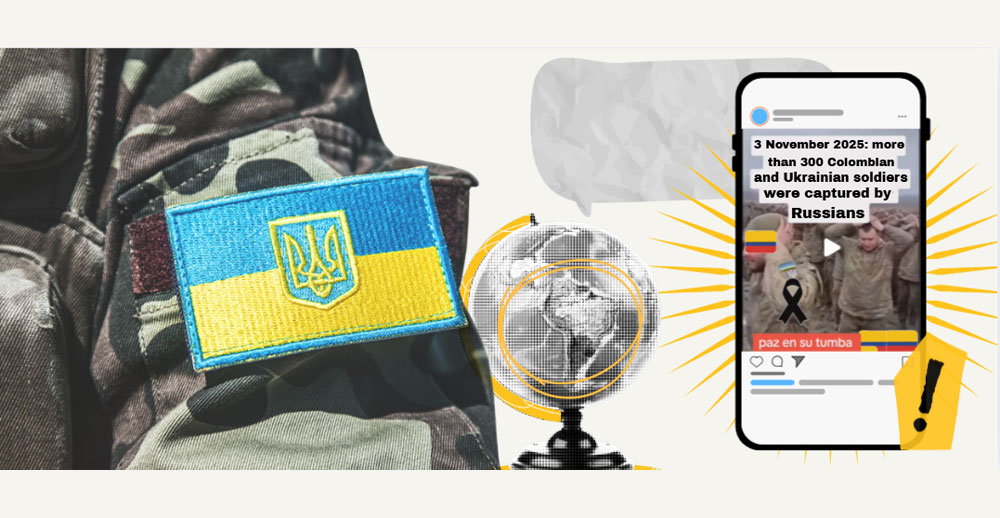
In response, Moscow has launched sophisticated disinformation operations targeting these potential recruits, particularly in Latin America. The campaigns employ multiple tactics: AI-generated imagery, decontextualized photos, exaggerated casualty figures, and false narratives about Ukraine’s treatment of fallen soldiers.
“These campaigns represent classic cases of Foreign Information Manipulation and Interference,” explains an investigator from the ATAFIMI project, a collaboration between fact-checking organizations including Maldita.es (Spain), StopFake (Ukraine), Myth Detector (Georgia), Delfi (Lithuania), and La Silla Vacía (Colombia).
Colombian Fighters: Prime Targets
Colombia’s history of armed conflict has produced a large pool of experienced military personnel. “They have been training for 60 years under a counter-insurgency doctrine, and effectively fighting. That’s why they’re so desired by foreign armies,” explains Laura Lizarazo, a national security expert at Control Risks.
Many retired Colombian soldiers seek opportunities abroad due to economic factors. According to The New York Times, they can earn up to three times more fighting in Ukraine than in their home country. Juan Carlos Portilla, an international lawyer from the University of La Sabana, describes them as “cheap labor who work without social security, health insurance, or occupational hazard coverage.”
While Ukraine targets Colombian recruits through social media and testimonials, Colombian authorities have issued warnings. In October 2025, Colombia’s Ministry of Defense posted on social media: “What seems like an opportunity ends up being a trap. You go looking for a better future and end up stuck in a war that is not yours.” President Gustavo Petro claimed Ukrainians treat Colombians “as an inferior race” and urged mercenaries to return home “immediately.”
The Russian Embassy in Colombia amplified these messages, expressing regret that “the number of Colombians who believe in the false promises of Ukrainian recruiters remains quite high.”
Distorting Death and Treatment of Casualties
A cornerstone of Russian disinformation is the narrative that Ukraine mistreats the bodies of fallen soldiers and refuses to pay compensation to families. This campaign began even before the full-scale invasion, with baseless claims about organ trafficking that have persisted despite medical experts pointing out the practical impossibility of such operations.
Vasyl Strelka, director of Ukraine’s Department of High-Tech Medical Care and Innovation, explained that organ transplantation requires compatibility between donor and recipient and must occur within two hours of removal, making international trafficking logistically unfeasible.
Russian sources frequently circulate fake or decontextualized images purporting to show foreign casualties. In one case, photographs of French soldiers who died in Mali in 2019 were presented as French casualties in Ukraine. Similarly, images of British soldiers killed in Afghanistan in 2006 were misrepresented as recent Ukrainian casualties.
The disinformation campaign extends to fabricated statistics. A fake graphic falsely attributed to Statista claimed “almost 5,000 foreign mercenaries have been killed in the Kursk region” since the war began. Statista confirmed to fact-checkers that the image was “fake.”
Exploiting Legitimate Concerns
Russian disinformation strategically exploits legitimate concerns about Ukraine’s conscription practices. AI-generated videos showing tearful Ukrainian men claiming to be forcibly conscripted have circulated in at least thirteen languages.
While Ukraine’s conscription policies have drawn criticism – with reports of rushed mobilizations that don’t respect legal exemptions – Russian propaganda significantly distorts the reality. False claims about Ukraine recruiting elderly people, children, and people with disabilities have spread despite Ukraine’s clear regulations exempting these groups.
The Kremlin has also created fake recruitment campaigns, mimicking a real Ukrainian Defense Ministry video that compared military salaries to consumer goods. Russian channels produced counterfeit advertisements claiming Colombian recruits could earn “$3,000 per month, the equivalent of 1,000 burritos,” which Ukrainian authorities confirmed were fabrications.
Casualty Counts as Psychological Warfare
Neither Russia nor Ukraine publishes comprehensive casualty figures, creating an information vacuum that disinformation exploits. The Center for Strategic and International Studies estimates Russia has suffered approximately one million casualties by mid-2025 – “five times more losses in Ukraine than in all Russian and Soviet wars combined” since World War II. Ukraine’s casualties are estimated at around 400,000.
Russian sources frequently circulate inflated Ukrainian casualty figures, claiming losses of 780,000 or even “more than one million people” in fabricated statements attributed to organizations like the Red Cross.
According to EUvsDisinfo, these narratives aim to create the impression of “the inevitability of a Russian victory” by portraying Ukraine as militarily exhausted. However, the Institute for the Study of War notes that Russia has failed to “break through Ukrainian lines or even push them back significantly,” undermining Moscow’s narrative of imminent victory.
As the war continues, so does the battle for influence over potential foreign fighters – with truth becoming an increasingly prominent casualty.
Fact Checker
Verify the accuracy of this article using The Disinformation Commission analysis and real-time sources.

12 Comments
Targeting Latin American recruits with these false claims is a particularly insidious move by the Kremlin. Ukraine has made significant efforts to welcome foreign fighters, and their service is essential for the country’s defense.
You’re right, this represents a worrying escalation in Russia’s disinformation efforts. The international community must do more to counter these divisive tactics and ensure the truth prevails.
This disinformation campaign is a concerning tactic to discourage foreign volunteers from assisting Ukraine’s defense efforts. It’s critical that the truth about organ trafficking allegations and casualties is widely shared to counter these false narratives.
Agreed. It’s crucial that the international community remains vigilant against Russian propaganda and continues to support Ukraine’s sovereignty.
It’s disheartening to see Russia stooping to such low tactics in their attempts to undermine Ukraine’s defense. These false narratives about organ trafficking and casualties are particularly abhorrent and must be swiftly refuted.
You’re absolutely right. The world must stand firm in its support for Ukraine and redouble efforts to counter Russian propaganda with the truth.
This news highlights the desperate measures the Kremlin is willing to take to discourage foreign support for Ukraine. It’s a clear sign of their weakening position and the importance of the international community’s continued solidarity with Ukraine.
Exactly. Russia’s reliance on these disinformation tactics is a testament to the strength and resilience of Ukraine’s defense, which is bolstered by the bravery of foreign volunteers.
It’s disturbing to see Russia resort to such brazen lies and fabrications in an attempt to undermine Ukraine’s foreign recruitment efforts. This highlights the regime’s desperation as they struggle on the battlefield.
Absolutely. These disinformation campaigns are a clear sign that Russia is losing the information war and grasping at straws. The world must continue to stand with Ukraine against this blatant propaganda.
The use of AI-generated imagery and other sophisticated techniques to spread these false claims is particularly concerning. It’s crucial that global fact-checking efforts remain vigilant and expose these lies to the world.
Agreed. The international community must work together to combat Russia’s disinformation machine and ensure the truth about Ukraine’s foreign volunteers reaches potential recruits.