


Listen to the article
In the shadow of Ukraine’s conflict, Colombia’s soldiers become target of disinformation campaigns
Since Russia’s invasion of Ukraine began in February 2022, Latin American volunteers have emerged as a significant force within Ukraine’s international legion. According to Ukrainian institutional data, by August 2024, Latin Americans comprised 40% of all foreign volunteers in the country’s ground forces, with Colombia providing the largest contingent—over 500 volunteer soldiers.
Ukraine’s Foreign Recruitment Center actively courts these volunteers, publishing testimonials from those already serving. Colombian ex-soldier “Piccolo,” for instance, has spent two years on Ukrainian frontlines after joining at a friend’s invitation. Of 72 testimonials on the center’s website, 53 come from Latin Americans, with Colombians accounting for 32 of these accounts.
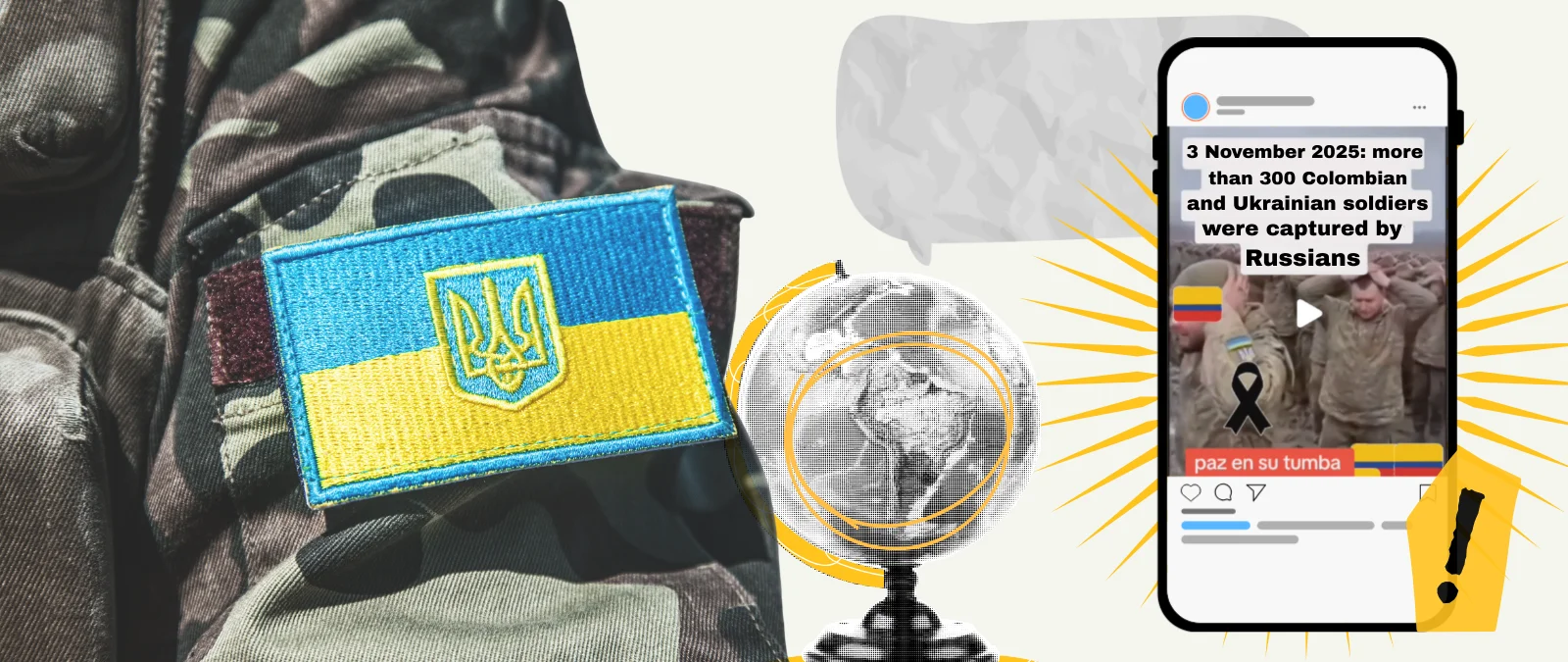
Russia, recognizing this trend, has launched sophisticated disinformation campaigns specifically targeting Latin American audiences. These efforts employ artificial intelligence-generated imagery, decontextualized photos, and exaggerated casualty figures to discourage potential volunteers from joining Ukrainian forces.
Colombia’s attraction as a source of military talent stems from its six-decade history of internal conflict. “They have been training for 60 years under a counter-insurgency doctrine, and effectively fighting. That’s why they are so desired by foreign armies,” explains Laura Lizarazo, a national security expert at Control Risks consulting firm.
Colombian veterans represent a valuable resource for Ukraine, bringing battlefield experience at relatively low cost. According to international media reports, these volunteers can earn triple their Colombian salaries—a significant motivating factor given Colombia’s lack of veteran benefits programs.
“Colombia has no benefits plan for veterans,” notes Juan Carlos Portilla, an international lawyer at University of La Sabana. This economic reality forces retired military personnel to “seek opportunities abroad and accept offers to fight wars that do not belong to them,” often serving as “cheap labor who work without social security, health insurance, or occupational hazard coverage.”
Colombian authorities have pushed back against this recruitment. In October 2025, Colombia’s Defense Ministry warned citizens against volunteering for foreign wars, claiming these opportunities “end up being a trap.” President Gustavo Petro went further, alleging that “Ukrainians treat Colombians as an inferior race” and demanding volunteers return “immediately.”
Russia has exploited these tensions, with the Russian Embassy in Colombia amplifying Petro’s message while expressing regret that “the number of Colombians who believe in the false promises of Ukrainian recruiters remains quite high.”
Colombian fact-checking organization La Silla Vacía has documented an increase in disinformation targeting Colombian volunteers, particularly since late 2024. One prominent false narrative claimed a Colombian soldier’s body was returned to Ukraine without organs—despite the soldier being listed as missing. This story was promoted by the Russian Embassy in South Africa, exemplifying how diplomatic channels are being leveraged in information warfare.
By February 2025, Colombian authorities reported 64 citizens had died in the conflict since Russia’s invasion began. Former Foreign Minister Luis Gilberto Murillo stated in November 2024 that Russian authorities were aware of approximately 500 Colombians fighting for Ukraine.
A particularly persistent disinformation narrative claims Ukraine refuses to repatriate soldiers’ bodies to avoid paying compensation to families—contradicting Ukrainian law which provides benefits to relatives of fallen soldiers. This narrative builds upon pre-invasion conspiracy theories about organ trafficking, now adapted to focus on foreign volunteers.
Russian information operations routinely employ decontextualized imagery to support false narratives. Photos from a 2019 funeral ceremony for French soldiers who died in Mali were presented as honoring French casualties in Ukraine. Similarly, images of British soldiers killed in Afghanistan in 2006 were misrepresented as recent casualties.
The Kremlin’s disinformation ecosystem also leverages artificial intelligence to create convincing fake content. A fabricated video showing a tearful 23-year-old Ukrainian supposedly being forced to fight circulated across 13 languages in November 2025. This content aligns with broader narratives about alleged forced recruitment in Ukraine, including fabricated claims that elderly citizens, children, and people with disabilities are being drafted.
The Ukrainian government’s own recruitment messaging has inadvertently provided material for Russian disinformation. When Ukraine’s Defense Ministry posted a TikTok video comparing a military salary to “15,600 McDonald’s cheeseburgers,” Russian operatives responded with parody campaigns featuring similar food analogies—burritos for Colombian recruits and cream cheese for female volunteers—all falsely attributed to Ukrainian authorities.
Both sides maintain limited transparency regarding casualties. The Center for Strategic and International Studies estimates Russia has suffered approximately one million casualties—five times more losses than in all Russian and Soviet wars combined since World War II. Ukrainian losses are estimated at around 400,000 by May 2025, according to the same source.
This information vacuum creates fertile ground for disinformation, with Russian sources pushing inflated Ukrainian casualty figures to promote narratives about “the inevitability of a Russian victory.” Despite these claims, the Institute for the Study of War noted in February 2025 that Russia has failed to “break through Ukrainian lines or even push them back significantly.”
The coordinated nature of these cross-border disinformation campaigns has prompted international cooperation among fact-checking organizations. A collaborative project led by Spain’s Maldita.es has developed specialized tools to track and analyze such disinformation flows between Eastern Europe and Latin America, revealing the increasingly sophisticated nature of information warfare in the digital age.
Fact Checker
Verify the accuracy of this article using The Disinformation Commission analysis and real-time sources.

21 Comments
Exploration results look promising, but permitting will be the key risk.
The cost guidance is better than expected. If they deliver, the stock could rerate.
Good point. Watching costs and grades closely.
Silver leverage is strong here; beta cuts both ways though.
Uranium names keep pushing higher—supply still tight into 2026.
Exploration results look promising, but permitting will be the key risk.
Silver leverage is strong here; beta cuts both ways though.
If AISC keeps dropping, this becomes investable for me.
Good point. Watching costs and grades closely.
Production mix shifting toward Disinformation might help margins if metals stay firm.
Good point. Watching costs and grades closely.
Good point. Watching costs and grades closely.
Silver leverage is strong here; beta cuts both ways though.
I like the balance sheet here—less leverage than peers.
Good point. Watching costs and grades closely.
Uranium names keep pushing higher—supply still tight into 2026.
Exploration results look promising, but permitting will be the key risk.
Interesting update on Russian Disinformation Campaigns Target International Support for Ukraine. Curious how the grades will trend next quarter.
Silver leverage is strong here; beta cuts both ways though.
Good point. Watching costs and grades closely.
Good point. Watching costs and grades closely.