


Listen to the article
Armenia and EU Deepen Partnership Amid Growing Russian Concerns
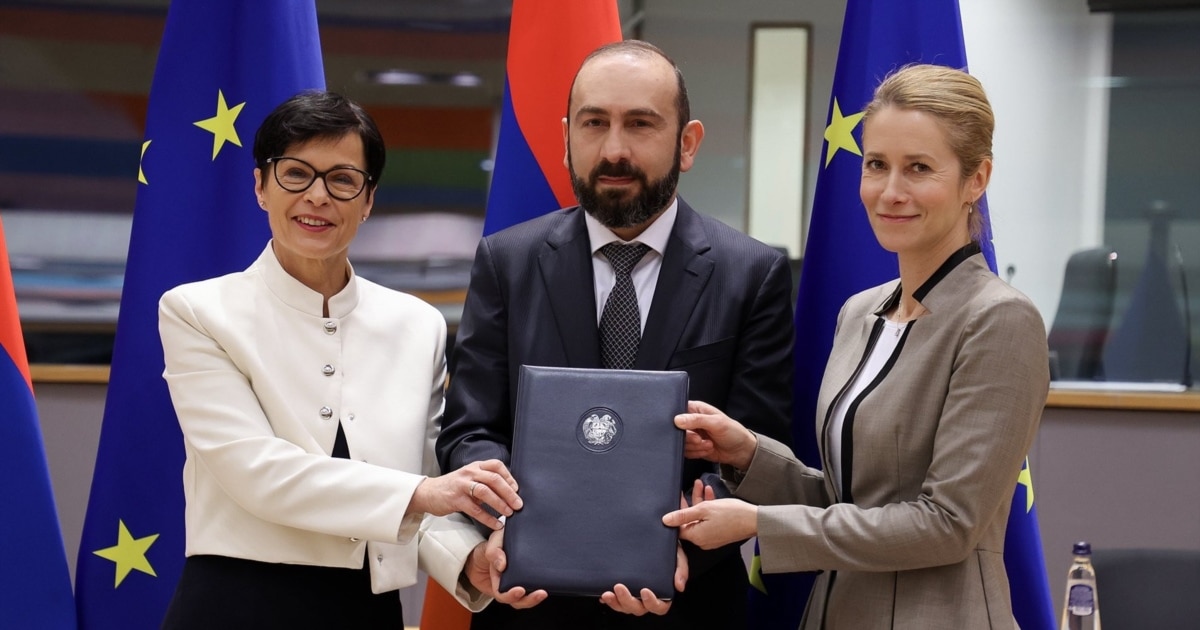
The European Union and Armenia signed a significant new partnership agreement in Brussels this week, marking what officials called “a new and more ambitious phase” in relations as the South Caucasus nation continues its gradual pivot westward.
EU foreign policy chief Kaja Kallas and Armenian Foreign Minister Ararat Mirzoyan formalized the document following high-level talks, with Kallas announcing an additional €15 million ($17.4 million) in EU aid. The package is specifically designed to strengthen Armenia’s resilience against external pressures, including what Brussels characterizes as Russian interference.
“Russia and its proxies are already ramping up disinformation campaigns in Armenia ahead of next year’s parliamentary election,” Kallas told reporters at the joint news conference. “We see the same networks that we saw deployed in Moldova that were active, so the playbook is identical. Our EU funding will also cover detection, analysis and response to foreign interference.”
While Mirzoyan avoided directly echoing these accusations against Russia, he acknowledged the agreement would address “new engagements to counter hybrid threats” facing Armenia. “The message of today’s meeting is clear: the Armenia-EU partnership is entering a new and more ambitious phase with a shared vision and responsibility to further deliver meaningful results for our citizens,” he stated.
The new agreement builds upon the 2017 Comprehensive and Enhanced Partnership Agreement (CEPA) between the EU and Armenia. According to Mirzoyan, it will “complement” and go “far beyond” the previous framework, though specifics regarding potential EU membership remained unclear.
Armenia’s westward shift has accelerated significantly this year. In spring, the Armenian parliament passed legislation formally declaring “the start of a process of Armenia’s accession to the European Union,” though the country has yet to submit an official membership application. No EU member state has explicitly endorsed Armenia’s potential candidacy.
This diplomatic realignment comes amid deteriorating relations between Yerevan and Moscow, traditionally Armenia’s closest ally. Russian officials have issued repeated warnings about severe economic consequences should Armenia pursue EU membership. Despite these threats, Prime Minister Nikol Pashinyan has remained defiant, stating in September that his government would intensify “efforts aimed at Armenia’s accession to the European Union.”
The economic stakes are substantial. Russian-Armenian economic ties remain deeply intertwined, with Russia accounting for over 35 percent of Armenia’s foreign trade in the first half of 2024, compared to the EU’s 12 percent. Armenia also depends heavily on Russian natural gas supplied at below-market rates, making the country particularly vulnerable to potential economic retaliation.
When questioned about how the EU might protect Armenia from possible Russian economic pressure, Kallas was circumspect. “We had extensive discussions about these issues today,” she noted. “The world order is clearly changing, and that’s why the strategic alignment of the common foreign and security policy for our partners is extremely important: with whom you really are.”
Meanwhile, the Kremlin has attempted to downplay tensions with Yerevan. Russian President Vladimir Putin claimed in September that bilateral relations were expanding “in all areas,” highlighting that trade between the two nations reached a record $11.7 billion last year according to Russian government statistics.
Armenia’s strategic reorientation follows years of growing frustration with Russia, particularly regarding Moscow’s perceived failure to provide security guarantees during the 2020 and 2023 conflicts with Azerbaijan over Nagorno-Karabakh. The territorial dispute ended with Azerbaijan reclaiming the enclave and triggering a mass exodus of ethnic Armenians.
As Armenia navigates this delicate diplomatic balance, the EU’s increased engagement reflects broader geopolitical competition in the South Caucasus, a region where Russia has traditionally maintained significant influence but where Western powers have shown growing interest since the collapse of the Soviet Union.
Fact Checker
Verify the accuracy of this article using The Disinformation Commission analysis and real-time sources.

16 Comments
Disinformation campaigns can be damaging to democratic institutions. I hope the EU’s funding and expertise can help Armenia counter foreign interference in its elections.
The EU-Armenia partnership agreement is a positive step, but the threat of Russian interference in the elections is concerning. Strengthening resilience against such meddling is critical.
The EU-Armenia partnership is an important development, but the specter of Russian interference is concerning. Vigilance and support for Armenia’s resilience will be crucial.
Indeed. Armenia’s sovereignty and democratic process must be protected from external manipulation. The EU’s assistance is timely and necessary.
Disinformation is a growing challenge for democracies worldwide. I’m glad to see the EU taking steps to support Armenia’s electoral integrity and sovereignty.
Agreed. Protecting the democratic process from foreign manipulation should be a top priority. Armenia deserves to have a free and fair vote.
While the details are unclear, the EU’s allegations of Russian disinformation campaigns in Armenia are worrying. Ensuring transparent and credible elections is essential for Armenia’s democratic development.
The EU’s accusations against Russia are serious. Protecting the integrity of Armenia’s elections should be a top priority for the international community. Transparency and fact-checking will be key.
Absolutely. Armenia deserves to make its own political choices without undue influence from foreign actors. The EU’s support is a positive step.
This is concerning if true. The EU must be vigilant in protecting Armenia’s democratic process from external meddling. Disinformation campaigns can be insidious and damaging to free elections.
I agree. Armenia deserves to make its own political choices without undue influence from Russia or anyone else. Transparency and fact-checking will be crucial.
It’s troubling to hear about Russia’s alleged attempts to meddle in Armenia’s elections. The EU should continue to support Armenia’s democratic development and protect its sovereignty.
Absolutely. Armenia deserves to chart its own course without undue foreign influence. Vigilance against disinformation will be key.
The EU’s support for Armenia’s resilience is welcome, especially given the country’s strategic location between Russia and the West. Strengthening democratic institutions is key.
Indeed. Armenia has been navigating a delicate geopolitical position, and EU assistance could help bolster its independence and sovereignty.
Disinformation campaigns are a worrying trend globally. I hope the EU’s funding and expertise can help Armenia counter foreign interference in its elections. Free and fair elections are essential.