


Listen to the article
Philippine Government Agencies Join Forces to Combat Online Disinformation
Three key Philippine government agencies have formed an alliance to tackle the growing threat of online disinformation, marking a significant step in the country’s fight against digital falsehoods.
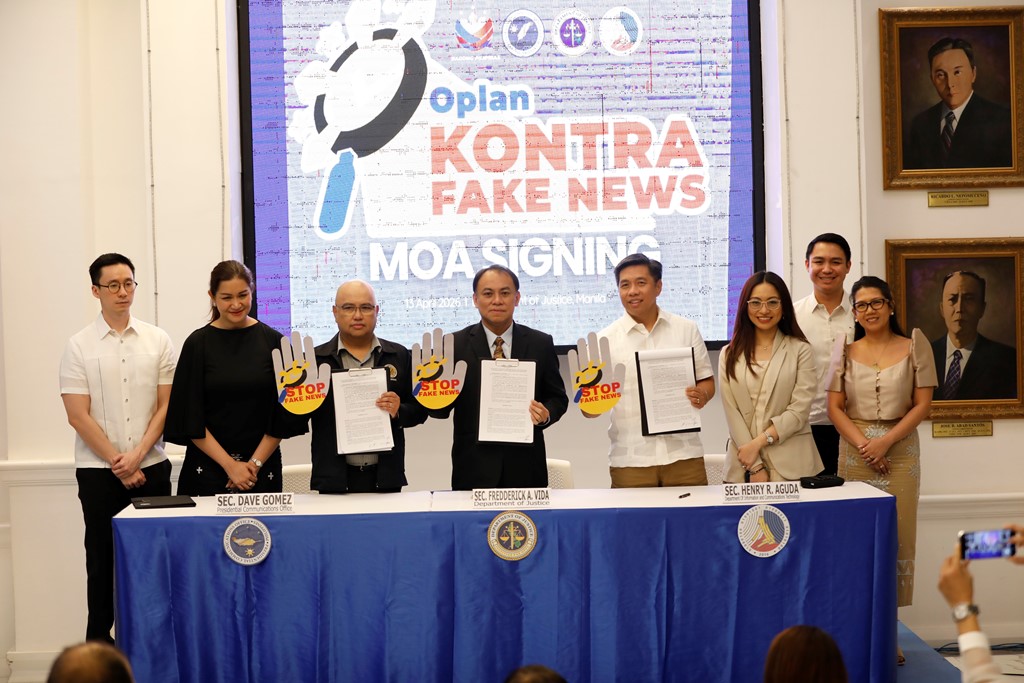
On Monday, the Presidential Communications Office (PCO), Department of Information and Communications Technology (DICT), and Department of Justice (DOJ) signed a memorandum of agreement (MOA) establishing a collaborative framework to address fake news, disinformation, and AI-generated deepfakes.
The agreement, signed by Acting Presidential Communications Secretary Dave M. Gomez, DICT Secretary Henry R. Aguda, and Acting Justice Secretary Frederick A. Vida at the DOJ headquarters, represents a whole-of-government strategy to counter false information threatening public safety, national security, and democratic institutions.
Speaking at the signing ceremony, Gomez emphasized the urgent need for this initiative in today’s digital landscape. “We are confronting a rapidly evolving information landscape where truth is increasingly vulnerable to distortion and manipulation,” he said. The PCO chief was quick to clarify that the effort is not intended to restrict free expression but rather to protect citizens from malicious actors exploiting technology.
The agreement comes at a critical time when disinformation campaigns have become more sophisticated and widespread in the Philippines. The country has seen a surge in misleading content across social media platforms, often targeting political processes and public health initiatives. Digital rights observers have long noted the Philippines’ vulnerability to coordinated disinformation, particularly during election periods.
Acting Justice Secretary Vida described the signing as “a pivotal step in safeguarding our democracy from the shadows of digital disinformation.” He warned that digitally mediated falsehoods have emerged as potent weapons against national stability, while assuring that enforcement activities would respect constitutional rights.
“Our commitment is clear: proactive defense, not overreach. We draw a firm line between criminal disinformation and protected speech,” Vida stated, addressing potential concerns about government overreach in regulating online content.
DICT Secretary Aguda highlighted how disinformation has evolved beyond simple gossip, noting in a mix of Filipino and English that “Hindi na ito simpleng tsismis. Ngayon, kasinungalingan can look real… divide, and erode public trust when clarity is most needed.” His comments reflect the growing concern about deepfake technology and AI-generated content that can convincingly mimic real people and events.
Aguda also emphasized that fighting disinformation requires broad participation, stating, “This is not just government acting on its own. This is a national responsibility.”
Under the agreement, each agency will have distinct responsibilities. The PCO will spearhead government communications strategies, public advisories, and media literacy campaigns to help citizens identify misleading information. The DICT will engage with technology platforms, strengthen cybersecurity measures, and support reporting systems such as eGovPH, which allows citizens to report suspicious online content.
The DOJ will evaluate cases for potential prosecution under existing legislation, including the Cybercrime Prevention Act of 2012 and the Data Privacy Act of 2012. The department will also coordinate international action against transnational disinformation networks, recognizing that many disinformation campaigns originate from beyond the Philippines’ borders.
An inter-agency steering committee will oversee implementation of the agreement, ensuring data protection standards are maintained throughout operations. The committee will also publish annual reports on their activities and achievements, promoting transparency in government efforts against disinformation.
Media and technology experts have noted that this initiative represents one of the most comprehensive government approaches to online disinformation in Southeast Asia, though its effectiveness will ultimately depend on implementation and the balance struck between security concerns and freedom of expression.
The MOA explicitly affirms that all actions taken under this agreement will uphold constitutional freedoms while promoting transparency, accountability, and public awareness in the ongoing battle against digital falsehoods.
Fact Checker
Verify the accuracy of this article using The Disinformation Commission analysis and real-time sources.

10 Comments
Tackling disinformation and deepfakes is a global challenge, and I’m encouraged to see the Philippines taking proactive steps to address it. Collaboration with international partners could further strengthen their efforts.
Deepfakes are a particularly concerning form of digital manipulation that can undermine trust in media and institutions. I’m glad to see the Philippines taking proactive measures to address this threat.
Absolutely, deepfakes pose significant risks to public discourse and national security. Strengthening cross-agency collaboration is a prudent approach.
The signing of this MOA is a positive development, but the real test will be in the implementation. Consistent and transparent enforcement will be crucial to the success of this initiative.
Curious to see how the PCO, DICT, and DOJ will operationalize this agreement and coordinate their efforts. Effective information sharing and clear lines of responsibility will be essential.
Good point. The details of implementation will be crucial in determining the real-world impact of this initiative. Maintaining a unified, whole-of-government approach will be critical.
As someone with an interest in mining, commodities, and energy, I’m curious to see how this agreement might impact the reporting and discourse around those topics. Ensuring the integrity of information in these sectors is paramount.
That’s a good observation. Disinformation can have significant consequences in industries like mining and energy, where accurate data and analysis are critical for investment decisions and policy-making.
The signing of this MOA demonstrates the Philippine government’s commitment to protecting its citizens from the harmful impacts of online falsehoods and misinformation. Transparency and accountability will be key to the success of this initiative.
This is an important step for the Philippines in combating the spread of disinformation and fake news online. Coordinating efforts across government agencies is crucial to tackle this growing challenge effectively.