


Listen to the article
The Philippine government intensified its fight against online disinformation on Monday with the signing of a landmark agreement between three key agencies aimed at combating the spread of fake news across digital platforms.
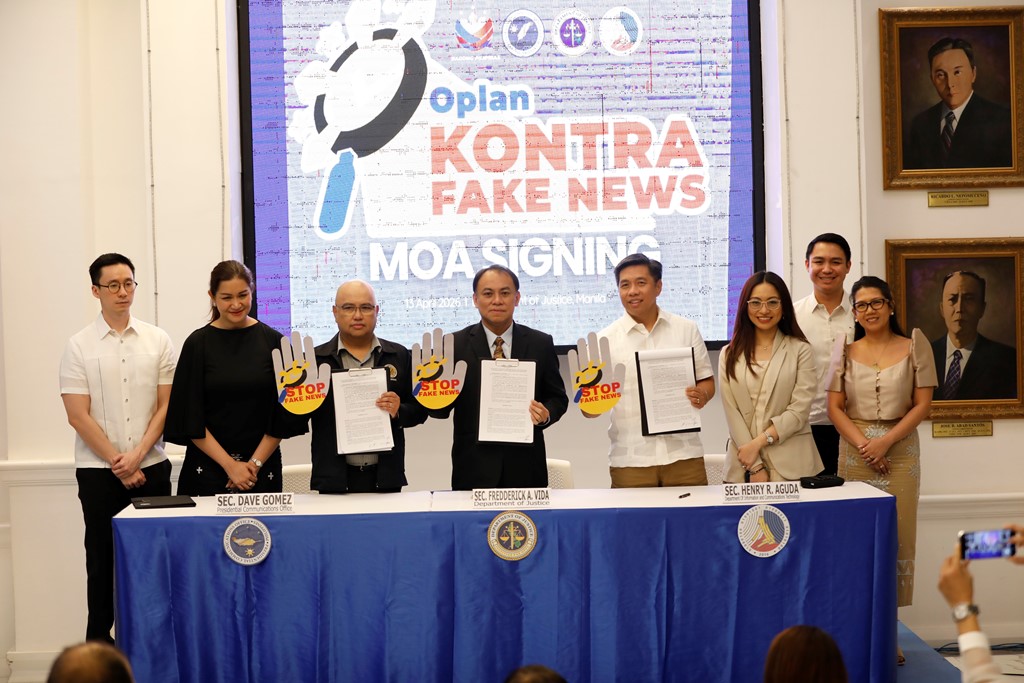
The Presidential Communications Office (PCO), Department of Information and Communications Technology (DICT), and Department of Justice (DOJ) formalized a memorandum of agreement (MoA) that establishes a coordinated, multi-agency approach to address false information threatening public safety, national security, and democratic institutions.
PCO Acting Secretary Dave Gomez, DICT Secretary Henry Aguda, and DOJ Acting Secretary Frederick Vida signed the agreement, which comes at a critical moment when digital misinformation has increasingly become a national concern.
“We are confronting a rapidly evolving information landscape where truth is increasingly vulnerable to distortion and manipulation,” Gomez stated during the signing ceremony. He emphasized that the initiative aims not to restrict free speech but to protect citizens from malicious actors who “exploit technology to deceive and divide.”
The timing of the agreement appears particularly significant, coming shortly after President Ferdinand R. Marcos Jr. publicly denounced falsehoods about his health condition. In a briefing late Monday, the President issued what officials described as a “stern warning” against those spreading fabricated information about his well-being.
Under the new agreement, the three agencies will work together to monitor, investigate, and prosecute individuals or groups responsible for orchestrating disinformation campaigns, with particular focus on those targeting government officials and institutions. This collaboration is expected to strengthen enforcement of existing legislation, notably the Cybercrime Prevention Act of 2012 and the Data Privacy Act of 2012.
Each agency has been assigned specific responsibilities within the framework. The PCO will spearhead government communications strategies and implement media literacy initiatives designed to help citizens identify and reject false information. This marks an expansion of the PCO’s traditional role as the government’s primary communications arm into more proactive media education efforts.
The DICT will contribute its technical expertise to enhance cybersecurity measures across government platforms and develop reporting systems for citizens to flag potential misinformation. These technical solutions aim to create early warning mechanisms for detecting coordinated disinformation campaigns before they gain significant traction.
Meanwhile, the DOJ will evaluate potential cases for prosecution and coordinate with international partners when disinformation operations cross national boundaries. This international dimension acknowledges the often transnational nature of sophisticated disinformation campaigns.
The Philippines has struggled with the proliferation of fake news in recent years, particularly on social media platforms where false information can spread rapidly. A 2023 Digital News Report by the Reuters Institute found that 59 percent of Filipinos expressed concern about their ability to distinguish real from fake information online, higher than the global average of 54 percent.
Media experts have cautiously welcomed the initiative while emphasizing the importance of maintaining free speech protections. Some advocacy groups have called for clearer guidelines on how authorities will distinguish between deliberate disinformation and protected political speech or opinion.
The multi-agency effort represents the most comprehensive government response to digital misinformation in the Philippines to date, following similar initiatives in other Southeast Asian countries grappling with the same challenge.
As implementation begins, officials say they will focus initially on establishing technical infrastructure for monitoring and reporting systems, followed by public awareness campaigns expected to launch later this year.
Fact Checker
Verify the accuracy of this article using The Disinformation Commission analysis and real-time sources.

26 Comments
If AISC keeps dropping, this becomes investable for me.
Good point. Watching costs and grades closely.
Good point. Watching costs and grades closely.
The cost guidance is better than expected. If they deliver, the stock could rerate.
Good point. Watching costs and grades closely.
Exploration results look promising, but permitting will be the key risk.
I like the balance sheet here—less leverage than peers.
Good point. Watching costs and grades closely.
Good point. Watching costs and grades closely.
Interesting update on PCO, DICT, and DOJ Form Alliance to Combat Fake News and Misinformation. Curious how the grades will trend next quarter.
I like the balance sheet here—less leverage than peers.
Good point. Watching costs and grades closely.
Good point. Watching costs and grades closely.
Production mix shifting toward Disinformation might help margins if metals stay firm.
Good point. Watching costs and grades closely.
Good point. Watching costs and grades closely.
Silver leverage is strong here; beta cuts both ways though.
Good point. Watching costs and grades closely.
I like the balance sheet here—less leverage than peers.
Good point. Watching costs and grades closely.
Good point. Watching costs and grades closely.
Production mix shifting toward Disinformation might help margins if metals stay firm.
Exploration results look promising, but permitting will be the key risk.
Silver leverage is strong here; beta cuts both ways though.
I like the balance sheet here—less leverage than peers.
Good point. Watching costs and grades closely.