


Listen to the article
Young Voices Join European Leaders to Combat Disinformation Threat
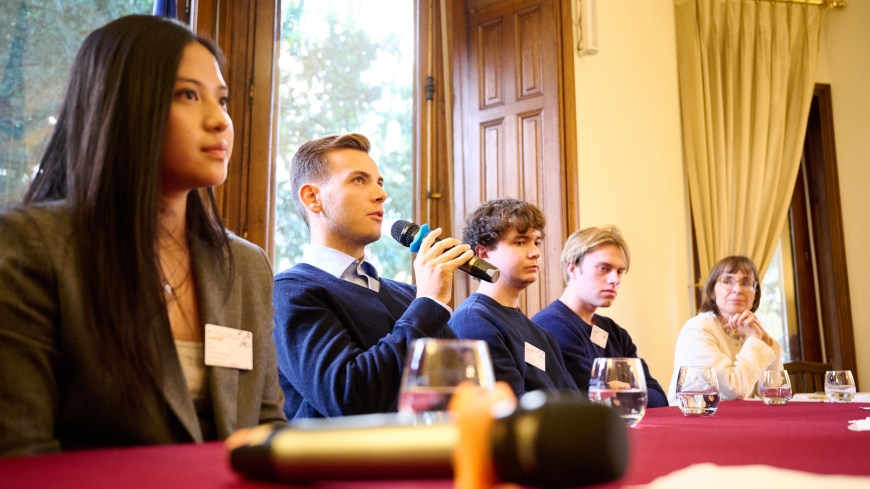
Norwegian high school students recently took center stage in Strasbourg to address one of democracy’s most pressing challenges: disinformation. The round-table discussion, hosted by the Norwegian presidency of the Group of Friends on the Safety of Journalists and Media Freedom, brought together winners of Norway’s prestigious “Free Word” essay competition with European officials to tackle the growing threat of false information in digital spaces.
“Where information comes from, different sources and who says what, has on a personal and collective level, formed our understanding of reality,” wrote Vy An Doan, one of the student participants whose essay focused on “who owns the truth” in today’s information ecosystem.
The event, titled “Fake or fact? How to combat disinformation in democratic societies,” examined how deliberately spread falsehoods undermine democratic participation and erode trust in institutions. It aimed to develop effective strategies to counter disinformation by drawing on initiatives like Norway’s Disinformation Strategy and the Council of Europe’s New Democratic Pact.
Council of Europe Deputy Secretary General Bjørn Berge opened the discussion with a stark assessment of disinformation’s societal impact. “Disinformation often turns real people into victims of technology deliberately misused. Disconnecting us, polarising society, reinforcing insecurities, feeding hate,” Berge told attendees. “It is in our power to counter lies with facts, with law, and with education.”
Berge acknowledged the double-edged nature of artificial intelligence in this fight. While AI can generate convincing fake content and target individuals with tailored disinformation, he emphasized that “AI can help detect disinformation and enhance our fact-checking efforts. We must therefore use AI as a weapon against the spread of malicious disinformation.”
France’s Permanent Representative to the Council of Europe, Ambassador Pap Ndiaye, highlighted the urgency of addressing disinformation from a national security perspective. Serving as Vice Chair of the Group of Friends on the Safety of Journalists and Media Freedom, Ndiaye noted that according to the third European External Action Service Report on Foreign Information Manipulation and Interference Threats, France has been the second most targeted country by hostile actors in Europe in 2024, trailing only Ukraine.
The panel featured four winners of Norway’s “Free Word” competition: Theodor Slaaen Borge, Vy An Doan, Alexander Røed Tjøsvoll, and Helleik Gram Kleivan. They were joined by Louisa Børresen, Deputy to the Permanent Representative of Norway to the Council of Europe, and Tatiana Monney, Policy Advisor for the New Democratic Pact.
The discussion highlighted the Council of Europe’s New Democratic Pact for Europe as a framework through which Member States can develop solutions to protect the information ecosystem. The pact aims to help institutions adapt to rapidly evolving threats and ensure that digital technologies strengthen rather than undermine democratic processes.
In addition to policy initiatives, the Council of Europe has launched the RESIST project (Strengthening Societal Resilience to Disinformation in Europe), funded by the European Economic Area and Norway Grants. This initiative seeks to enhance member states’ capacity to withstand disinformation campaigns while empowering younger generations through media and information literacy programs.
The inclusion of high school students in this high-level discussion represents a significant shift in approaching disinformation challenges. By bringing youth perspectives to the table, European officials acknowledge that younger generations not only face unique vulnerabilities to disinformation but also bring valuable insights into how digital platforms shape information consumption.
This collaborative approach between educational institutions, young citizens, and governmental bodies reflects a growing recognition that countering disinformation requires multi-generational efforts that combine technological solutions with critical thinking skills and media literacy.
As digital platforms continue to evolve and information threats become more sophisticated, initiatives like the Strasbourg round-table discussion demonstrate Europe’s commitment to preserving information integrity as a cornerstone of democratic societies.
Fact Checker
Verify the accuracy of this article using The Disinformation Commission analysis and real-time sources.

10 Comments
Combating disinformation is crucial for protecting democratic values. It’s encouraging to see Norway and other European leaders taking proactive steps to empower citizens, especially young voices, in this effort.
Engaging the youth in this discussion is a smart move. Their fresh perspectives can provide valuable insights on navigating the complex information landscape.
Disinformation undermines the very foundations of democracy. I applaud Norway’s efforts to empower citizens, especially the younger generation, in the fight against this growing challenge.
Addressing the disinformation threat requires a multi-pronged approach. Glad to see Norway and European leaders bringing together diverse stakeholders, including young people, to tackle this complex issue.
Strengthening democratic participation and media freedom are essential to countering the spread of false narratives. This is a timely and crucial discussion.
The event’s focus on developing effective strategies to combat disinformation is crucial. Collaborative efforts between governments, civil society, and the public can help build resilience against the erosion of trust in institutions.
I’m curious to learn more about the specific initiatives like Norway’s Disinformation Strategy and the Council of Europe’s New Democratic Pact, and how they aim to address this challenge.
Kudos to the Norwegian high school students for their thoughtful contributions on the ownership of truth in today’s digital age. Their participation is a testament to the importance of empowering young voices.
Disinformation has become a major threat to democratic societies. I’m glad to see Norway and the Council of Europe taking concrete actions to counter the spread of false narratives.
Strengthening media literacy and source verification will be key to equipping citizens with the tools to discern fact from fiction online.