


Listen to the article
Ghana Combats Misinformation Through Information, Not Censorship, Says Government Spokesperson
Ghana will fight the growing tide of misinformation and disinformation through accurate and timely information rather than resorting to censorship, according to Felix Kwakye Ofosu, Minister of State in charge of Government Communications and presidential spokesperson.
Speaking at this year’s World Press Freedom Day commemoration in Accra, Kwakye Ofosu emphasized that while falsehoods, deepfakes, and coordinated disinformation campaigns pose serious threats to national security, public health, and democratic governance, censorship is counterproductive.
“Censorship only breeds more suspicion and drives information underground,” Kwakye Ofosu told attendees at the event co-hosted by the British High Commission and the Embassy of the Kingdom of the Netherlands in Ghana. “But let us be clear. A distinction must be struck between censorship and appropriate law enforcement response to the misuse of platforms to commit crimes and foster social discord.”
The government remains “acutely aware of the need to act swiftly to stem the tide of misinformation,” he added, while reaffirming the administration’s commitment to protecting journalists and upholding media pluralism. He stressed that no reporter should face harassment, detention, or threats for carrying out legitimate duties.
Ghana’s government also pledged to continue fully implementing the Right to Information Act, with Kwakye Ofosu noting that “transparency is a right and not a favour.” He called on journalists to maintain ethical standards, including accuracy and fairness, warning against the harmful effects of sensationalism, unverified allegations, and hate speech.
“Democracy is not a gift that lasts forever. It is a practice that must be renewed every day, and journalism is one of the daily practices that keeps it alive,” Kwakye Ofosu said.
British High Commissioner to Ghana, Dr. Christian Rogg, echoed these sentiments, describing a free, independent, and pluralistic media as essential for protecting peace, democracy, and public trust. However, he cautioned that even countries with long-standing traditions of press freedom, including Ghana and the United Kingdom, remain vulnerable to fake news and online propaganda.
Dr. Rogg pointed to specific examples of disinformation dangers, including false information spread during the COVID-19 pandemic, violence in the UK stemming from online misinformation, and fake stories inflaming tensions in conflict areas such as Bawku in Ghana’s Upper East Region.
“Press freedom is not self-sustaining. It requires vigilance, partnership and political will,” Dr. Rogg stated. “Today is not just about marking this particular day, but it’s also about renewing our shared commitment to truth, accountability, and the democratic values that depend on a free press.”
Jeroen Verheul, Ambassador of the Kingdom of the Netherlands to Ghana, commended Ghana’s commitment to press freedom while noting there remains room for improvement in the country’s World Press Freedom Index ranking. He highlighted that journalists worldwide face threats from organized crime, corporate interests, and legal intimidation designed to suppress stories.
The Dutch ambassador emphasized the importance of protecting investigative journalists and ensuring accountability for attacks against them. He specifically mentioned the unresolved murder of Ghanaian investigative journalist Ahmed Hussein-Suale, who was shot dead in 2019 following his work on football corruption, as a case requiring continued attention.
The event brought together government officials, diplomats, journalists, media practitioners, and civil society actors for in-depth discussions on the evolving media landscape in Ghana. A panel discussion identified several key threats to information integrity, including AI-generated content, algorithm-driven virality, monetization incentives that reward sensationalism, and declining journalistic standards.
Experts at the forum stressed the need for stronger fact-checking mechanisms, increased platform accountability, improved media regulation, and enhanced collaboration among media organizations, security agencies, and technology companies to safeguard information integrity and strengthen democratic institutions in Ghana.
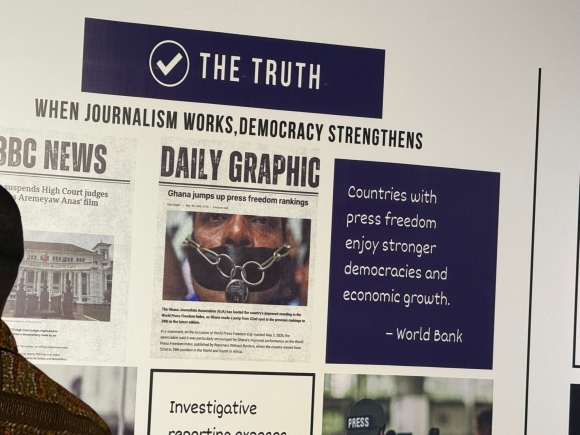
As Ghana approaches elections in December, the discussions underscored the critical importance of addressing misinformation challenges while maintaining press freedom as a cornerstone of the country’s democratic system.
Fact Checker
Verify the accuracy of this article using The Disinformation Commission analysis and real-time sources.

22 Comments
This is an interesting and measured approach to tackling the spread of misinformation. Focusing on providing reliable information, rather than resorting to censorship, is a wise strategy.
I agree, empowering people with facts is a more sustainable and effective solution than heavy-handed censorship. Ghana’s approach seems well-considered and aligned with democratic principles.
This is an interesting strategy to tackle misinformation. Balancing free speech with public safety is always a delicate act, so focusing on facts and information dissemination makes sense.
Exactly, censorship can be counterproductive, while equipping citizens with trustworthy data allows them to discern truth from fiction. A collaborative, transparent approach seems prudent.
Transparency and information-sharing are critical to combating misinformation. Ghana’s strategy of avoiding censorship while prioritizing accurate data dissemination is a prudent path forward.
Absolutely. Censorship can backfire and drive disinformation underground, while an open, fact-based approach allows the public to make informed decisions. This seems like a sensible way to address the challenge.
Ghana’s strategy of leveraging transparency and information-sharing to combat misinformation, rather than resorting to censorship, is a thoughtful and commendable approach.
Agreed. Providing the public with reliable data allows them to make informed decisions, which is a more sustainable solution than heavy-handed content restrictions. This seems like a well-considered path forward.
Combating misinformation through better information rather than censorship is a commendable strategy. It empowers the public to discern fact from fiction.
Absolutely. A free and open exchange of ideas, backed by credible data, is essential for a healthy democracy. This approach seems well-suited to the task at hand.
This is a nuanced and prudent approach to a complex issue. Avoiding censorship while prioritizing accurate information dissemination is a wise path forward in combating misinformation.
I concur. Empowering citizens with facts, rather than restricting access to information, enables them to discern truth from fiction. This seems like a constructive strategy to address the challenge.
Addressing misinformation through transparency and education is a commendable approach. Censorship can be counterproductive, so equipping the public with reliable information is key.
Absolutely. Providing people the tools to critically evaluate information allows them to make informed decisions, which is crucial for a healthy democracy. Ghana’s strategy appears thoughtful and well-balanced.
Ghana seems to be taking a measured and thoughtful approach to this challenge. Leveraging transparency and information sharing, rather than outright censorship, is a wise path forward.
I concur. Providing people the tools to critically evaluate information is more effective than restricting access. This allows them to make informed decisions.
This is a thoughtful and nuanced approach to a complex issue. Providing accurate, timely information is key, while avoiding the pitfalls of censorship. Ghana seems to be on the right track.
I agree, striking the right balance between free speech and responsible information sharing is crucial. Empowering the public with facts is a more sustainable solution.
Addressing misinformation through transparency and education is a wise approach. Censorship can backfire and drive content underground, so empowering people with accurate information is key.
I agree, providing the public with reliable facts is crucial to combat the spread of falsehoods and disinformation. A multi-pronged strategy is needed.
Addressing misinformation through improved information dissemination, rather than censorship, is a wise and balanced approach. Empowering citizens with facts is crucial for a healthy democracy.
I concur. Censorship can backfire and drive misinformation underground, while an open, transparent strategy focused on data-sharing is more likely to succeed. Ghana’s strategy appears well-suited to the challenge at hand.