


Listen to the article
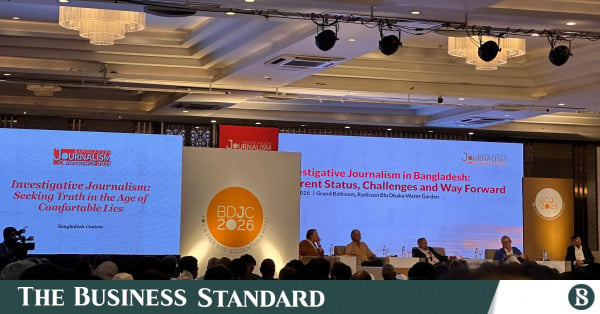
Investigative journalism in South Asia faces mounting challenges from political interference, disinformation, and economic pressures, according to experts gathered at the Bangladesh Journalism Conference 2026 in Dhaka.
The conference, hosted at the Radisson Blu Dhaka Water Garden, brought together media professionals from across the region to discuss the deteriorating landscape for press freedom and the specific threats to investigative reporting.
International freedom of expression expert Joan Barata emphasized that media freedom must be balanced with responsibility, warning that political actors often employ legal and institutional mechanisms to obstruct independent journalism.
“Freedom of expression is great, but it comes with responsibility,” Barata said. He highlighted the financial vulnerability of news organizations as a particular concern, adding, “Without a proper business model, without viable media from an economic point of view, the system will not work.”
The financial sustainability crisis facing news organizations has become a critical factor in their ability to remain independent, with many outlets increasingly susceptible to pressure from advertisers and political interests.
Transparency International Bangladesh Executive Director Iftekharuzzaman noted that journalists and human rights defenders have operated under increasing pressure since August 2024, expressing disappointment in the interim government’s response to attacks on leading media institutions.
“The way one of Bangladesh’s leading media institutions came under attack, and the way the interim government remained largely silent, reflects a deeply irresponsible stance,” he said, adding that authorities failed to act despite repeated appeals for intervention.
Mahfuz Anam, Editor of The Daily Star, emphasized the essential role of editorial independence in enabling investigative journalism, which he described as vital for ensuring accountability in governance and exposing corruption.
“When your reporter does investigative journalism, the first issue that will arise is exposing those who are committing corruption,” Anam said. He lamented the weakening of editorial institutions in Bangladesh, where editors often face pressure from both political forces and media owners.
“Unfortunately, in our country, the institution of the editor has not grown,” he observed, pointing to the tendency of many journalists to become politically aligned, which undermines professional independence and accountability reporting.
Anam linked the failure of past governments to their suppression of independent media. “One of the main reasons for the weaknesses and the fall of the past governments was that they did not allow the independent media to flourish. Because independent media raised questions. It verified their accountability. It exposed them,” he said.
International voices at the conference reinforced these concerns. Zaffar Abbas, editor of Pakistan’s English-language daily Dawn, described how investigative journalism in South Asia now depends not just on courageous reporters but on whether media owners can withstand political and financial retaliation.
“When you expose corruption in the private sector or state institutions, retaliation is inevitable,” Abbas said, sharing his experience of facing significant consequences for investigating corruption in Pakistan’s property, financial, and government sectors.
Canadian investigative journalist Julian Sher highlighted the increasingly global nature of corruption, calling for cross-border collaboration among journalists. “My experience investigating corruption in Canada and around the world is that corruption is global. The money is moving around the world, so we need cooperation across borders to investigate it,” he explained.
The conference also addressed the growing threat of online misinformation, particularly during election periods, and the need for stronger safeguards to protect information integrity.
Participants expressed concern that increasing commercialization within the media industry is further weakening accountability journalism and threatening the sustainability of investigative reporting throughout the region.
The two-day event features 12 sessions with over 20 speakers and has attracted more than 500 participants, including media professionals from over ten countries such as the United States, the United Kingdom, India, Pakistan, and Canada.
As the conference continues, attendees are exploring potential solutions to strengthen press freedom protections and develop sustainable models for independent journalism in an increasingly challenging environment.
Fact Checker
Verify the accuracy of this article using The Disinformation Commission analysis and real-time sources.

11 Comments
This is a concerning trend. Investigative journalism plays a vital role in holding power to account and exposing the truth. We need strong, independent media that can withstand polarization and disinformation tactics.
Absolutely. A free and vibrant press is the cornerstone of a healthy democracy. Protecting journalists and their ability to report without fear or interference should be a top priority.
This is a complex and multifaceted issue, and it’s encouraging to see experts from diverse backgrounds coming together to tackle it. Protecting the integrity of investigative journalism will require a multifaceted approach involving legal reforms, financial support, and a renewed commitment to media literacy and truth-telling.
Balancing freedom of expression with responsibility is a delicate dance. While journalists must be able to report freely, they also have a duty to uphold ethical standards and avoid contributing to the spread of disinformation. Finding the right equilibrium is vital.
The connection between financial sustainability and media independence is an important one. Outlets that rely heavily on advertising or political funding may be more susceptible to influence and less able to pursue hard-hitting investigations. This is a complex challenge without easy solutions.
The financial vulnerability of news organizations is a serious issue that warrants attention. Without a sustainable business model, the future of investigative journalism is at risk. Governments and the public need to find ways to support quality, independent reporting.
Agreed. Perhaps innovative funding models or greater public investment in journalism could help address this challenge. It’s crucial that we find solutions to safeguard the vital work of investigative reporters.
It’s heartening to see media professionals from across South Asia coming together to discuss these critical issues. Collaboration and solidarity within the journalism community will be crucial in navigating these threats to press freedom.
Agreed. Building strong networks and sharing best practices can help journalists support one another and strengthen the industry as a whole. International cooperation will also be key in addressing these transnational challenges.
I’m curious to know more about the specific tactics used by political actors to obstruct independent journalism in South Asia. What legal and institutional mechanisms are they employing, and how can these be countered?
That’s a great question. Understanding the tools used to undermine press freedom is the first step in developing effective strategies to protect it. Transparency and public pressure will be key in pushing back against these efforts.