


Listen to the article
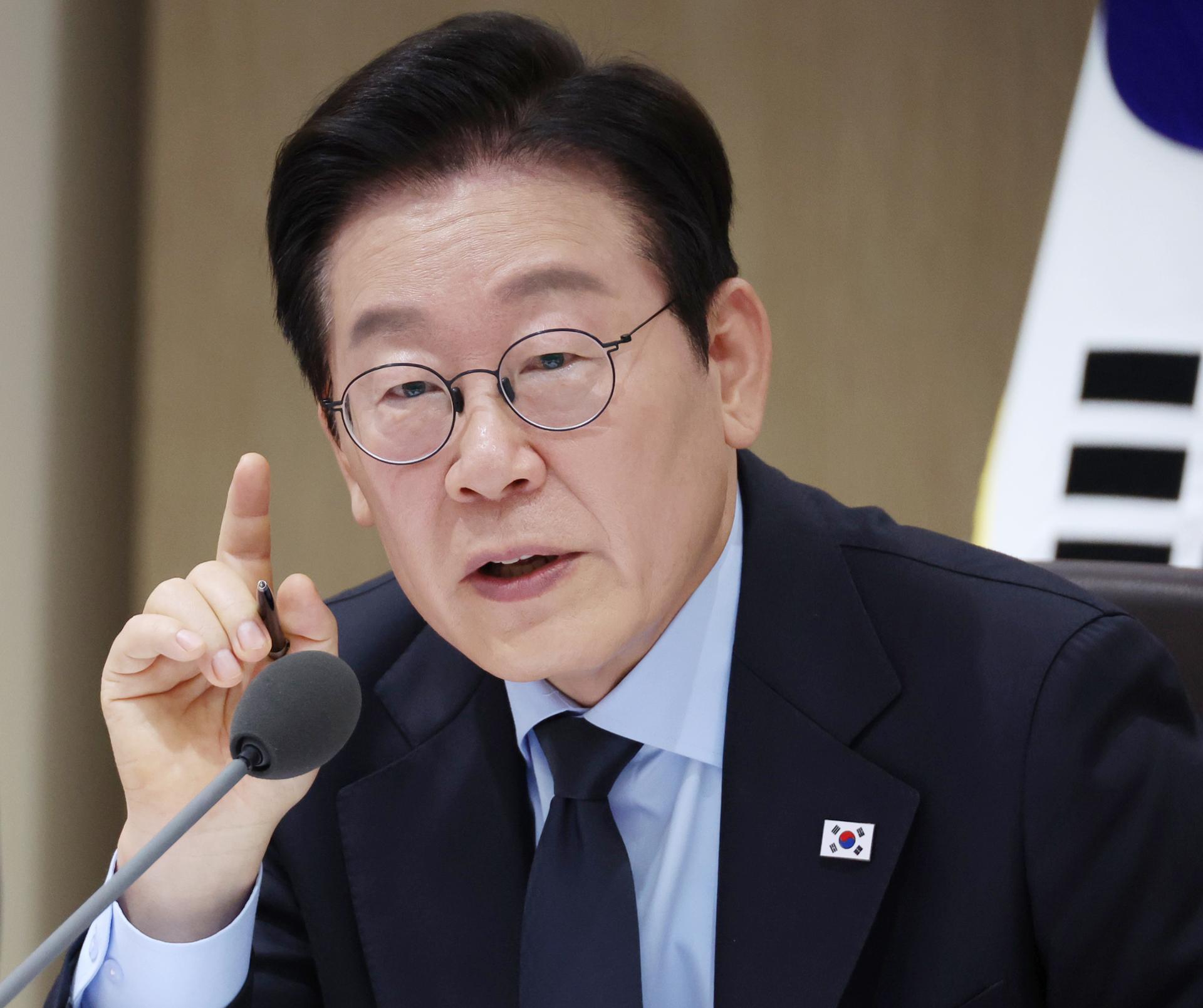
South Korean President Lee Jae Myung announced a sweeping crackdown on hate speech and disinformation Tuesday, describing such content as “crimes that clearly go beyond the limits of free expression” during a Cabinet meeting at the presidential office in Yongsan.
The president called for immediate action to strengthen penalties against those spreading hateful or false information, particularly on social media platforms, which he said is “eroding social trust and undermining democracy.”
“We can no longer overlook hate or disinformation disguised as opinion,” Lee declared. “Acts that distort facts or violate human dignity are crimes that must be punished as such.”
In one of the most significant measures announced, Lee directed his administration to implement automatic dismissal procedures for civil servants who use discriminatory language. The rule will apply to all senior officials, including those at independent bodies like the National Human Rights Commission and the Korean Red Cross.
Personnel Management Minister Choi Dong-suk, who proposed the new disciplinary rules, stated firmly: “If a public official engages in hate speech, they should automatically be disqualified from office.” Lee approved the proposal and instructed that it be “implemented as quickly as possible.”
The president’s announcement comes amid growing concerns about the social impact of online hate speech in South Korea, where social media use is among the highest in the world. Recent incidents have highlighted the issue’s urgency and reach across Korean society.
Lee specifically referenced a controversy involving Korean Red Cross President Kim Chul-soo, who reportedly made racist remarks about foreign ambassadors at a diplomatic event. “A senior official recently made comments about ‘white faces and black faces’ and still holds his position,” Lee said. “This cannot be accepted in public service.” Following the president’s remarks and an ordered government inspection, Kim offered his resignation.
In another recent incident highlighting racial insensitivity, officials in Gumi City were forced to remove promotional material for their Noodle Festival after public outcry over a performer appearing in blackface, impersonating a character from the 1980s cartoon “Dooly the Little Dinosaur.”
Justice Minister Jung Sung-ho announced that the government would support parliamentary discussions on anti-hate speech legislation modeled after similar laws in Europe and Japan. The proposed legislation would include fines for online platforms that fail to remove hateful or manipulated content in a timely manner.
Lee also endorsed plans to abolish the criminal defamation clause that currently punishes even factual statements, suggesting such cases “should be settled under civil law rather than through criminal prosecution.” This represents a significant shift in Korea’s approach to defamation, which has historically been criticized by press freedom advocates.
The president further urged political parties to self-regulate, removing banners and slogans containing hateful or vulgar language. “Even if a law is intended to protect political expression, it must be revised or abolished if it is being misused,” he said.
The government’s approach attempts to balance free speech protections with growing concerns about online discourse. Lee emphasized that police authorities would play a leading role in stopping the spread of false content, saying the government must “draw a clear boundary between legitimate speech and incitement that endangers the public.”
“Freedom of expression cannot justify indecent or divisive words,” Lee concluded. “Hate and falsehoods threaten the very foundation of democracy and must be confronted by law.”
The announcement signals a significant policy shift in South Korea’s approach to regulating online speech, joining several other democratic nations that have introduced stricter measures against hate speech and disinformation in recent years.
Fact Checker
Verify the accuracy of this article using The Disinformation Commission analysis and real-time sources.

8 Comments
Combating disinformation is crucial, but I hope this crackdown doesn’t inadvertently censor legitimate criticism or dissenting views. Maintaining the right balance between free expression and social responsibility will be challenging.
I agree, it’s a delicate balance. Defining the line between disinformation and valid debate will require nuance and care. Oversight and public input will be important to get this right.
While I applaud the intention to uphold civil discourse, I worry these measures could have unintended consequences and be abused for political gain. Ensuring impartial enforcement and protecting whistleblowers will be critical.
Interesting that they’re targeting civil servants as well. Automatic dismissal for hate speech seems like a tough stance, but one that could help set an example. I wonder how they’ll define ‘discriminatory language’ and enforce it fairly.
You raise a good point. Clear guidelines and transparent processes will be key to ensuring this policy is applied consistently and doesn’t infringe on legitimate free speech.
This is an ambitious plan, but it remains to be seen how effectively it can be implemented. I’m skeptical that automatic dismissals for hate speech will withstand legal challenges. Proactive media literacy education may be a more sustainable approach.
This is a bold move to crack down on hate speech and disinformation. Strong measures are needed to protect democracy and civil discourse. I’m curious to see how the public responds and if this leads to more accountability for social media platforms.
Tackling the complex issue of online disinformation is admirable, but the devil will be in the details. I hope they can find a way to empower citizens and platforms to self-regulate, rather than relying solely on heavy-handed government intervention.