


Listen to the article
Russia Weaponizes Water Crisis in Occupied Ukrainian Territories for Propaganda
Russia has systematically manipulated the issue of water resources in occupied Ukrainian territories, turning it into a propaganda tool to justify its ongoing aggression, according to the Center for Countering Disinformation (CPD) at Ukraine’s National Security and Defense Council.
In a recent Telegram statement, the CPD revealed that the Kremlin has spent years crafting a sophisticated disinformation campaign around water shortages, particularly in Crimea, which Russia illegally annexed in 2014. The center emphasized that Moscow has built “an entire disinformation system” focused on water scarcity issues.
“Since 2014, Russian authorities have consistently accused Ukraine of implementing a ‘water blockade’ in Crimea,” the CPD noted, referencing analysis from EUvsDisinfo, the European Union’s disinformation tracking initiative. However, the center pointed out that international law explicitly places responsibility for meeting basic needs of populations in occupied territories on the occupying power.
The water narrative gained new dimensions following Russia’s full-scale invasion in 2022. Russian propaganda began positioning water access as one of the primary justifications for the war, ranging from claims about “liberating” the North Crimean Canal to assertions that the Dnieper River “belongs to Russia” – statements the CPD described as “absurd.”
This propaganda strategy serves a dual purpose: justifying military aggression to domestic and international audiences while deflecting blame for Russia’s failure to provide essential services in territories under its control.
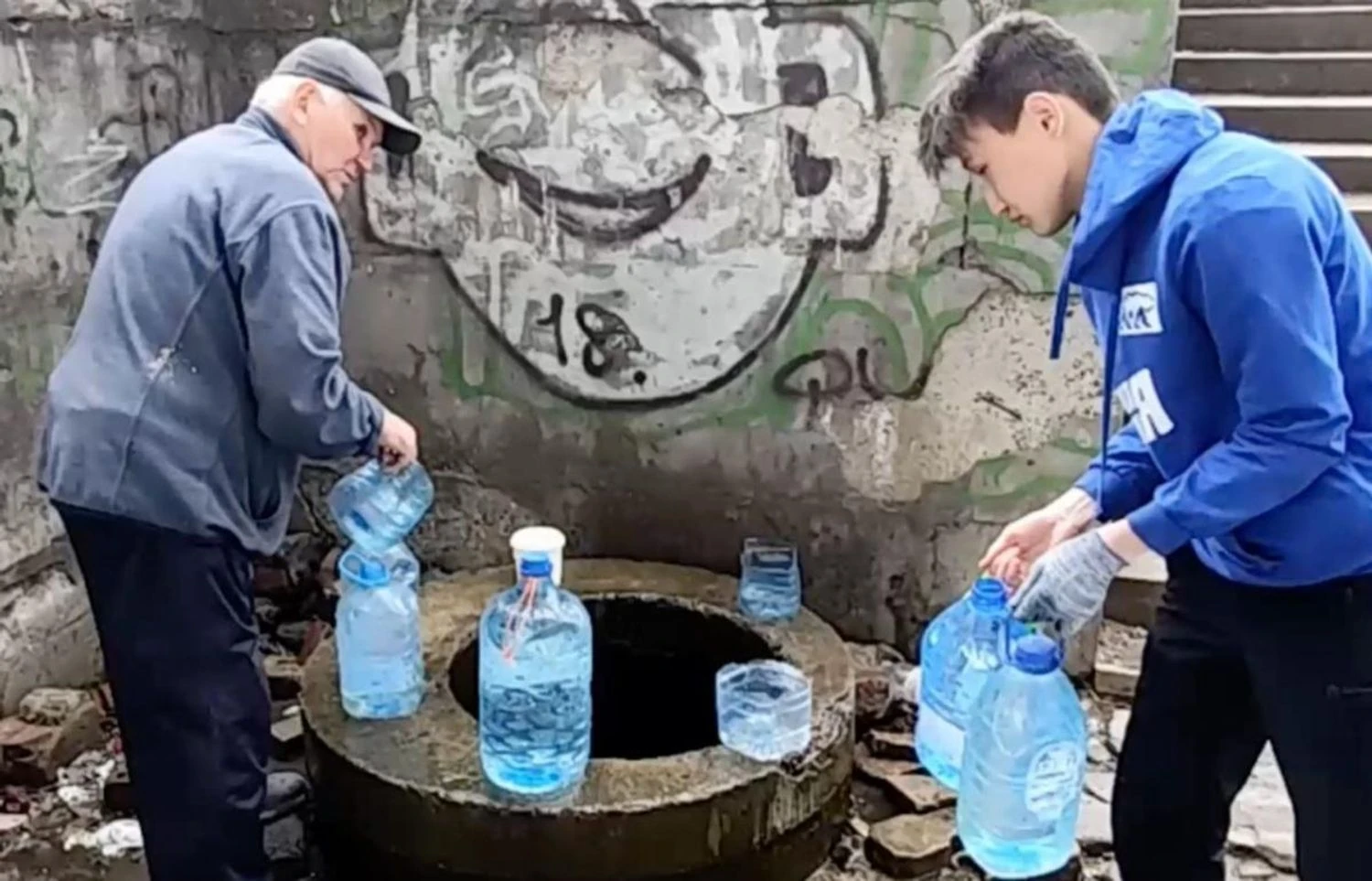
The water crisis in occupied regions has reached critical levels in 2025. Major cities in eastern Ukraine under Russian occupation now face severe water shortages, with no immediate solutions in sight. In Mariupol, a city devastated by Russian forces in 2022, residents receive water only once every two days for a maximum of four hours, according to the Mariupol City Council.
Economic exploitation has accompanied the humanitarian crisis. Prices for bottled water in occupied territories have surged dramatically, with costs jumping from 50 to 80 rubles (approximately 60% increase) for a five-liter bottle within just days. This price gouging compounds the suffering of local populations already struggling under occupation.
The visible symbol of this water emergency has become the blue water barrels now appearing throughout occupied areas. These barrels, containing technical water not suitable for drinking, have long represented water shortages in occupied Donbas and are now being installed in Crimea as well.
Water security experts note that Russia’s actions mirror historical examples of using resource control as a weapon of war. By controlling access to water, occupying forces can exert tremendous pressure on civilian populations while creating justifications for territorial control.
When actual water supply problems emerge, the Kremlin launches fresh waves of disinformation, ranging from claims about “Putin’s personal control” of the situation to fantastical proposals about desalinating the Sea of Azov. These narratives aim to project an image of Russian authorities actively addressing problems they themselves have created or exacerbated.
The CPD’s analysis demonstrates how resource manipulation integrates with information warfare in Russia’s occupation strategy. By controlling both physical resources and the narrative around them, Russian authorities attempt to normalize occupation while presenting themselves as problem-solvers rather than the cause of civilian suffering.
“The responsibility for this crisis lies solely with Russia,” the CPD concluded, emphasizing that despite elaborate propaganda efforts, the stark reality of water insecurity in occupied Ukrainian territories remains a direct consequence of Russian occupation policies.
Fact Checker
Verify the accuracy of this article using The Disinformation Commission analysis and real-time sources.

11 Comments
This report highlights Russia’s sophisticated disinformation campaign around the water crisis in Crimea and occupied Ukraine. It’s a sobering reminder of the lengths the Kremlin will go to justify its actions.
It’s alarming to see how Russia is weaponizing water scarcity for political gain. This highlights the need for the international community to maintain vigilance against disinformation and hold the Kremlin accountable.
Russia’s weaponization of water scarcity is a disturbing development. The international community must scrutinize these claims and hold the Kremlin accountable for its responsibilities under international law.
Absolutely. Disinformation tactics that exploit environmental issues for political gain are particularly egregious and must be challenged with facts and transparency.
Water resources are a critical issue, and it’s troubling to see how Russia is manipulating this for its own political ends. Transparency and adherence to international norms are essential here.
Agreed. Using water scarcity as a pretext for aggression is a cynical tactic that undermines efforts to address genuine environmental and humanitarian challenges.
This report underscores the importance of independent, fact-based analysis to counter the Kremlin’s disinformation campaigns. Addressing genuine water scarcity issues should be the priority, not propaganda.
Agreed. Objective reporting and rigorous scrutiny of claims are essential to exposing the Kremlin’s exploitative tactics and upholding international norms.
Interesting how the Kremlin is weaponizing water scarcity for propaganda purposes in occupied Ukrainian territories. It’s concerning to see disinformation tactics being used to justify aggression.
Yes, this is a concerning trend. The international community must hold Russia accountable for its responsibilities as an occupying power under international law.
The Kremlin’s efforts to spin the water crisis in occupied Ukraine as a justification for aggression is a troubling example of how authoritarian regimes can manipulate information to suit their narrative.