


Listen to the article
In one of the deadliest terror attacks in recent years, four gunmen targeted tourists in Pahalgam, Jammu and Kashmir (J&K) on April 22, 2025, killing 25 Indians and one local resident. India immediately accused Pakistan of orchestrating the attack, an allegation Pakistan denied, setting the stage for a dangerous escalation between the nuclear-armed neighbors.
Two weeks later, on May 7, India launched “Operation Sindoor,” conducting missile strikes across multiple locations in Pakistan. According to India’s government, the operation targeted nine sites they described as “terrorist infrastructure.” Pakistan’s military spokesperson reported at least 26 deaths from these strikes, including women and children.
Pakistan swiftly retaliated with cross-border strikes of its own and claimed to have shot down Indian fighter jets, though the exact numbers remain disputed. The nearly 100-hour military exchange included intense shelling along the Line of Control (LoC) in J&K, resulting in numerous casualties. Death tolls remain contested, with Pakistan reporting approximately 30 fatalities while India acknowledged 16 deaths in the Jammu region.
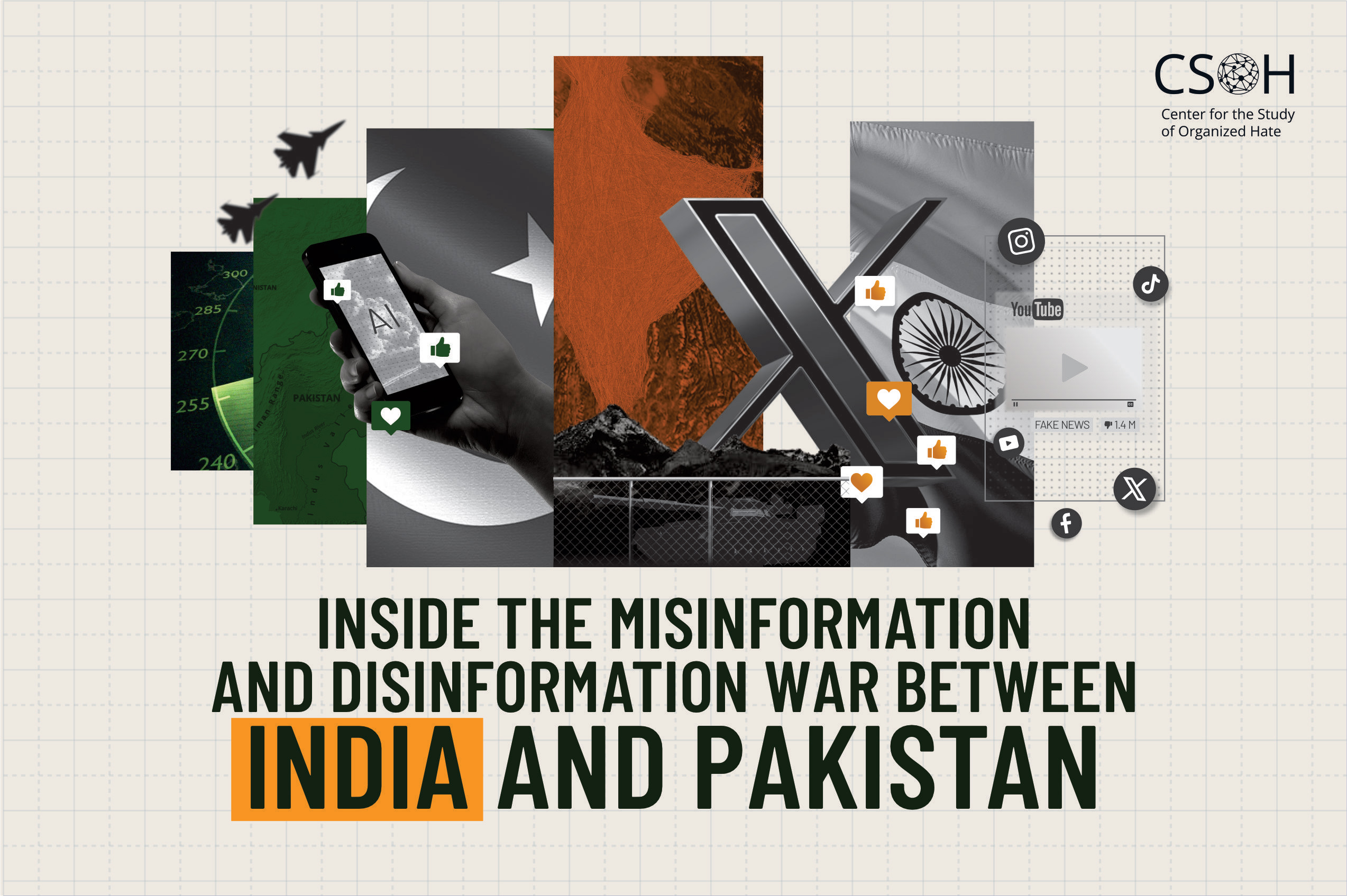
As military operations unfolded on the ground, a parallel battle raged in the digital sphere. A surge of misinformation and disinformation spread rapidly across social media platforms, shaping public perception and further inflaming tensions between the two countries. False reports of military victories, doctored videos of airstrikes, fabricated images of destroyed infrastructure, and baseless rumors about deaths or arrests of high-profile figures proliferated across X (formerly Twitter), Facebook, Instagram, and YouTube.
India’s Press Information Bureau (PIB) reported countering at least seven major instances of misinformation, including altered images, recycled footage, and false attributions. Fact-checking agencies and independent researchers observed that these misleading narratives deliberately exploited emotionally charged content to drive engagement, escalate nationalist sentiment, and manufacture support for all-out war.
A collaborative analysis by Indian news outlet The News Minute and Alt News fact-checker Mohammed Zubair revealed that disinformation was strategically timed to intensify tensions, legitimize retaliatory military actions, and pressure both governments into increasingly aggressive postures. This online ecosystem of false information directly influenced real-world escalation, molding public opinion and diplomatic narratives.
This weaponization of misinformation represents part of a broader global trend in hybrid warfare. A 2022 report by the Organization for Security and Co-operation in Europe (OSCE) Parliamentary Assembly documented similar tactics during the Russia-Ukraine conflict, where various actors systematically deployed propaganda to polarize audiences, justify military operations, and manipulate international perceptions.
A comprehensive analysis of the information landscape during the May 2025 India-Pakistan conflict revealed several key patterns. Coordinated misinformation campaigns emerged on both sides, with Indian pro-government influencers openly characterizing their efforts as “electronic warfare.” Mainstream media outlets, particularly in India, amplified unverified claims by broadcasting them as “breaking news,” lending credibility to fabricated stories.
One particularly troubling trend was the repurposing of video game footage as “evidence” of military victories. This content, edited with text overlays, patriotic soundtracks, and strategic commentary, generated millions of views. Additionally, old or unrelated visuals from previous conflicts were frequently re-contextualized to suggest ongoing military actions.
The conflict also marked a significant evolution in disinformation tactics through the use of AI-generated content. Fabricated stories about Pakistani military figures, supported by AI-generated visuals, circulated widely in India. Similarly, AI-generated content falsely depicting Indian military losses spread across Pakistani social networks.
Social media platforms served as the primary vectors for this cross-border information warfare. Despite efforts by fact-checking organizations, much of this misleading content remained unchallenged, amplifying its reach and impact. X emerged as the main hub for both misinformation and disinformation, with analysis showing that of 437 examined posts, 179 originated from verified accounts, yet only 73 were flagged with Community Notes.
The India-Pakistan conflict of May 2025 highlights the evolving role of digital platforms as battlegrounds for narrative control, where emotionally charged content is leveraged to escalate tensions and shape strategic outcomes in modern conflicts.
Fact Checker
Verify the accuracy of this article using The Disinformation Commission analysis and real-time sources.

20 Comments
Exploration results look promising, but permitting will be the key risk.
Good point. Watching costs and grades closely.
Good point. Watching costs and grades closely.
Nice to see insider buying—usually a good signal in this space.
Uranium names keep pushing higher—supply still tight into 2026.
Good point. Watching costs and grades closely.
I like the balance sheet here—less leverage than peers.
Production mix shifting toward Disinformation might help margins if metals stay firm.
If AISC keeps dropping, this becomes investable for me.
Good point. Watching costs and grades closely.
Uranium names keep pushing higher—supply still tight into 2026.
Good point. Watching costs and grades closely.
Good point. Watching costs and grades closely.
The cost guidance is better than expected. If they deliver, the stock could rerate.
Good point. Watching costs and grades closely.
Good point. Watching costs and grades closely.
If AISC keeps dropping, this becomes investable for me.
Good point. Watching costs and grades closely.
Good point. Watching costs and grades closely.
Production mix shifting toward Disinformation might help margins if metals stay firm.