


Listen to the article
India Calls for Rules-Based Maritime Security at Regional Conclave
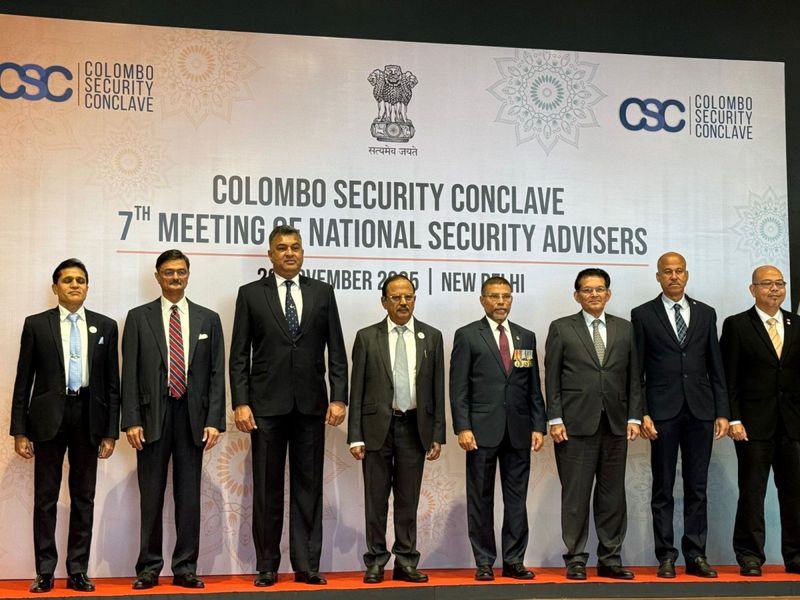
India has called for the creation of a maritime security environment rooted in rules-based order during the seventh meeting of the Colombo Security Conclave (CSC) held in New Delhi on Thursday. The high-level gathering brought together national security advisers from member states including the Maldives, Mauritius, Sri Lanka, and Bangladesh.
National Security Adviser Ajit Doval emphasized the strategic significance of the Indian Ocean region and the necessity for collective action on maritime security. Addressing the delegates, Doval noted that the regional security grouping has “gained immense significance today in the midst of a rapidly changing and challenging global security environment.”
“We need to shape a favorable environment to nurture an open, inclusive maritime domain anchored firmly on a rule-based order,” Doval stated. “We also need to work closely for the preservation and use of our common maritime heritage.”
The Seychelles, which previously held observer status, agreed to become a full member of the conclave, while Malaysia participated as a guest for the first time, signaling the group’s expanding influence in the Indian Ocean region.
Bangladesh’s representative, Khalilur Rahman, used the platform to emphasize his country’s “zero tolerance policy towards all forms of terrorism.” His participation marks only the second ministerial-level visit from Dhaka since the caretaker administration led by Muhammad Yunus took power in August 2024.
Rahman highlighted emerging security challenges facing the region, particularly in the digital sphere. “Of late, we have been facing a constant barrage of misinformation and disinformation. We are committed towards securing our own cyberspace, critical infrastructure and technology,” he said, emphasizing that “national actions are not enough.”
The Bangladeshi official called for collective action, stating that the CSC needed to “articulate and implement our collective actions in facing up to the challenges of cybersecurity, misinformation and disinformation.”
Rahman’s focus on misinformation comes amid ongoing tensions between India and Bangladesh regarding allegations of communal violence following the collapse of Sheikh Hasina’s government. Bangladesh officials have dismissed Indian government claims of widespread attacks on Hindus as unfounded, suggesting that Indian media and social media users have been spreading misinformation that fuels friction between the neighboring countries.
While Bangladesh acknowledges that Hindu communities faced violent attacks after Hasina’s ouster, officials maintain that these incidents were politically motivated rather than religiously driven. The current caretaker government has been working to address these concerns while establishing its diplomatic footing in the region.
The timing of the CSC meeting is particularly significant, occurring just two days after former Prime Minister Sheikh Hasina, currently in exile in India, was sentenced to death in absentia by a Bangladeshi court for “crimes against humanity” related to the July 2024 uprising. Official statements did not indicate whether this matter was discussed during the conclave or in the bilateral meeting between Rahman and Doval that took place a day earlier.
According to a statement from India’s Ministry of External Affairs, the CSC’s first secretary general presented a comprehensive review of activities undertaken since the conclave’s previous meeting in Mauritius in December 2023. Member states reportedly discussed ways to enhance cooperation through training and capacity-building initiatives while reaffirming their commitment to strengthening regional security partnerships across the Indian Ocean.
The CSC has emerged as a significant forum for addressing shared security concerns in the Indian Ocean region, with maritime security, counterterrorism, and cybersecurity forming the core focus areas. As regional dynamics continue to evolve, particularly with the political transition in Bangladesh and growing great power competition in the Indo-Pacific, the conclave represents an important mechanism for coordinating security responses among these strategically located nations.
Fact Checker
Verify the accuracy of this article using The Disinformation Commission analysis and real-time sources.

8 Comments
India’s call for preserving the common maritime heritage of the region is an important consideration. Balancing economic development, environmental protection, and security interests in the Indian Ocean will require nuanced cooperation between these nations.
It will be interesting to see how the discussions at the conclave unfold and what concrete steps the member states take to advance a rules-based maritime order in the Indian Ocean region. Balancing diverse national interests will be key.
The expansion of the Colombo Security Conclave, with Seychelles becoming a full member and Malaysia participating as a guest, suggests growing interest in this regional security platform. Addressing maritime security issues collectively is a sensible approach.
Absolutely. With India’s emphasis on a rules-based order, this could provide a constructive forum for countries in the region to coordinate their efforts and perspectives on maritime governance.
An interesting development in the region. India’s call for a rules-based maritime order aligns with the need for collective action to address shared security challenges. It will be important to see how the conclave’s membership and agenda evolve going forward.
Agreed. Maintaining open and inclusive maritime domains is crucial, especially given the complex geopolitical environment. Collaboration between these regional partners could help strengthen maritime security in the Indian Ocean.
The warning from Bangladesh about disinformation is also timely. Maintaining transparency and combating the spread of false narratives should be a priority, especially on sensitive geopolitical issues like maritime security.
You raise a good point. Disinformation can undermine constructive dialogue and cooperation, so addressing this challenge will be crucial for the success of the Colombo Security Conclave.