


Listen to the article
Misinformation Hampers Pakistan’s HPV Vaccine Campaign Despite Successful Rollout
Pakistan’s recent human papillomavirus (HPV) vaccine campaign faced significant resistance, primarily fueled by misinformation spreading across social media platforms. Despite the challenges, health officials managed to vaccinate 9 million girls aged 9-14 by the end of the extended campaign on October 1—representing approximately 77 percent of the targeted population.
The free vaccination drive aimed to reach 13 million girls across Punjab, Sindh, Azad Jammu and Kashmir, and Islamabad. The program, which offered the normally expensive vaccine (retail price of Rs7,500) at no cost, was implemented through collaboration between Pakistan’s government, the World Health Organization, and vaccine alliance GAVI.
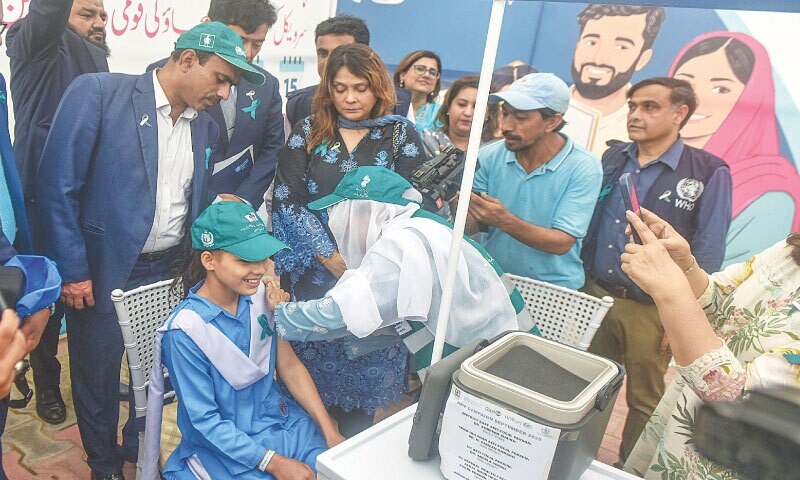
Health officials were initially alarmed when state minister for national health revealed on September 24 that only 34 percent—around 4.5 million girls—had been vaccinated. This prompted federal health minister Mustafa Kamal to have his own daughter vaccinated in front of the press to boost public confidence.
“The refusal rate was extremely high in the first few days,” Kamal said. “I realized that the best way to allay parents’ concerns was to get my daughter inoculated.” He noted that coverage improved significantly following this public demonstration.
Vaccine hesitancy in Pakistan has deep roots. The country has historically struggled with immunization campaigns, most notably following revelations that the CIA organized a fake polio vaccination drive to track Osama bin Laden in 2011. The COVID-19 pandemic further reinforced vaccine skepticism.
The HPV vaccine faced additional scrutiny because it targeted adolescent girls, leading to widespread concerns about its potential impact on fertility and reproductive health—despite no scientific evidence supporting such claims.
Digital platforms became breeding grounds for misinformation. One YouTube channel with 176,000 followers falsely claimed the vaccine causes infertility and incorrectly associated HPV exclusively with promiscuity. Though the video was eventually removed, segments continued circulating online.
Another viral video, viewed over 350,000 times on X (formerly Twitter), falsely showed schoolgirls fainting after allegedly receiving the HPV vaccine. Fact-checkers later revealed the footage was unrelated to the vaccination drive, but by then, the damage had been done.
Dr. Naeem Majeed, a Karachi-based public health professional, explained why resistance emerges: “Whenever vaccines are free or mandatory, people start questioning intentions. Anti-vaxxer movements exist worldwide and have grown stronger with increased online polarization.”
He noted that in Muslim-majority countries, there’s a recurring fear that vaccines targeting women and girls might interfere with fertility. “This perception resurfaces every few years, even though it has no basis in science.”
The HPV vaccine specifically faced an additional layer of controversy because it targets adolescent girls before they become sexually active. Many parents misinterpreted this as an implication about promiscuity, rather than understanding it as preventative healthcare.
HPV, transmitted through sexual contact, can cause cervical cancer years or decades after infection. According to the Aga Khan University Hospital, cervical cancer remains a significant public health threat in Pakistan, with over 5,000 new cases and approximately 3,000 deaths reported annually.
Interestingly, resistance to the HPV vaccine was higher in urban centers compared to rural areas—the opposite of what public health campaigns typically encounter. Dr. Majeed attributes this to urban populations consuming more social media content where misinformation spreads rapidly.
Despite these challenges, the 77 percent coverage achieved represents a success compared to first-time HPV vaccine rollouts in other countries. Beginning January, routine HPV immunization will be incorporated into Pakistan’s schedule for all girls aged nine.
Future campaigns are planned for Khyber Pakhtunkhwa, Balochistan, and Gilgit-Baltistan in 2026 and 2027. However, before proceeding, health experts emphasize the need to address online misinformation that has real consequences for public health.
For many families like Bushra’s in Islamabad, who convinced relatives not to vaccinate their daughters based on conspiracy theories, the cost could be high. Denying adolescent girls access to this preventative healthcare means potentially putting their future health at risk of a preventable cancer.
Unless health authorities can effectively combat misinformation and build greater trust, many Pakistani girls will continue to miss out on this potentially life-saving vaccine.
Fact Checker
Verify the accuracy of this article using The Disinformation Commission analysis and real-time sources.

8 Comments
Misinformation around vaccines and medical treatments is a serious threat to public health. Pakistan’s experience with the HPV vaccine campaign shows how difficult it can be to overcome vaccine hesitancy driven by false claims. Continued vigilance and fact-based outreach will be crucial.
It’s troubling to see the refusal rate for this important HPV vaccine campaign was so high initially due to misinformation. Kudos to the health officials for their persistence and for taking steps to boost public confidence. Ongoing efforts to counter misinformation will be crucial.
This highlights the urgent need to address health misinformation, which can have devastating consequences. I’m glad to see the HPV vaccine campaign in Pakistan ultimately reached a significant portion of the target population despite the initial challenges.
Yes, the ability of misinformation to undermine public health initiatives is deeply concerning. Persistent education efforts and building trust in health authorities will be key to overcoming these obstacles.
This is a concerning issue. Health misinformation can undermine vital public health initiatives and put lives at risk. I hope Pakistan’s experience serves as a lesson for other countries to be proactive in combating disinformation around vaccines and medical treatments.
Agreed. Vaccine hesitancy driven by misinformation is a growing global problem that requires a multi-pronged approach of education, transparency, and combating the spread of false claims online.
Tackling health misinformation is crucial to ensure safe and effective vaccine campaigns. Despite the challenges, I’m glad to see Pakistan reached 77% of its targeted population for the HPV vaccine rollout. Ongoing education efforts will be key to further improve public confidence.
Absolutely. Vaccine hesitancy fueled by misinformation can have deadly consequences. Kudos to Pakistan’s health officials for persisting and ultimately vaccinating millions of girls.