


Listen to the article
A van packed with multimedia tools brings media literacy to rural communities in Ghana – and shows that the most effective way to counter disinformation starts with empowering the individual.
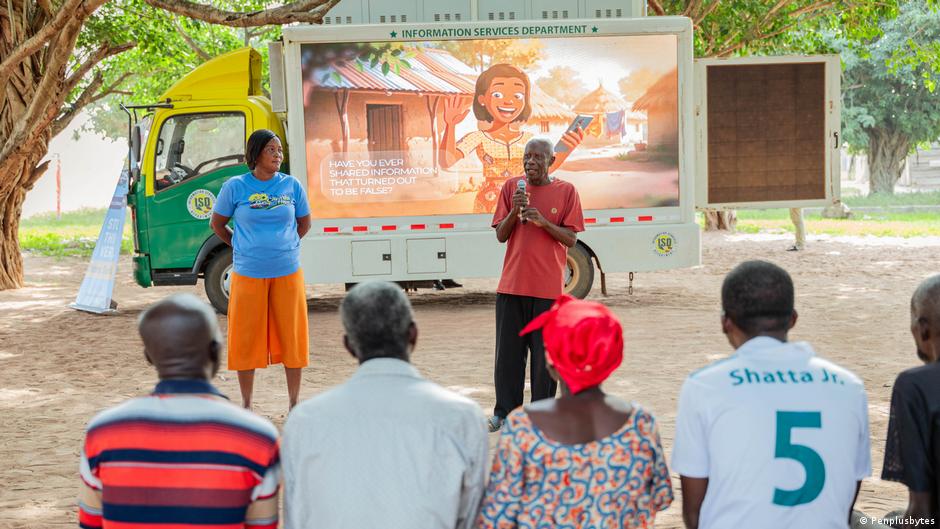
As dawn breaks over a rural Ghanaian village, a heavy van navigates dusty streets and uneven roads toward the community square. By arrival time, the area is already filling with expectant residents. Some have been waiting for more than an hour. Farmers have paused their fieldwork, and parents have rearranged their morning routines to attend the gathering. The neat rows of plastic chairs fill quickly, with latecomers bringing their own seating.
This scene, resembling preparation for a concert or political rally, is actually one of thirteen interactive workshop sessions in the “MIL Caravan of Hope” initiative. The program’s mission is simple yet powerful: spark conversations about Media and Information Literacy (MIL) and empower individuals to protect themselves against the growing threat of disinformation.
“Around rural Ghana, we found that many people are exposed to different forms of misinformation, particularly through word of mouth, mobile phones and local media,” explains Rebecca Avusu, Project Associate for Penplusbytes, DW Akademie’s partner in Ghana. “But what they lack are the practical skills to critically assess information and verify before sharing.”
This challenge is universal, affecting communities from Europe to Ghana’s urban centers and remote rural areas alike. The program operates in five of Ghana’s 16 regions, visiting thirteen communities and reaching over 3,000 direct beneficiaries.
The success of the MIL Caravan hinges on its close collaboration with local community development workers and leaders, who help select destinations and often serve as facilitators for the workshops. “People here know and trust these people,” notes Osman Abubakari-Sadiq, Project Manager at DW Akademie. “The materials are best conveyed through familiar faces, people who understand the context and speak the local language.”
Once setup is complete, each session launches participants on a two-hour journey exploring various types of misinformation and practical countermeasures. The curriculum draws directly from personal stories and issues the community members have experienced firsthand.
“Many people have received a call claiming a family member is sick in hospital and needs money,” Avusu says. “Of course, they want to rush and help. But we tell them to stop, think, and verify this with a person they trust.”
To enhance accessibility, particularly for those with limited literacy, the traveling roadshow employs a diverse mix of engaging formats: radio drama, animated videos, skit performances, pictorial flipbooks, and facilitated discussions. All materials are presented in local languages, ensuring maximum comprehension and inclusion across different age groups and educational backgrounds.
“Our role was not to introduce entirely new ideas but to strengthen instincts that people already possessed,” Avusu notes after conversations with participants from diverse backgrounds.
The workshops reveal how disinformation affects not just individuals but entire communities. In Kpoeta Ashanti, for example, participants shared a story about rumors of ghost visitations that spread rapidly through the village. “Nobody knew where the rumor came from, but everyone acted on it. The people were in a state of fear and panic,” Avusu recounts.
By sharing these experiences collectively and developing strategies to overcome them, the MIL Caravan helps participants understand they aren’t facing these challenges alone – and that individual action still matters.
“Our aim is to show people: if you are requesting facts, you are requesting the truth,” explains Abubakari-Sadiq. “This project seeks to empower them to be active citizens in a democratic space. Our main objective is to make sure you are informed, ask the right questions, and make the right decisions based on factual and verified information.”
After approximately two hours of presentations and discussions at each location, the team prepares to move on to the next community. However, departing isn’t always straightforward.
“Their response to us was so positive,” says Abubakari-Sadiq. “When we started packing up, they said they really didn’t want us to leave, despite the fact that they were all busy with work.”
Avusu adds, “Several times, we were approached by people from neighboring communities who had attended. They asked us to visit their villages as well, to share this information with their fellow community members.”
The impact extends beyond each visit. “We leave all the materials with the facilitators and community development people, so they can further share them with the community. This way we make sure the discussion continues,” explains Avusu.
The first MIL Caravan of Hope, which ran from January to March 2026, was a pilot project whose continuation depends on future funding and availability. However, Avusu remains optimistic that the Caravan will continue its journey in some form. For the immediate future, the team plans follow-up visits to assess the long-term impact of their training sessions and is developing concepts to expand the project to reach even more communities.
The “MIL Caravan of Hope” is implemented by Penplusbytes in partnership with DW Akademie, with support from Germany’s Federal Ministry for Economic Cooperation and Development. The initiative collaborates with Ghana’s District Assemblies, the Information Services Department, community radio stations, and local civil society organizations to ensure strong local ownership and sustainability.
Fact Checker
Verify the accuracy of this article using The Disinformation Commission analysis and real-time sources.

14 Comments
It’s great to see this type of innovative outreach program taking root in Ghana. Bringing media literacy education directly to rural communities is a smart and impactful approach.
Countering disinformation is a global challenge, so it’s great to see this initiative taking root in Ghana. Building awareness and critical thinking around media sources is a vital first step.
While the threat of disinformation is concerning, I’m encouraged to see organizations taking proactive steps to empower citizens. This grassroots program in Ghana is a positive example.
Disinformation can have serious real-world consequences, so initiatives like the MIL Caravan of Hope are crucial. Equipping rural Ghanaians with media literacy skills is an important investment.
Agreed. Building digital resilience at the community level is essential to combat the spread of harmful misinformation.
The MIL Caravan of Hope sounds like a really engaging way to raise awareness about disinformation. I’m curious to learn more about the specific workshop activities and how they resonate with rural Ghanaian participants.
Yes, the hands-on, interactive format seems well-suited to effectively communicate media literacy concepts in a relatable way.
The MIL Caravan of Hope sounds like an impactful way to reach underserved rural communities. Bringing media literacy training directly to people’s doorsteps is a smart strategy.
Absolutely. Meeting people where they are and making the content accessible is key for this type of educational outreach.
Equipping individuals with the skills to critically evaluate information sources is crucial in today’s digital landscape. The MIL Caravan of Hope is an admirable initiative tackling this important challenge.
This is a great initiative to bring media literacy education to rural communities in Ghana. Empowering individuals to spot and counter disinformation is crucial in the digital age.
Agreed. Grassroots programs like this can make a real difference in building digital resilience at the community level.
I’m curious to learn more about the specific multimedia tools and workshop content used in the MIL Caravan of Hope. Equipping rural Ghanaians with practical media literacy skills is an innovative approach.
Yes, the details on the workshop format and activities would be interesting. Hands-on, interactive sessions seem well-suited for this type of outreach.