


Listen to the article
French Navy Debunks Pakistani Media Claims About Indian Rafale Jets
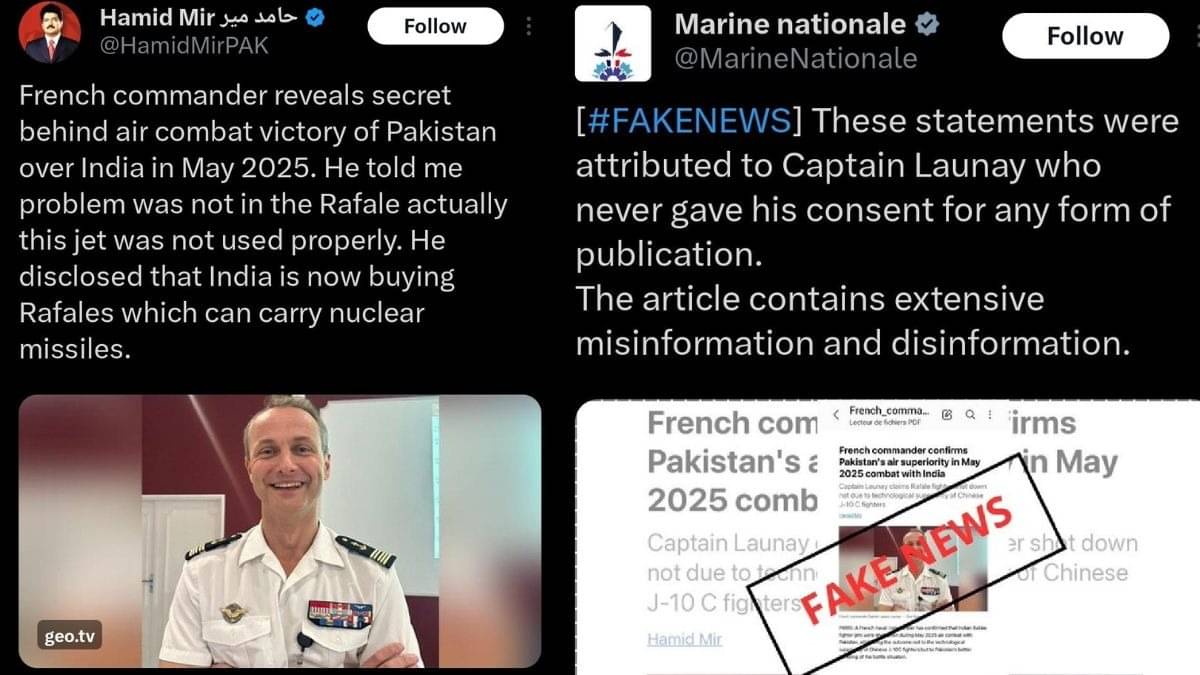
The French Navy has issued a forceful rebuttal to claims made by Pakistan’s Geo TV and correspondent Hamid Mir regarding alleged Indian military losses during tensions following the April 22 Pahalgam terror attack. The Pakistani media outlet had reported that a French naval commander confirmed Pakistan’s air superiority and the downing of Indian Rafale fighter jets during a purported military engagement.
In an unusual direct response on its official X (formerly Twitter) account, the French Navy posted screenshots of the articles, labeling them with the hashtag “Fake News.” The navy’s statement categorically denied the reporting, describing it as containing “extensive misinformation and disinformation.”
“These statements were attributed to Captain Launay, who never gave his consent for any form of publication,” the French Navy stated firmly, adding that when questioned about “Operation Sindoor,” Captain Launay neither confirmed nor denied any claims about military losses. The navy clarified that the captain refused to comment on allegations regarding Chinese jamming of Indian aircraft and never mentioned the Chinese J-10 fighter jets, directly contradicting the Pakistani media narrative.
The incident highlights growing concerns about disinformation campaigns targeting military capabilities in the region. A recent report by the U.S.-China Economic and Security Review Commission revealed that China had orchestrated a coordinated disinformation effort around “Operation Sindoor,” using fake social media accounts to distribute AI-generated images purportedly showing debris from downed aircraft.
According to the commission’s findings, this campaign had clear strategic objectives: to undermine confidence in French Rafale fighter jets while promoting China’s own J-35 aircraft in the competitive international defense market. The report stated that Beijing “opportunistically” exploited tensions between India and Pakistan to showcase its weapons systems, particularly as China continues to navigate its own complex border relationship with India.
“China launched a disinformation campaign to prevent sales of French Rafale aircraft in favour of its own J-35s, using fake social media profiles to propagate AI images of supposed ‘debris’ from the planes that China’s weaponry destroyed,” the report detailed.
The controversy takes place against a backdrop of India’s significant investment in French Rafale fighter jets as part of its military modernization program. India finalized a deal worth approximately €7.8 billion with France’s Dassault Aviation in 2016 for 36 Rafale jets, with the last aircraft delivered in 2022. The Indian Air Force has positioned these advanced multirole fighters as crucial elements in its strategic capabilities.
India’s ruling Bharatiya Janata Party (BJP) has also weighed in on the controversy, condemning what it described as a “desperate misinformation campaign” by Pakistan. BJP IT Cell chief Amit Malviya specifically mentioned Pakistani correspondent Hamid Mir, accusing him of repeatedly circulating fabricated claims about the Rafale jets and an alleged conflict in May.
“When official institutions start debunking their propaganda, you know how desperate Pakistan’s misinformation machinery has become,” the BJP stated. The party also suggested that Mir maintains connections with several Indian journalists, though it did not provide specific evidence for this claim.
The French Navy’s unusual step of directly addressing the false reporting underscores the serious implications of such misinformation in a region characterized by delicate military balances and ongoing tensions. Military analysts note that disinformation about weapons capabilities can have real consequences for regional stability and defense procurement decisions across South Asia.
As defense technology continues to evolve in the Indo-Pacific region, the incident serves as a reminder of how military hardware has become not just a battlefield asset but also a target for information warfare campaigns.
Fact Checker
Verify the accuracy of this article using The Disinformation Commission analysis and real-time sources.

13 Comments
The French Navy’s response highlights the importance of scrutinizing claims, especially when they involve sensitive military matters. Kudos to them for quickly addressing this misinformation.
The French Navy’s refutation is a good reminder that we should always be critical consumers of information, especially when it comes to sensitive military and geopolitical topics. Fact-checking is paramount.
The French Navy’s response seems measured and appropriate. Calling out misinformation directly is important to maintain transparency and trust. I wonder what motivated the initial Pakistani media claims.
That’s a good question. It would be interesting to understand the context and potential agenda behind the original reporting. Fact-checking and accountability are essential.
Interesting to see the French Navy directly refute these claims. Misinformation campaigns can be damaging, so it’s good they’re pushing back and clarifying the facts.
This highlights the importance of verifying information, especially when it comes to sensitive military matters. Kudos to the French Navy for setting the record straight.
Kudos to the French Navy for their swift and direct response. Calling out disinformation is crucial, and I’m glad they’re taking the time to set the record straight on these false claims.
It’s concerning to see the spread of disinformation, but I’m glad the French Navy is taking a firm stance against these false narratives. Fact-checking is crucial in today’s information landscape.
This is a textbook example of how misinformation can quickly spiral out of control. The French Navy’s decisive action in refuting these claims is commendable and helps maintain trust in reliable sources.
This is a stark reminder of the need for reliable, verified information, especially on military and geopolitical issues. I appreciate the French Navy taking the time to firmly refute these false claims.
Absolutely. Spreading misinformation, even inadvertently, can have serious consequences. It’s reassuring to see the navy take such a proactive approach to setting the record straight.
It’s good to see the French Navy taking a strong stance against the spread of misinformation. Fact-checking and transparency are essential, especially when it comes to national security issues.
Curious to know more about the motivations behind the initial Pakistani media reporting. Was this an intentional disinformation campaign or a case of sloppy journalism? Either way, the French Navy’s refutation is warranted.