


Listen to the article
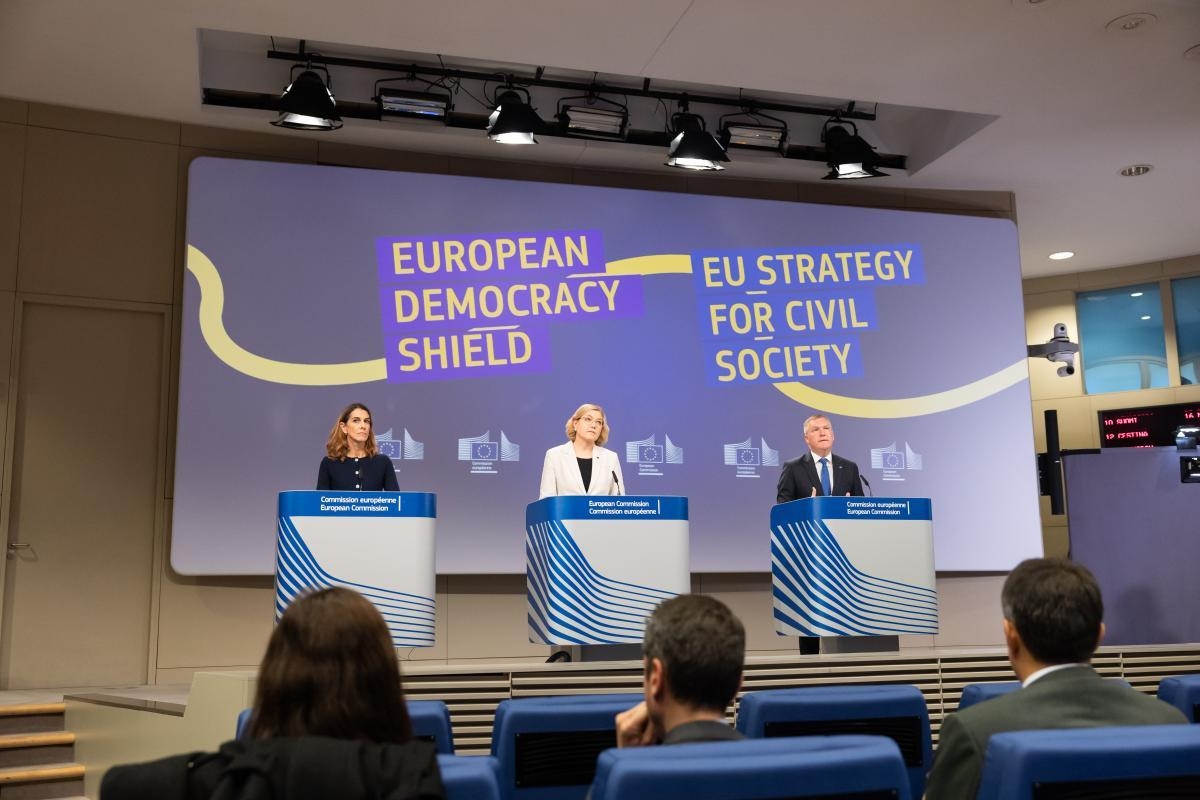
The European Commission on Wednesday unveiled its European Democracy Shield, a comprehensive initiative designed to combat foreign disinformation and political interference across the European Union. The plan, which relies heavily on the 2023 Digital Services Act (DSA) for enforcement, comes after being initially announced by Commission President Ursula von der Leyen in a speech to Parliament earlier this year.
The urgency behind the shield has been underscored by recent foreign disinformation campaigns that have raised significant concerns throughout the bloc. Russia’s documented interference in recent parliamentary elections in Romania and Moldova has demonstrated the real threat to fair democratic processes within and near EU borders.
“The investments and actions we take now will determine the health of our democracies and the stability of our societies for the next generation of European citizens,” EU Rule-of-Law Commissioner Michael McGrath emphasized during Wednesday’s press conference.
While the proposal introduces several cooperative initiatives, questions remain about its effectiveness, as it largely depends on the DSA for enforcement mechanisms. This reliance has prompted some observers to question whether the Democracy Shield might prove to be more symbolic than substantive.
At its core, the initiative aims to leverage both the DSA and AI Act to manage online disinformation. The Commission will establish a DSA incidents and crisis protocol to enhance coordination among authorities during large-scale disinformation operations, while simultaneously working with technology platforms to remove financial incentives for spreading false information.
To specifically address election interference, member states and the Commission are updating the DSA Elections Toolkit, which will include practical guidance on AI use during elections. The plan also calls for creating a European Cooperation Network on Elections, developing a blueprint for countering foreign information manipulation, and establishing a European Network of Fact-Checkers.
Commission officials have emphasized that these measures are not about creating a “ministry of truth” or controlling content. “This is just about ensuring that there is transparency and that the democratic debate can take place in an environment where people know where the information is coming from,” a Commission official clarified.
Another key component involves establishing a European Centre for Democratic Resilience, where EU member states and candidate countries can voluntarily combine resources to build cooperative capacity and better anticipate democratic threats. “There is a need to step up coordination, to reduce fragmentation, and to make sure that all capabilities and expertise are brought together,” explained another Commission official.
The Democracy Shield additionally aims to support journalists through new legal protections and a Media Resilience Programme, while also focusing on educating citizens about disinformation and digital literacy, with special attention to youth initiatives.
However, enforcement capabilities remain a significant concern. The European Partnership for Democracy (EPD), a network of NGOs, while generally supportive of the proposal’s commitment to improving the media landscape and including EU candidate countries, has expressed reservations about its effectiveness.
“The document is an important step in the right direction, but is by no means a complete response to the current challenges faced by democracy across Europe,” noted Emma Quaedvlieg, policy advisor at EPD. She pointed out that relying solely on the DSA will likely be insufficient to combat disinformation effectively.
For the proposal to succeed, Quaedvlieg stressed that “investigations under the DSA [must] take less time, given the speed of developments in the online information environment – by the time investigations are concluded, irreparable damage may already be done to our democracy.” She cited the Commission’s ongoing two-year investigation into X (formerly Twitter) for alleged DSA disinformation rule breaches, which has yet to reach a conclusion.
Enforcement challenges are further complicated by the United States’ increasing opposition to digital regulations. President Donald Trump has threatened retaliatory tariffs against the EU should it impose fines on American companies, a stance that appears to have influenced the relatively cautious wording of the Democracy Shield proposal.
“It’s expected, given the pressure exerted by the new US administration, but it’s a dangerous precedent for the EU, showing its willingness to fold in an area where it’s seen as a trailblazer globally,” Quaedvlieg concluded.
As the EU moves forward with implementing this initiative, balancing effective enforcement with international diplomatic considerations will likely determine whether the European Democracy Shield becomes a robust defense or merely an aspirational framework.
Fact Checker
Verify the accuracy of this article using The Disinformation Commission analysis and real-time sources.

20 Comments
The EU’s move to shield its democracies from foreign disinformation is understandable, but the complexity of the underlying DSA legislation is concerning. Effective implementation will be key to its success.
Agreed, the EU will need to carefully monitor and adjust this initiative as needed to ensure it achieves the desired outcomes of protecting democratic processes.
Combating foreign interference in elections is a noble goal, but the EU’s ‘Democracy Shield’ initiative seems to place a heavy burden on the Digital Services Act for enforcement. Its true impact remains to be seen.
Exactly, the success of this initiative hinges on the DSA’s ability to be consistently and rigorously applied across all EU member states.
Securing free and fair elections is crucial for the EU, so this move to counter foreign disinformation campaigns is an important step. But the execution will be key – the devil is in the details of this legislation.
Absolutely, the EU will need to carefully monitor how this initiative is implemented to ensure it achieves its intended goals of safeguarding democracy.
This EU initiative to combat disinformation and protect democratic processes seems timely and necessary, given the threats posed by foreign interference. However, its reliance on the complex DSA legislation raises concerns about its ultimate effectiveness.
Agreed, the success of this ‘Democracy Shield’ will hinge on the DSA’s enforcement mechanisms being robust and consistently applied across the EU.
While the EU’s ‘Democracy Shield’ initiative is a step in the right direction, its reliance on the DSA for enforcement raises concerns about its practical application and effectiveness in deterring foreign interference.
Agreed, the EU will need to carefully assess the performance of this initiative and make necessary refinements to ensure it provides robust protection for democratic processes.
Protecting the integrity of elections is a crucial task, and the EU’s ‘Democracy Shield’ aims to address this. However, its reliance on the DSA raises questions about its practical application and overall effectiveness.
A valid concern. The EU will need to ensure strong coordination and consistent implementation of this initiative across member states to make it a meaningful deterrent.
The EU’s efforts to combat foreign disinformation and safeguard its democracies are commendable, but the ‘Democracy Shield’s’ reliance on the DSA raises questions about its practical effectiveness and scalability.
Agreed, the true test will be in how well the EU can implement and enforce this initiative across its diverse member states to achieve the desired outcomes.
Securing free and fair elections is paramount, so the EU’s ‘Democracy Shield’ is a welcome move. However, the complexity of the underlying DSA legislation could hinder its implementation and impact.
A fair point. The EU will need to ensure strong coordination and consistent application of this initiative across all member states to make it an effective deterrent.
While the ‘Democracy Shield’ aims to address a serious threat, its reliance on the complex DSA raises questions about its practicality and scalability across the diverse EU member states. Enforcement will be critical.
A fair point. The EU will need to ensure consistent application of this legislation to make it an effective deterrent against foreign disinformation campaigns.
The EU’s efforts to combat foreign disinformation and safeguard its democracies are admirable, but the complexities of the underlying DSA legislation could hinder the ‘Democracy Shield’s’ real-world impact.
Absolutely, the EU will need to closely monitor the implementation of this initiative and be prepared to make adjustments to ensure it achieves its stated goals.