


Listen to the article
Digital Trenches Deepen as North Macedonia Approaches 2025 Elections
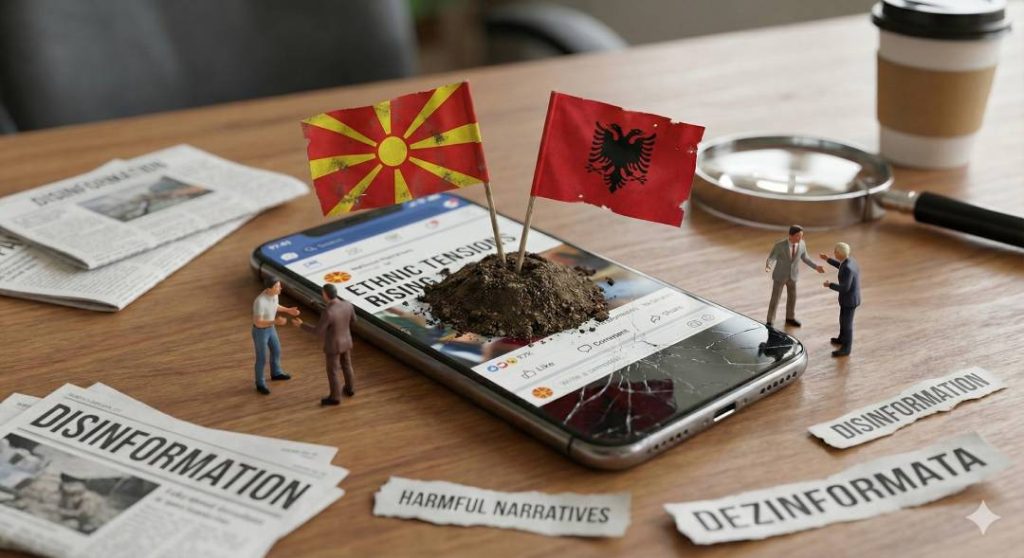
A three-month monitoring of North Macedonia’s online space has revealed an alarming pattern of ethnic polarization as the country heads toward local elections in October 2025. The study, conducted from July through September, documents how social media has become a battleground where ethnic Macedonian and Albanian communities exist in separate information ecosystems with minimal overlap.
Rather than fostering dialogue, the digital landscape has devolved into parallel monologues steeped in hostility. Each ethnic community portrays itself as the victim while casting the other as an existential threat. These toxic narratives have spilled beyond the digital realm into everyday life—affecting interactions on sports fields, in schools, on public transport, and in neighborhoods.
“What appears to be sporadic incidents on social networks is actually a precisely synchronized machinery of disinformation,” notes the report, which analyzed hundreds of viral posts across platforms. The primary aim of these campaigns appears to be transforming ethnic identity into political currency, regardless of the damage to social cohesion.
Among ethnic Macedonians, one dominant narrative centers on fears of losing sovereignty and national identity. The report highlights how a midnight march by the “Ballisti” fan group of the Shkendija football club was reframed through sensationalist media coverage as a quasi-military operation. Bosnian outlet SportSport.ba and subsequently Macedonian media amplified an extreme social media comment claiming “The end is coming for the Slav-Macedonians” by presenting it as an official statement from the fan group.
This narrative reinforces perceptions of Albanians as “aggressors” and feeds into broader stereotypes. An August Facebook post from the page “Misija” satirically suggested that property in predominantly Albanian Aračinovo should cost €4,000 per square meter “because you buy once and have no expenses until the end of your life.” Though framed as humor, the post resonated with existing prejudices about Albanians allegedly not paying for utilities or respecting laws.
In the Albanian community’s online spaces, narratives of systemic discrimination and persecution dominate. The ethnic Albanian political party DUI exploited this sentiment in July when it accused state institutions of “ethnic cleansing” after hiring 25 ethnic Macedonians and only one Albanian at the Ministry of Defense. Despite the hiring being legally compliant, Albanian-language media portrayed it as evidence of a systematic plan to exclude Albanians and create a mono-ethnic state.
Such tensions are easily inflamed by misinformation. In September, unverified claims that an Albanian doctor at Skopje’s Children’s Clinic was forbidden from speaking Albanian spread rapidly across social media. Despite lacking confirmation, the story was widely accepted because it aligned with existing narratives of oppression.
Physical security incidents further heightened community tensions. An August attack in Bitola on a boy wearing a T-shirt with a double-headed eagle (an Albanian symbol) sparked divergent interpretations. Albanian commentators framed it as evidence that they are treated as second-class citizens, while the group behind the attack claimed the incident had no ethnic motivation but was a reaction to what they perceived as a deliberate provocation.
The most concerning aspect identified in the report is how both communities use identical arguments to justify increased radicalization. Both sides claim that authorities apply “double standards,” punishing their community while allowing the other side’s provocations to go unpunished. This creates a cycle where each incident becomes an opportunity to compare grievances rather than condemn violence.
The dehumanizing rhetoric reached disturbing levels following an incident at a youth football match in Shtip where parents physically attacked children. Instead of universal condemnation of violence against minors, social media commenters resorted to ethnic slurs, with some calling Albanians a “savage tribe” while others compared the situation to pre-war Kosovo.
Experts suggest that merely fact-checking disinformation is insufficient when emotions override factual information. The report calls for proactive use of unifying narratives that deconstruct divisive logic, requiring engagement from political leaders who can shift focus from ethnic to civic discourse.
“The real division is not between those who cross themselves and those who bow down,” the report concludes, “but between those who have access to quality public services and those left on the margins.”
As North Macedonia approaches its electoral cycle, addressing these digital divides may prove as crucial to national stability as the political contests themselves.
Fact Checker
Verify the accuracy of this article using The Disinformation Commission analysis and real-time sources.

11 Comments
Nice to see insider buying—usually a good signal in this space.
Good point. Watching costs and grades closely.
Good point. Watching costs and grades closely.
Nice to see insider buying—usually a good signal in this space.
Good point. Watching costs and grades closely.
Good point. Watching costs and grades closely.
Interesting update on Ethnic Disinformation Campaigns Distort Reality Ahead of Elections. Curious how the grades will trend next quarter.
Good point. Watching costs and grades closely.
Good point. Watching costs and grades closely.
I like the balance sheet here—less leverage than peers.
Production mix shifting toward Disinformation might help margins if metals stay firm.