


Listen to the article
A Spanish language radio disinformation monitoring tool created by a Detroit journalist is expanding nationwide and globally, thanks to significant new funding.
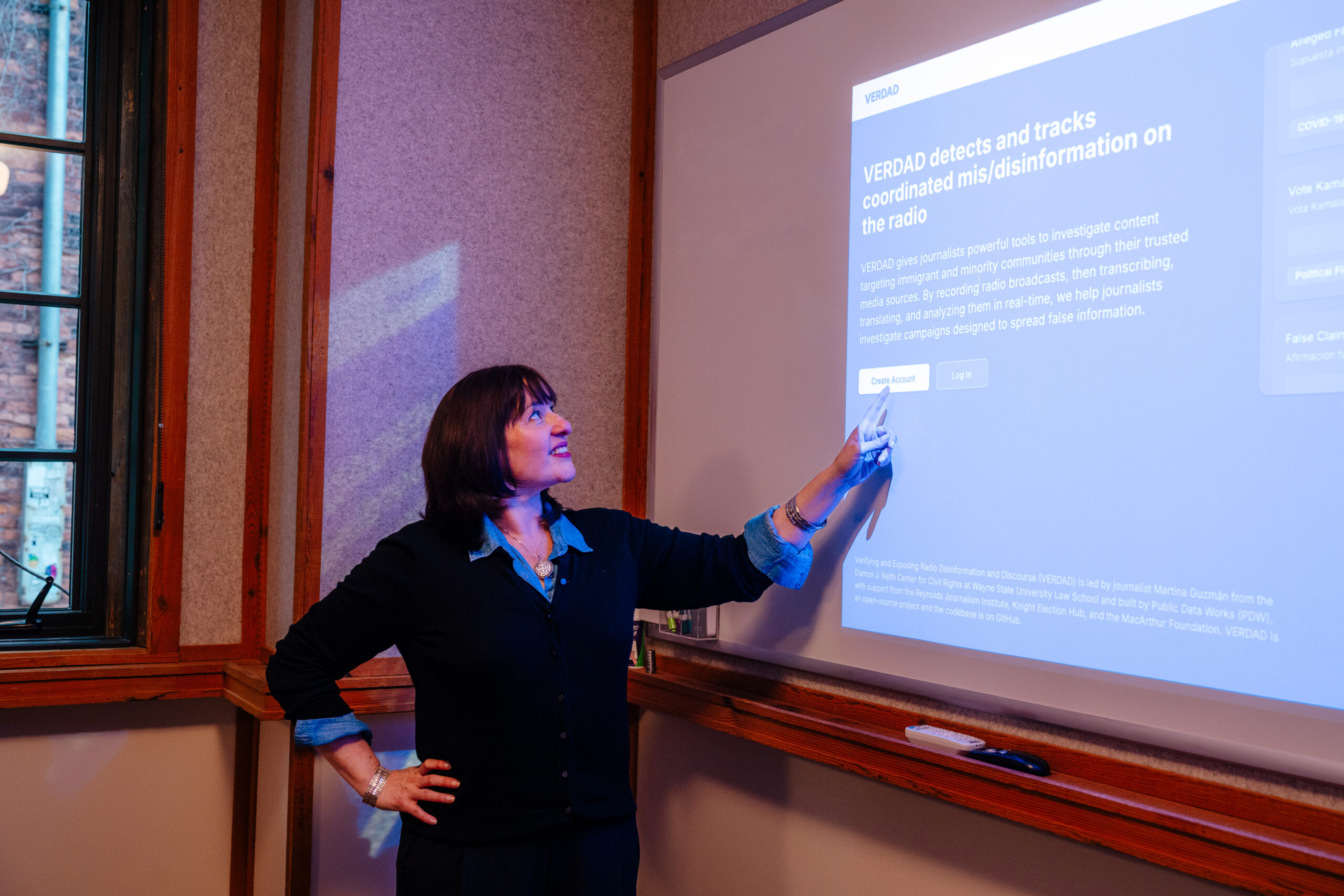
Journalist Martina Guzman, working with Wayne State University’s Damon J. Keith Center for Civil Rights, has developed an AI-powered system called VERDAD (Verifying and Exposing Disinformation and Discourse) that tracks and analyzes misinformation targeting Spanish-speaking audiences through radio broadcasts.
The initiative recently secured a $350,000 grant to extend its reach beyond its initial scope. According to Guzman, who spoke with reporter Nargis Rahman, the expansion will include monitoring in all 50 states, covering multiple languages, and extending to international markets.
The tool comes at a critical time when concerns about misinformation targeting linguistic minorities have increased. Spanish-speaking communities in the United States have been particularly vulnerable to coordinated disinformation campaigns, especially during election cycles and public health crises like the COVID-19 pandemic.
VERDAD represents a technological response to a growing problem that has received less attention than English-language misinformation. Radio remains a particularly important medium for many Spanish-speaking communities across the United States, making it a prime vector for targeted disinformation campaigns.
The Wayne State University Law School’s involvement underscores the legal and civil rights dimensions of combating disinformation. The Damon J. Keith Center, named after the late civil rights champion and federal judge, has increasingly focused on media literacy and information justice as core components of civil rights work in the digital age.
Media experts note that while much attention has been paid to social media disinformation, broadcast radio continues to be an influential medium in many communities, yet has received less scrutiny from fact-checkers and researchers.
The expansion of VERDAD comes amid broader national conversations about disinformation’s impact on democratic processes and public discourse. By focusing on non-English media environments, Guzman’s project addresses a significant gap in existing monitoring systems.
The AI components of the tool likely use natural language processing to identify patterns of misinformation across broadcasts, helping human analysts process large volumes of audio content more efficiently than would be possible through manual monitoring alone.
This development highlights Detroit’s growing role as a center for media innovation and civil rights initiatives. Wayne State’s involvement positions the city at the forefront of efforts to address digital-era challenges to informed civic participation.
Technological solutions like VERDAD represent just one approach to the complex problem of media disinformation. Media literacy advocates emphasize that such tools work best when paired with community education and engagement efforts that build resilience against misleading information.
The project’s expansion into multiple languages reflects the diverse linguistic landscape of the United States and acknowledges that disinformation strategies often target specific cultural and linguistic communities with tailored messaging.
As VERDAD scales up its operations, it will likely face technical challenges in adapting its algorithms to different languages and dialects, as well as varying broadcast formats across regions and countries.
The initiative’s progress will be closely watched by researchers and practitioners in fields ranging from journalism and communication to political science and legal studies, as it represents an innovative intersection of technology, civil rights, and media accountability.
Fact Checker
Verify the accuracy of this article using The Disinformation Commission analysis and real-time sources.

13 Comments
Interesting to see this Detroit-based initiative receiving significant funding to scale up its operations. Tracking and exposing disinformation targeting linguistic minorities is an important and underappreciated challenge.
Agreed. Addressing this issue at the local and regional level, as well as nationally and globally, is essential for strengthening democratic discourse.
The expansion of the VERDAD tool to monitor disinformation in multiple languages and across international markets is a positive development. Combating the spread of misinformation is crucial for informed decision-making.
This new VERDAD tool to monitor Spanish-language disinformation is an important development. Tracking and exposing misinformation targeting minority communities is crucial for preserving democratic discourse.
Agreed, linguistic minorities are particularly vulnerable to coordinated disinformation campaigns. This technology could make a real difference in combating such issues.
It’s good to see funding being allocated to expand the reach of this disinformation monitoring tool. Addressing the spread of misinformation in multiple languages is essential.
Absolutely. Extending the tool’s coverage to all 50 states and international markets is an encouraging step in the right direction.
This is an important initiative, especially given the vulnerabilities of Spanish-speaking communities to election-related and pandemic-related misinformation. Glad to see efforts to address this problem.
Yes, the COVID-19 pandemic has highlighted the urgent need to counter disinformation in diverse language communities. This tool could make a real difference.
I’m curious to learn more about how the VERDAD system works in terms of its AI-powered analysis and tracking capabilities. Technological solutions to combat disinformation are sorely needed.
I’m glad to see that the VERDAD tool is expanding its reach. Disinformation campaigns can have serious consequences, particularly for vulnerable communities. This seems like a promising technological solution.
The VERDAD tool’s ability to track and analyze misinformation in multiple languages is a significant step forward. Ensuring linguistic minorities have access to accurate information is crucial for an informed citizenry.
Absolutely. This initiative could serve as a model for other communities looking to combat the spread of disinformation in their local contexts.