


Listen to the article
Scientists Call for Urgent Action Against Climate Misinformation at COP30
Scientists at the UN Climate Conference (COP30) in Belém, Brazil, have issued an urgent call for coordinated global efforts to combat the rising tide of climate misinformation that threatens to undermine climate policy implementation.
The Union of Concerned Scientists (UCS) highlighted how climate disinformation is proliferating across social media and traditional media platforms, creating significant obstacles to effective climate action while endangering public health and democratic processes.
“Disinformation is everywhere. It’s sophisticated. It’s evolving rapidly,” warned J. Timmons Roberts, Professor of Environmental Studies and Sociology at Brown University and Executive Director of the Climate Social Science Network. “Structural power deploys disinformation to preserve the status quo. The fossil fuel industry spends about 10 times as much as the environmental and renewable energy sectors combined.”
Roberts emphasized that countering disinformation requires understanding the tactics, key actors, and the flow of power behind these campaigns. He advocated for strategic approaches, including “appealing to conservative identities, to the identities of the people you’re speaking to, and using debunking and pre-bunking strategies.”
A global coalition of scientists, civil society organizations, Indigenous Peoples, and faith leaders has published an open letter calling on policymakers to take decisive action against climate misinformation. The letter underscores that both the United Nations and the World Economic Forum have identified climate change and disinformation among humanity’s greatest existential threats.
Ben Backwell, CEO of the Global Wind Energy Council, framed the issue as a matter of public safety rather than free speech. “Governments need to see this as a kind of public safety issue. This is not freedom of speech. This is the control of libraries and communications by very confident people,” he stated.
Backwell pointed to media consolidation as a significant concern, advocating for greater media democratization and support for independent journalism to counter the influence of wealthy interests controlling information channels.
Tuesday’s press conference, held on the conference’s designated “information integrity” day, featured experts highlighting how major social media platforms like Meta, X (formerly Twitter), and TikTok actively contribute to the spread of false climate information.
“Disinformation and misinformation are their business model,” said Pierre Cannet, Global Head of Public Affairs and Policy at environmental law organization ClientEarth. “This is why we are calling on countries to join this effort for information integrity—not just at the conference, but also back home—and to enforce laws that address misinformation and disinformation.”
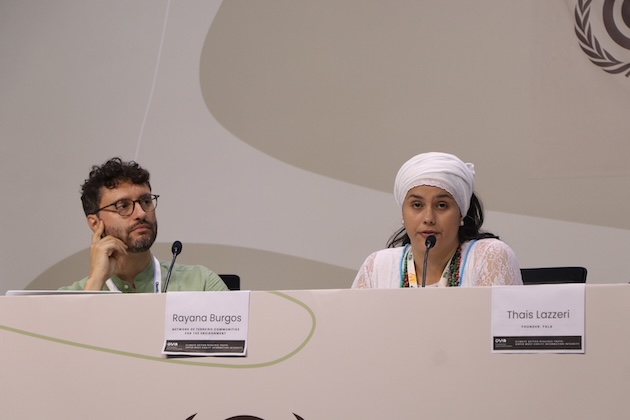
The fossil fuel industry received particular scrutiny for its role in coordinated misinformation campaigns. Brazilian political scientist Rayana Burgos from the Network of Terreiro Communities for the Environment delivered a pointed rebuke: “The fossil fuel industry has polluted our art, and now it’s polluting our information. So, we clearly say: stop the lies, stop the delay.”
Burgos stressed that accurate information is foundational to climate justice. “Without truth, there can be no climate justice or final action,” she said. “We need to act together. Access to information is a human right.”
The calls for action come as climate misinformation tactics grow increasingly sophisticated. Research presented at the conference demonstrated how various actors exploit digital platforms to sow doubt about climate science and delay meaningful policy implementation.
The UCS and allied organizations are advocating for a multi-pronged approach that includes stronger platform regulations, enhanced media literacy programs, and greater transparency about funding sources behind climate communications.
As COP30 progresses, the battle against climate misinformation has emerged as a critical component of broader climate action strategies, with experts emphasizing that even the most ambitious climate policies will fail without an informed public and honest public discourse.
Fact Checker
Verify the accuracy of this article using The Disinformation Commission analysis and real-time sources.

14 Comments
This is a critical challenge for the climate justice movement. Countering well-funded disinformation campaigns will require innovative strategies and cross-sector collaboration. I hope the COP30 conference leads to meaningful progress on this front.
Agreed. Building public trust in climate science and policy solutions is essential. Grassroots efforts to educate and empower citizens should complement high-level policy initiatives.
It’s alarming to see the fossil fuel industry exploiting disinformation tactics to preserve the status quo. We need to expose these tactics and ensure that climate policy is guided by facts, not corporate propaganda.
This is a wake-up call for all of us. Climate disinformation is a threat to public health, democracy, and the planet. We must come together to demand accountability, transparency, and evidence-based policymaking.
Tackling climate disinformation is critical for climate justice. Fossil fuel interests have deep pockets to spread misinformation and obstruct climate action. We need a coordinated global effort to counter these tactics with facts and evidence-based policies.
Absolutely. The role of social media in amplifying climate disinformation is very concerning. Fact-checking and media literacy efforts will be key to combating this challenge.
This is a crucial moment for the climate justice movement. Addressing disinformation head-on is essential for achieving meaningful progress on climate action. I’m hopeful that the COP30 conference can chart a path forward.
This is a sobering wake-up call. The scale and sophistication of climate disinformation campaigns is alarming. We must be vigilant and support initiatives that elevate scientific consensus over corporate propaganda.
Agreed. Holding the fossil fuel industry accountable for funding these disinformation efforts should be a priority. Transparency and public awareness are crucial for effective climate action.
Disinformation is a formidable obstacle to climate justice. I hope the experts at COP30 can develop effective strategies to counter these sophisticated campaigns and elevate the voices of frontline communities and youth activists.
Absolutely. Empowering diverse stakeholders and centering their perspectives will be crucial for building a more equitable and sustainable future.
The scale and impact of climate disinformation is deeply concerning. I hope the experts at COP30 can develop innovative, multilateral approaches to combat this challenge and accelerate the transition to a sustainable, just future.
Agreed. Building broad-based coalitions and strengthening media literacy efforts will be key to disrupting the disinformation ecosystem and empowering citizens to make informed decisions.
Climate change is a complex issue, but the scientific evidence is clear. I’m concerned about how disinformation sows doubt and confusion, undermining the urgent need for policy changes. We must champion truth over falsehoods.