


Listen to the article
US Report Highlights Chinese Disinformation Campaign Following India-Pakistan Conflict
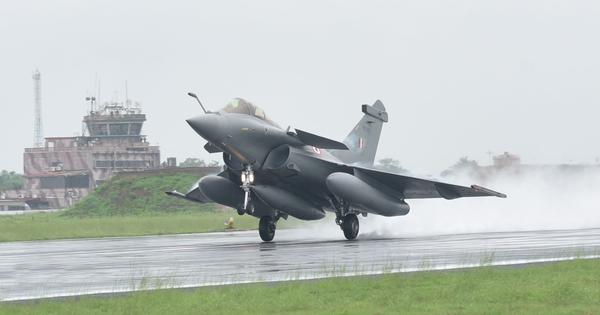
The United States government has acknowledged reports of China launching a sophisticated disinformation campaign after the May conflict between India and Pakistan, according to a newly released congressional report. The campaign allegedly aimed to undermine sales of French Rafale fighter jets while promoting China’s own J-35 aircraft.
The annual report by the US-China Economic and Security Review Commission, submitted to Congress on Tuesday, details how China used fake social media accounts to spread AI-generated photos purporting to show debris from Indian fighter jets supposedly destroyed by Chinese weapons.
“Pakistan’s use of Chinese weapons to down French Rafale fighter jets used by India became a particular selling point for Chinese embassy defence sales efforts,” the report stated. This claim persisted “despite the fact that only three jets flown by India’s military were reportedly downed and all may not have been Rafales.”
The commission cited a July Associated Press article quoting French Air Force chief General Jérôme Bellanger, who indicated he had seen evidence of three Indian fighter jet losses: a Rafale, a Russian-made Su-30MKI, and a Mirage 2000, the latter also being French-manufactured but of an earlier generation.
According to French intelligence cited in the report, China’s campaign extended beyond fake photos to include “video game images” designed to discredit the Rafale while promoting China’s J-35, a fifth-generation fighter jet currently being inducted into the Chinese People’s Liberation Army Air Force. Pakistan is reportedly planning to acquire these jets as well.
While the US commission stopped short of labeling the May conflict a “proxy war” between India and China, saying such a designation “may overstate China’s role as an instigator,” it did note that Beijing “opportunistically leveraged” the situation to showcase its weapons. The report added that Pakistani military operations relied heavily on Chinese intelligence support.
This assessment aligns with statements made in July by Lieutenant General Rahul R Singh, the deputy Indian Army chief, who claimed Pakistan received real-time intelligence from China regarding India’s military deployments during Operation Sindoor. Singh noted that 81% of Pakistan’s military hardware acquired over the past five years came from China, describing the arrangement as “like a live lab available to them.”
The four-day conflict began on May 7 when Indian forces launched Operation Sindoor, targeting alleged terrorist camps in Pakistan and Pakistan-occupied Kashmir. This military action came in response to an April 22 terror attack in Jammu and Kashmir’s Pahalgam that killed 26 people. The two nations reached a ceasefire agreement on May 10.
Conflicting claims surround aircraft losses during the engagement. Pakistan has asserted it shot down Indian fighter jets in air-to-air combat, though these claims remain unverified by independent sources. India has acknowledged suffering aircraft losses but has not specified the exact number.
Indian Defence Secretary RK Singh told CNBC-TV18 in July that reports of multiple Rafale losses were “absolutely not correct,” while the Indian Air Force has claimed it downed five Pakistani aircraft, including F-16s (US-manufactured) and JF-17s (Chinese-made). In August, Indian Air Force Chief AP Singh further stated that one large Pakistani aircraft—either an electronic intelligence plane or an airborne early warning system—was also shot down.
Pakistan has not confirmed losing any aircraft but has acknowledged that several of its airbases were struck during the hostilities.
The US report’s revelations underscore the complex geopolitical dynamics in South Asia, where military conflicts increasingly serve as showcases for competing weapons systems and provide opportunities for information warfare campaigns with significant commercial implications for global defense markets.
Fact Checker
Verify the accuracy of this article using The Disinformation Commission analysis and real-time sources.

8 Comments
It’s concerning to see the extent to which China is willing to go to undermine the Rafale jets. This type of coordinated disinformation campaign is a worrying trend that warrants close monitoring and response.
Interesting to see the US government taking note of this alleged Chinese disinformation campaign targeting the Rafale jets. It highlights the ongoing geopolitical tensions and information warfare between the major powers.
Agreed, the use of fake social media accounts and AI-generated content to sway public opinion is quite concerning. Transparency and fact-checking are crucial in today’s information landscape.
This highlights the ongoing battle for influence and narratives in the global arms trade. The Rafale jet sales are clearly a sensitive issue, and China seems willing to employ underhanded tactics to undermine its competitors.
The revelation of this Chinese disinformation campaign is a timely reminder of the need for vigilance and critical thinking when consuming information, especially on topics related to national security and military capabilities.
Exactly, we must be wary of attempts to sway public opinion through the use of false or misleading information. Fact-checking and maintaining a healthy skepticism are essential in these matters.
The claim about Pakistan using Chinese weapons to down Indian Rafale jets seems dubious, given the conflicting reports on the actual number of jets lost. Disinformation can be a powerful tool in modern conflicts.
Absolutely, verifying the accuracy of such claims is critical. It’s troubling to see the lengths that countries will go to in order to gain an advantage, even if it means spreading misinformation.