


Listen to the article
China Conspiracy Claims Surge Amid South Korea’s Political Turmoil
Following former President Yoon Suk Yeol’s failed attempt to impose martial law last year, South Korea plunged into its deepest political crisis in decades, creating an environment where disinformation flourished. Among the most persistent narratives that emerged was the claim that China had orchestrated Yoon’s downfall.
Right-wing forums, popular YouTubers, and even lawmakers amplified accusations that Beijing had infiltrated anti-Yoon protests, funded his impeachment campaign, and manipulated online opinion ahead of the June snap election that brought opposition leader Lee Jae Myung to power.
Yoon himself legitimized these suspicions during televised remarks last December when defending his failed decree. “Forces linked to North Korea and China are threatening our democracy from within,” he warned, lending credibility to the growing anti-China sentiment.
However, an AFP Fact Check investigation examining the most widespread claims found no substantial evidence supporting these allegations. Experts instead point to domestic political rivalries and pre-existing anti-China sentiment as the primary drivers of this narrative.
“There used to be goodwill toward China, a sense of economic partnership,” explained Ha Nam-suk, a professor at the University of Seoul. “But as competition deepened and cultural disputes intensified, frustration turned into resentment. Politicians understood that, and some used it as a convenient rallying tool.”
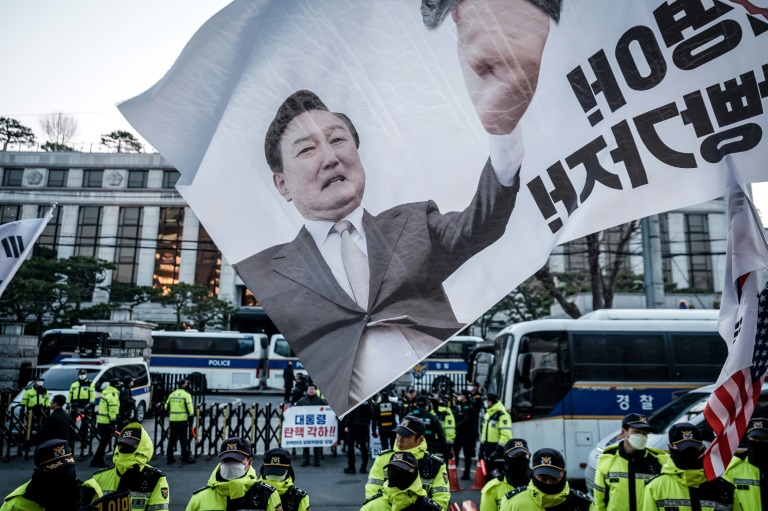
The tensions eventually spilled onto Seoul’s streets this autumn, with demonstrators waving flags and chanting slogans against “Chinese infiltration.”
Among the most notable falsehoods was a claim that “99 Chinese spies” had been arrested at the National Election Commission (NEC) and subsequently flown to Okinawa by the US military. AFP’s investigation revealed the photos used to support this claim actually depicted Chinese fishermen detained for illegal fishing in 2016. Both the NEC and US Forces Korea dismissed these reports as “entirely false,” yet the claim continued circulating through pro-Yoon networks and was even referenced by his lawyer before the Constitutional Court.
“Younger Koreans already had strong resentment toward China over cultural and historical issues,” Ha noted. “After Yoon’s impeachment, online influencers weaponized that resentment, turning frustration into political identity.”
The Constitutional Court itself became entangled in the conspiracy theories when a doctored image purportedly showed top judge Moon Hyung-bae “swearing allegiance before a Chinese flag.” The original photograph, taken by news agency Yonhap, actually featured South Korea’s flag. When the Court unanimously voted to remove Yoon from office in April, these rumors gained further traction among supporters who believed the judiciary had been “compromised.” Surveys conducted early this year indicated public distrust in the court had risen beyond 40 percent.
After Lee won the presidency, similar themes resurfaced with posts falsely claiming that The Guardian had reported China helped Lee win. The actual article cited a White House official’s general concerns about Chinese influence in democracies without any reference to South Korea’s election. Nevertheless, conservative lawmaker Yoo Sang-bum amplified the narrative, claiming Chinese nationals “heavily participated in pro-impeachment rallies.”
More recently, the Justice Ministry’s introduction of a visa-free program for Chinese group tourists in August provoked additional tensions. Former Prime Minister Hwang Kyo-ahn alleged the program was a plot to enable fraud in next year’s elections, despite the National Election Commission’s clarification that only foreigners with at least three years of permanent residency can vote in local elections.
Kim Hee-gyo, a professor at Kwangwoon University, observed that with Yoon no longer in power, hard-liners needed a new focus for their discontent. “They filled the vacuum by constructing an external enemy, turning general anti-China feeling into ideological sinophobia,” he explained.
The phenomenon extends beyond South Korea’s borders, according to Professor Ha, who warned: “Across democracies, we’re watching crusade-style politics take root — where one side must die for the other to survive.”
Fact Checker
Verify the accuracy of this article using The Disinformation Commission analysis and real-time sources.

16 Comments
This is a complex issue, with domestic political factors seemingly playing a bigger role than external interference. I wonder how it will impact South Korea’s economic and resource policies going forward.
Good point. The fallout from this crisis could have ripple effects on the mining and energy sectors in the region, depending on how South Korea’s policies evolve.
Interesting to see how the allegations against China gained traction, even without substantial evidence. This speaks to the power of disinformation in shaping political narratives.
Yes, it’s a cautionary tale about the potential for disinformation to distort public discourse, even in advanced democracies. Rigorous fact-checking and media literacy are crucial.
The mining and commodities sectors can certainly be impacted by geopolitical tensions and disinformation campaigns. It’s important to scrutinize claims and rely on reputable sources.
Absolutely, fact-checking is crucial to cut through the noise, especially when it comes to sensitive issues like this involving major powers like China.
Disinformation is a serious challenge, and it’s worrying to see how it can destabilize democratic institutions. I hope South Korea is able to address the root causes of this crisis.
Agreed. Strengthening democratic resilience and fact-based policymaking will be crucial to mitigate the impact of such disinformation campaigns in the future.
This crisis highlights the need for greater media literacy and critical thinking around online information, especially when it comes to sensitive topics like China-South Korea relations.
You’re right. Equipping the public with the tools to identify and counter disinformation should be a priority for policymakers and media outlets.
The mining and energy sectors are often intertwined with geopolitics, so it’s important to closely monitor developments like this. Maintaining objectivity and relying on credible sources is key.
Absolutely. Investors and industry stakeholders need to stay vigilant and fact-check claims, especially when it comes to politically charged issues that could affect commodity markets.
The mining and energy sectors are often shaped by geopolitical factors, so developments like this are worth following closely. Maintaining an objective, evidence-based perspective is key.
Agreed. Investors and industry analysts need to be diligent in separating fact from fiction, especially when it comes to claims that could impact commodity prices and market dynamics.
Interesting to see how disinformation can fuel political crises, even in developed democracies like South Korea. Curious to learn more about the role of anti-China sentiment in these dynamics.
Yes, the allegations against China’s involvement seem to lack substantial evidence based on the fact-checking. Domestic political rivalries appear to be the primary driver here.