


Listen to the article
Tensions Persist as South Korea Marks Martial Law Anniversary
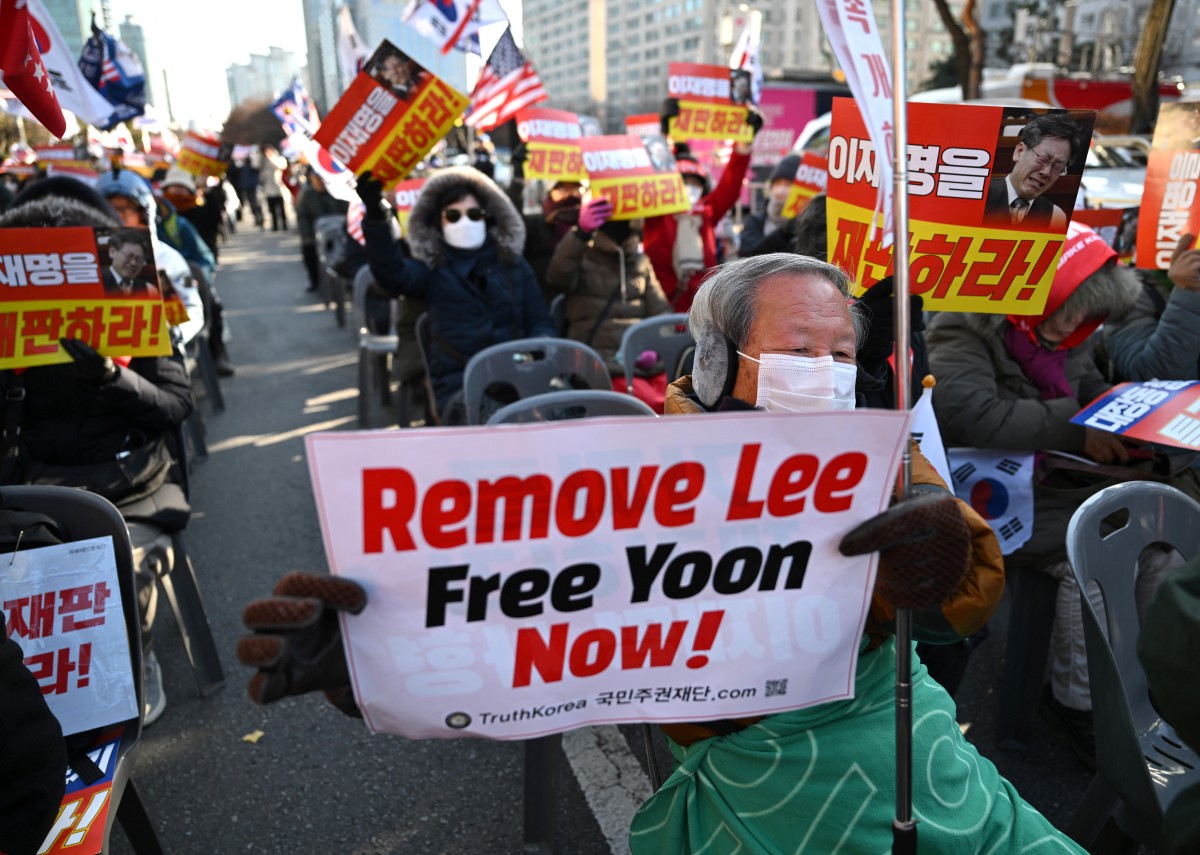
Hundreds of demonstrators gathered outside South Korea’s National Assembly in Seoul yesterday, marking the first anniversary of former President Yoon Suk Yeol’s controversial declaration of martial law. Protesters, many carrying placards reading “Remove Lee, Free Yoon now!” demanded the release of the former president and the removal of current leader President Lee Jae-myung.
The demonstration highlights the continuing political divide that has gripped the nation since the dramatic events of December 2024, when Yoon declared martial law amid escalating tensions with North Korea and domestic political turmoil. That decision, which Yoon’s supporters claim was necessary for national security, led to his impeachment by the National Assembly two months later and his subsequent removal from office.
Political analysts note that the anniversary comes at a particularly sensitive time for South Korea’s democracy. “What we’re seeing today is the unresolved trauma of last year’s constitutional crisis,” explained Dr. Kim Min-ji, a political science professor at Seoul National University. “The country remains deeply polarized between those who view Yoon’s actions as an attempted power grab and those who believe he was acting in the national interest.”
The martial law declaration, unprecedented in modern South Korean history, followed allegations that North Korean operatives had infiltrated several government agencies. Critics, however, pointed to Yoon’s declining popularity and his administration’s corruption scandals as the real motivation behind the move.
Current President Lee Jae-myung, who took office after a special election in April 2025, has faced persistent challenges in uniting the country. His administration has promised investigations into the previous government’s actions, while Yoon remains in detention awaiting trial on charges of abuse of power and violating the constitution.
“The rally today represents a significant portion of the population that feels disenfranchised by recent political developments,” said Park Sung-min, a political consultant in Seoul. “About 30 percent of South Koreans still support the former president and view his detention as politically motivated.”
The controversy has had measurable impacts on South Korea’s economy and international standing. Foreign direct investment decreased by 15 percent in the first half of 2025, while the Korean won has experienced periodic volatility. Major corporations like Samsung and Hyundai have publicly called for political stability to prevent further economic damage.
Internationally, the political crisis has complicated South Korea’s strategic relationships. The United States, a key ally, has expressed concern about the political instability while maintaining diplomatic ties with the new administration. Meanwhile, North Korea has exploited the situation through increased propaganda claiming the South’s democracy is failing.
“What’s particularly concerning is how this political division affects South Korea’s security posture,” noted Jean Park, a security expert at the Korea Institute for Defense Analyses. “At a time when regional tensions are high, internal political cohesion is more important than ever.”
The protesters yesterday represented various conservative groups and former military officials who support Yoon. They were met by a smaller counter-demonstration supporting the current administration, though police maintained separation between the groups to prevent confrontations.
Legal experts expect Yoon’s trial to begin early next year, potentially reigniting tensions. Constitutional Court Justice Choi Jin-wook, speaking in a personal capacity at a recent legal forum, suggested that the case would “test the resilience of South Korea’s democratic institutions.”
As South Korea approaches the end of 2025, the political wounds from last year’s crisis show few signs of healing. With presidential elections scheduled for 2027, political observers warn that the country’s polarization may continue to deepen unless both conservative and progressive leaders work toward reconciliation.
“What we’re witnessing isn’t just about Yoon or Lee,” concluded Professor Kim. “It’s about the future direction of South Korean democracy and whether the country can move beyond personality politics toward addressing the substantial challenges it faces both domestically and internationally.”
Fact Checker
Verify the accuracy of this article using The Disinformation Commission analysis and real-time sources.

8 Comments
Disinformation can certainly fan the flames of geopolitical tensions. It’s concerning to see the lingering divisions in South Korea over last year’s events. Maintaining democratic stability will require bridging these divides through open and honest dialogue.
It’s troubling to see the lasting impact of last year’s constitutional crisis in South Korea. Rebuilding trust and unity in the face of disinformation and deep political polarization will be a significant challenge for the country’s leaders.
Absolutely, restoring faith in democratic institutions will be critical. Hopefully, the South Korean people can come together to find a constructive path forward.
Disinformation can be a powerful weapon, capable of sowing discord and undermining stability, as this situation in South Korea demonstrates. Tackling the spread of false narratives will be essential for the country to heal and move past this turbulent period.
This is a complex situation with a lot of history and emotion involved. I’m curious to learn more about how disinformation campaigns may have contributed to the escalation of tensions between China and South Korea. Understanding the role of information warfare will be important.
Marking the anniversary of such a tumultuous event is sure to be a sensitive and charged affair. The South Korean government will need to tread carefully to avoid further inflaming divisions while still allowing for legitimate political expression and debate.
The martial law declaration and subsequent impeachment of the former president seem to have left deep scars in South Korean politics. Hopefully, the country can find a way to move forward and heal these wounds through lawful and peaceful means.
You’re right, reconciliation will be crucial. Unresolved trauma like this can fester and destabilize a democracy if not addressed properly.