


Listen to the article
South Korea’s Political Turmoil Fuels Anti-China Conspiracy Theories
South Korea’s worst political crisis in decades has become fertile ground for widespread disinformation, with China emerging as the central villain in a web of conspiracy theories. Following former President Yoon Suk Yeol’s failed attempt to impose martial law in December 2024 and his subsequent impeachment, a narrative portraying Beijing as the puppet master behind his downfall has gained remarkable traction.
The conspiracy theory began spreading through right-wing online forums and was quickly amplified by influential YouTubers and opposition politicians. Claims that China had infiltrated protests, funded Yoon’s impeachment campaign, and manipulated public opinion ahead of the June election that brought Lee Jae Myung to power resonated widely across social media platforms.
Yoon himself contributed to these suspicions during a televised address defending his martial law decree, warning that “forces linked to North Korea and China are threatening our democracy from within.”
However, an extensive review of the most prevalent claims about Beijing’s influence found no substantive evidence to support them. Experts instead describe the phenomenon as a reflection of domestic political divisions combined with South Korea’s growing anti-China sentiment.
“There used to be goodwill toward China, a sense of economic partnership,” explained Ha Nam-suk, a professor at the University of Seoul. “But as competition deepened and cultural disputes intensified, frustration turned into resentment. Politicians understood that, and some used it as a convenient rallying tool.”
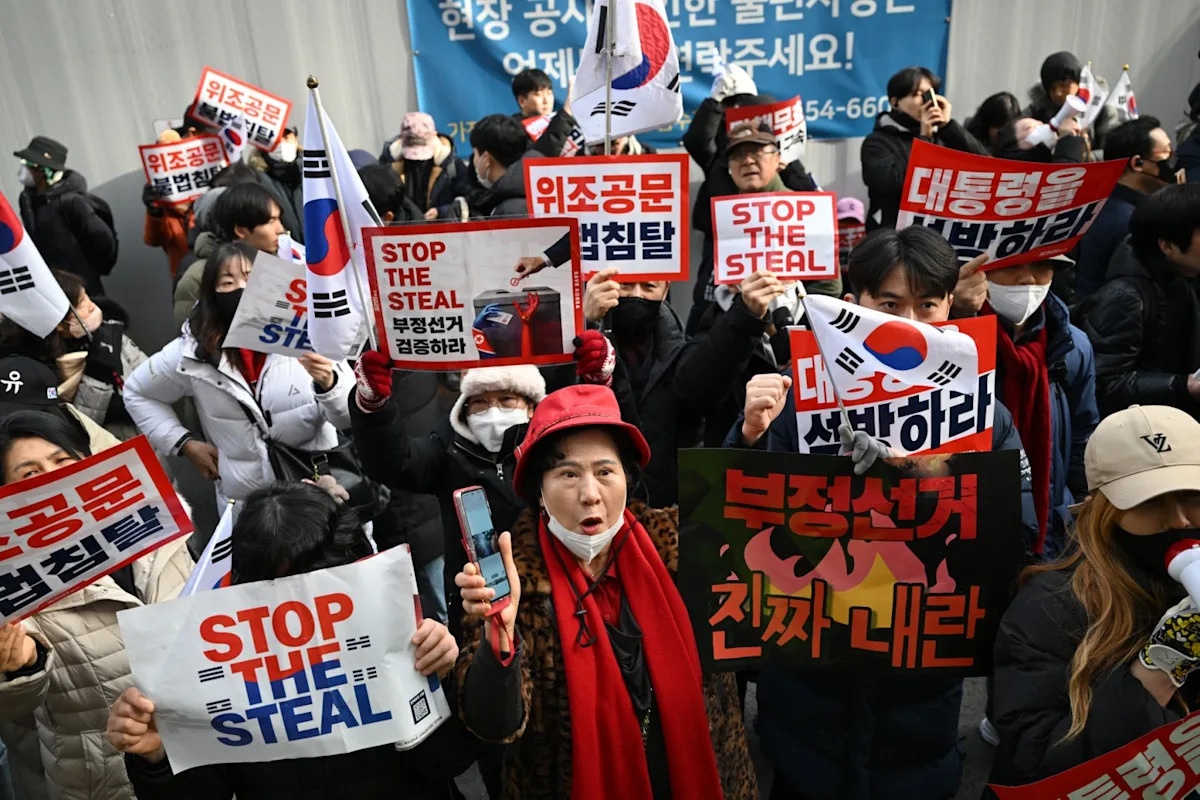
The anti-China narrative has had real-world consequences. Throughout August and September, small right-wing groups took to Seoul’s streets, waving flags and chanting against “Chinese infiltration.” Recent surveys indicate increasingly negative perceptions of China among South Koreans, while Chinese residents report facing growing discrimination and harassment.
The “99 Chinese Spies” Hoax
The disinformation campaign gained momentum in January, shortly after Yoon’s impeachment. Right-wing YouTuber Shin In-kyun claimed “99 Chinese spies” had been arrested at the National Election Commission (NEC) and were flown to Okinawa by the U.S. military. The story spread rapidly through fringe forums like Ilbe and DC Inside before being picked up by conservative media outlet Sky eDaily and circulating widely on Facebook.
Investigation revealed the supposed evidence—photographs of detained Chinese nationals—actually showed fishermen arrested for illegal fishing in 2016. Both the NEC and U.S. Forces Korea explicitly denied these reports, calling them “entirely false.”
Nevertheless, the false narrative gained such traction that Yoon’s lawyer later referenced it during proceedings at the Constitutional Court.
“Younger Koreans already had strong resentment toward China over cultural and historical issues,” Professor Ha explained. “After Yoon’s impeachment, online influencers weaponized that resentment, turning frustration into political identity.”
Courts Become Targets
By February, conspiracy theories turned toward South Korea’s Constitutional Court. Justice Moon Hyung-bae, who oversaw Yoon’s impeachment trial, became the target of doctored images allegedly showing him “swearing allegiance before a Chinese flag.” The original Yonhap photograph clearly showed South Korea’s flag.
Despite the obvious manipulation, the rumor gained traction among Yoon supporters who believed the judiciary had been “compromised.” Public distrust in the courts rose beyond 40 percent in early-year surveys.
The heightened suspicion contributed to violence in January when pro-Yoon protesters stormed the Seoul Western District Court, which had issued Yoon’s arrest warrant. Their actions were fueled by growing belief in an elaborate political conspiracy.
Anti-Yoon demonstrations also became targets for disinformation. When protesters in central Seoul displayed multilingual posters explaining the impeachment situation to tourists—including in Chinese, English, Thai and Japanese—the Chinese-language version was singled out as “proof” that China had orchestrated Yoon’s downfall.
Election Conspiracies
When opposition leader Lee won the June presidential election, the anti-China narrative reached new heights. Social media posts falsely claimed The Guardian had reported Chinese interference in the election. In reality, the article merely cited a White House official’s general concerns about Chinese influence in democracies worldwide, without any specific reference to South Korea’s vote.
Though baseless, these claims drew tens of thousands of interactions across Facebook and YouTube. “Once those stories took hold, they became symbols of something larger,” said Kim Hee-gyo, a professor at Kwangwoon University. “You see banners from far-right groups and even some opposition People Power Party figures using identical language—that kind of coordination doesn’t happen by chance.”
Immigration Policy Fuels Further Conspiracy
In the latter half of 2025, the disinformation campaign shifted focus to immigration policy. When the Justice Ministry introduced a visa-free program for Chinese group tourists ahead of the APEC summit, former prime minister Hwang Kyo-ahn claimed it was a plot to enable election fraud.
“The local elections next year are on June 3,” Hwang wrote on Facebook. “I can already smell (the ruling party’s) plan to commit election fraud by mobilizing Chinese people en masse.”
The National Election Commission quickly clarified that only foreigners with at least three years of permanent residency can vote in local elections, making such fraud impossible. Nevertheless, additional rumors spread claiming all Chinese nationals could enter South Korea without passports or health checks—claims the Justice Ministry immediately labeled “completely false.”
As South Korea continues navigating its political turbulence, experts warn that the weaponization of anti-China sentiment represents a dangerous trend. “When you see protesters in Seoul shouting at Chinese residents, it feels chillingly familiar,” Professor Ha said. “This isn’t just a Korean problem. Across democracies, we’re watching crusade-style politics take root—where one side must die for the other to survive.”
Fact Checker
Verify the accuracy of this article using The Disinformation Commission analysis and real-time sources.

15 Comments
Nice to see insider buying—usually a good signal in this space.
Good point. Watching costs and grades closely.
Interesting update on China Disinformation’s Role in South Korea’s Year of Political Turmoil. Curious how the grades will trend next quarter.
Good point. Watching costs and grades closely.
If AISC keeps dropping, this becomes investable for me.
I like the balance sheet here—less leverage than peers.
Good point. Watching costs and grades closely.
Good point. Watching costs and grades closely.
Production mix shifting toward Disinformation might help margins if metals stay firm.
Good point. Watching costs and grades closely.
The cost guidance is better than expected. If they deliver, the stock could rerate.
Interesting update on China Disinformation’s Role in South Korea’s Year of Political Turmoil. Curious how the grades will trend next quarter.
Good point. Watching costs and grades closely.
If AISC keeps dropping, this becomes investable for me.
Good point. Watching costs and grades closely.