


Listen to the article
Canada’s border agency on Tuesday affirmed its commitment to protecting staff from threats and harassment, but with a significant qualification—only if incidents occur “at work or as a direct result of their duties.”
The Canada Border Services Agency (CBSA) was responding to explosive allegations from an officer who claims the department abandoned him after India used him in a targeted disinformation campaign.
In a lawsuit filed in Ottawa last week, veteran border officer Sandeep Singh Sidhu alleged the Indian government falsely branded him a terrorist as retaliation against Canada amid escalating diplomatic tensions between the two nations.
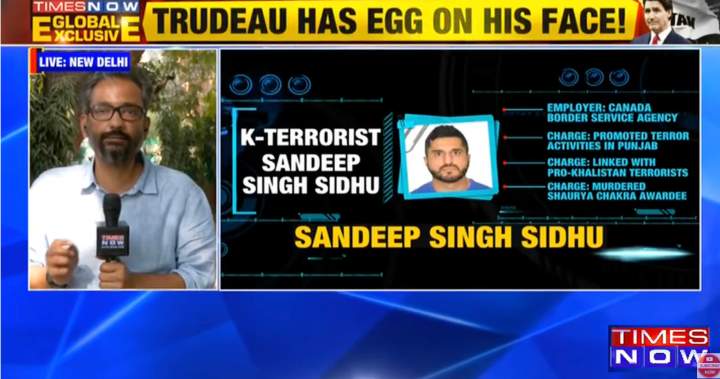
According to court documents, after Canada accused India of assassinating British Columbia Sikh leader Hardeep Singh Nijjar in 2023, Indian media outlets countered with reports claiming Sidhu was wanted for a fatal 2020 terrorist attack while simultaneously being employed by the Canadian government.
The news reports, which sourced allegations to India’s National Investigation Agency (NIA) counter-terrorism police, used a photograph of Sidhu that he had provided exclusively to the Indian government when applying for a travel visa.
Indian press coverage portrayed Canada’s alleged employment of a supposed terrorist in a national security position as “hypocrisy” that undermined Ottawa’s criticism of New Delhi.
Sidhu, who has served as a border officer for two decades, maintains he has never been involved in terrorism. He believes India targeted him because he has a common Sikh name and holds a visible, uniformed position within Canada’s national security apparatus.
The consequences of these allegations were severe. Sidhu faced threats from supporters of Indian Prime Minister Narendra Modi, including a disturbing post on X that displayed his Abbotsford, B.C., home address with the message, “Go and kill him.”
When Sidhu informed CBSA supervisors and requested assistance, his superiors allegedly told him the matter was not work-related and declined to provide support, according to the lawsuit.
The CBSA, in a statement responding to questions about the case, said it had received the lawsuit on December 2 and therefore could not comment specifically, but affirmed its general policy: “The Canada Border Services Agency is committed to protecting, supporting, and assisting employees and their families if they face harassment, assault, or threats against them or their property, while at work or as a direct result of their duties.”
Jeffrey Kroeker, one of Sidhu’s Toronto-based lawyers, strongly disputed the agency’s position, arguing that the Indian government targeted his client precisely because of his CBSA uniform.
“The CBSA knew the risk was real, especially since Mr. Sidhu brought the matter to the CBSA’s attention and because the very reason for the misinformation campaign was about Canada accusing India for conducting assassinations on Canadian soil,” Kroeker said.
The lawyer added: “The CBSA clearly knew his life was at risk precisely because he was a CBSA officer and wearing the uniform of Canada, and they did nothing to help him. Worse, they mocked him, made his matters worse and turned their backs on him at his most vulnerable moment of need.”
The Indian High Commission in Ottawa has not responded to requests for comment about the case, and Indian news outlets contacted by Global News have similarly remained silent.
While the Canadian government has reportedly cleared Sidhu of India’s allegations, finding them baseless, he continues to struggle with the aftermath of what his lawyers described as “an orchestrated misinformation campaign.”
The case unfolds against the backdrop of longstanding Indian efforts to characterize Canada as harboring terrorists who support independence for Khalistan, the Sikh-majority Punjab region in India. Although the Canadian Security Intelligence Service maintains that only a small fraction of Khalistan supporters are extremists, India has consistently portrayed the matter as a significant security threat and demanded action.
Relations between the two countries deteriorated sharply following the June 2023 killing of Hardeep Singh Nijjar and other violent incidents linked to Indian agents, which prompted Canada to expel diplomats suspected of involvement in these attacks.
Recently, Prime Minister Mark Carney has sought to repair diplomatic ties with India, hoping to negotiate a trade deal amid new tariffs imposed by the White House on Canadian exports. Whether this high-profile legal case will complicate these efforts remains to be seen.
Fact Checker
Verify the accuracy of this article using The Disinformation Commission analysis and real-time sources.

21 Comments
The cost guidance is better than expected. If they deliver, the stock could rerate.
Good point. Watching costs and grades closely.
Good point. Watching costs and grades closely.
Uranium names keep pushing higher—supply still tight into 2026.
Nice to see insider buying—usually a good signal in this space.
Good point. Watching costs and grades closely.
Good point. Watching costs and grades closely.
The cost guidance is better than expected. If they deliver, the stock could rerate.
Good point. Watching costs and grades closely.
Exploration results look promising, but permitting will be the key risk.
Nice to see insider buying—usually a good signal in this space.
Good point. Watching costs and grades closely.
Good point. Watching costs and grades closely.
Exploration results look promising, but permitting will be the key risk.
The cost guidance is better than expected. If they deliver, the stock could rerate.
Good point. Watching costs and grades closely.
Good point. Watching costs and grades closely.
I like the balance sheet here—less leverage than peers.
Good point. Watching costs and grades closely.
Good point. Watching costs and grades closely.
Silver leverage is strong here; beta cuts both ways though.