


Listen to the article
Global Stock Markets Plunge as Tech Sell-off Spreads from Wall Street
Asian and European markets tumbled sharply on Tuesday as concerns over inflated valuations in artificial intelligence stocks triggered a significant sell-off. Benchmarks in Tokyo and Seoul plummeted more than 3%, following Monday’s losses in U.S. markets where Nvidia and other AI-related shares led the decline.
The futures for the S&P 500 and the Dow Jones Industrial Average both indicated further weakness, down 0.3% ahead of the U.S. market open. This suggests Wall Street may continue its downward trend as investors recalibrate expectations.
Market sentiment has been particularly fragile ahead of Nvidia’s earnings report scheduled for Wednesday. The chip giant, which has been at the center of the AI investment boom, has seen its stock price skyrocket nearly 40% this year despite Tuesday’s 1.8% decline. Concerns that AI stock valuations have become detached from fundamentals have created volatility across global markets, with outsized impacts on economies heavily reliant on semiconductor exports.
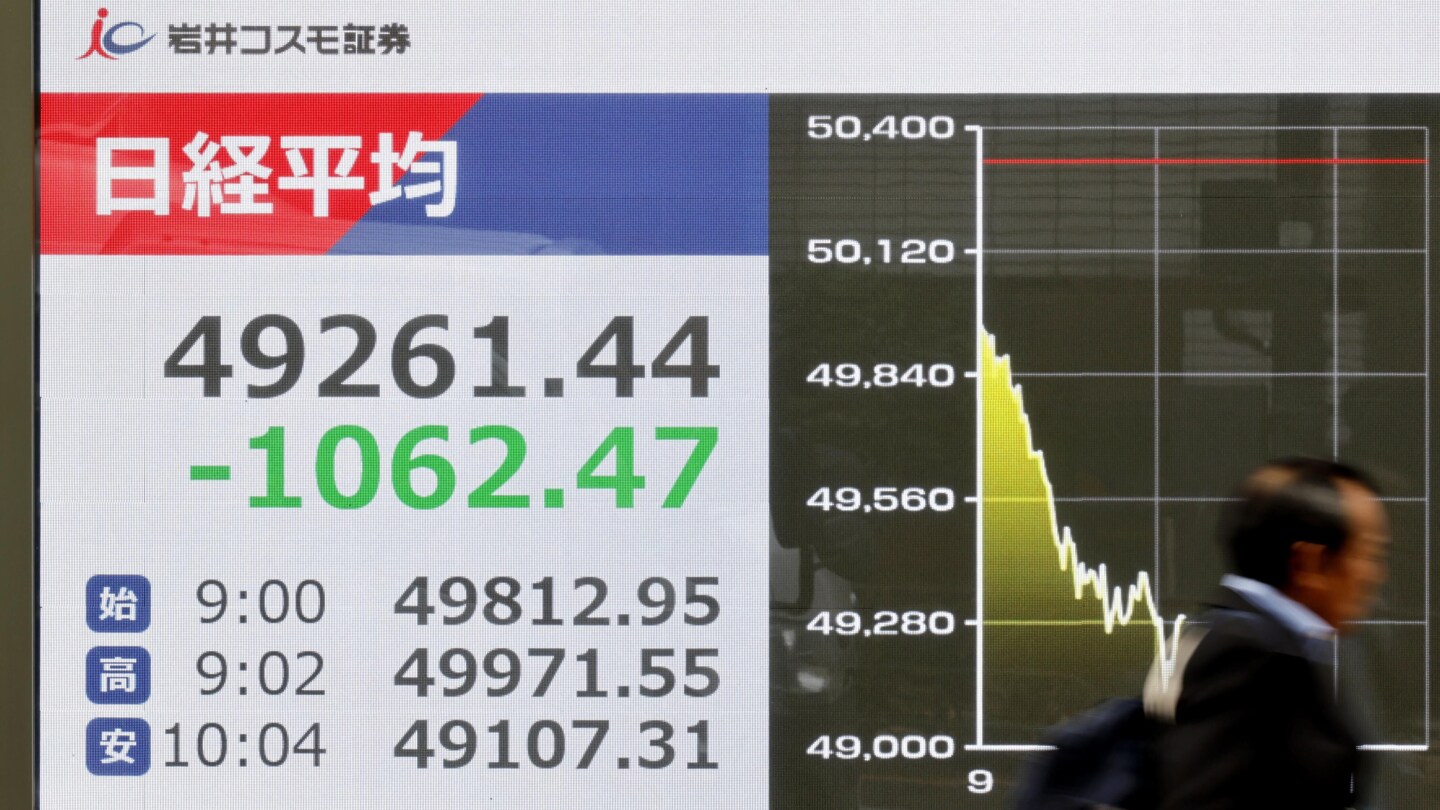
In Asia, Japan’s Nikkei 225 dropped 3.2% to 48,702.98, with technology shares bearing the brunt of the selling. Tokyo Electron plunged 5.5% while Advantest fell 3.7%. South Korea’s Kospi suffered an even steeper decline of 3.3%, with Samsung Electronics dropping 2.8% and chip manufacturer SK Hynix plummeting 5.9%.
Taiwan, home to TSMC, the world’s largest contract chip manufacturer, saw its Taiex index fall 2.5% as TSMC shares declined by 2.8%. Chinese markets also felt the pressure, with Hong Kong’s Hang Seng down 1.7% and Shanghai’s Composite index losing 0.8%.
European markets followed the downward trajectory, with Germany’s DAX falling 1.3%, France’s CAC 40 declining 1.4%, and Britain’s FTSE 100 dropping 1%.
Adding to investor anxiety is the looming release of delayed U.S. employment data on Thursday. The figures, postponed due to the recent government shutdown, could significantly impact Federal Reserve policy decisions regarding interest rates. A robust jobs report would likely discourage further rate cuts, while weak employment numbers might heighten concerns about economic stability.
Japanese markets faced additional pressure as yields on 30-year government bonds surged to 3.31%, reflecting increased risk perception as Prime Minister Sanae Takaichi prepares to boost government spending and delay plans to reduce Japan’s substantial national debt. The yen traded above 155 to the U.S. dollar, near its highest level since February, and reached its lowest point against the euro since the unified European currency launched in 1999.
Beyond technology stocks, other recent high-momentum market sectors experienced significant declines. Bitcoin extended its recent slide, trading down 1% at $91,100 early Tuesday, dragging cryptocurrency-related stocks lower. Coinbase Global fell 7.1% and Robinhood Markets dropped 5.3% in Monday’s U.S. session.
Market analysts have been warning that U.S. stocks could be vulnerable to a correction after their sharp rise since April, which has left many valuations appearing stretched. The S&P 500 fell 0.9% on Monday, continuing its retreat from the all-time high set late last month.
Adding complexity to the market outlook is the Federal Reserve’s approach to interest rates. While expectations had been for continued rate cuts to support a slowing job market, persistent above-target inflation presents a policy challenge. With limited economic data due to the government shutdown, some Fed officials have suggested a wait-and-see approach until December for greater clarity.
In commodity markets, oil prices showed modest declines, with U.S. benchmark crude dropping 19 cents to $59.72 per barrel, while Brent crude, the international standard, fell 21 cents to $63.99 per barrel.
Fact Checker
Verify the accuracy of this article using The Disinformation Commission analysis and real-time sources.

10 Comments
The AI investment frenzy has certainly created some frothy conditions. Prudent investors will want to watch for signs of overcorrection and potential opportunities.
The reliance of some economies on semiconductor exports makes them particularly vulnerable to these types of swings in the tech sector. Diversification may be key for weathering these storms.
Curious to see how the major indices perform in the US today. The AI investment boom has certainly created some bubbles that now need to be deflated.
It will be interesting to see if this tech-led downturn spreads further or if it remains relatively contained. A lot depends on the broader economic conditions.
Semiconductor-dependent economies like Japan and South Korea are feeling the pinch. This highlights the need for greater diversification and resilience in the global supply chain.
Interesting to see the ripple effects of the US tech downturn spreading to other markets. It highlights how interconnected the global economy has become.
That’s a good point. Overvaluation in one sector can quickly become a broader market issue. Prudent risk management will be crucial for investors navigating this volatility.
The tech sell-off is certainly causing some jitters in global markets. Investors will be closely watching Nvidia’s earnings report for signs of how AI stocks are faring.
This sell-off underscores the importance of fundamental analysis, even in the era of disruptive technologies. Separating hype from real value will be critical for investors.
Well said. Maintaining discipline and a clear-eyed view of valuations is crucial when market exuberance takes over.