


Listen to the article
European Markets Rise While Asia Retreats as Investors Navigate US Government Shutdown
Shares advanced across European markets on Tuesday, contrasting with a retreat in Asian trading, as investors showed resilience amid the latest developments in ending the U.S. government shutdown.
The markets displayed minimal reaction after the Senate passed legislation to reopen the government, suggesting the news had already been priced into investor expectations. In Europe, Germany’s DAX rose 0.2% to 24,015.97, while France’s CAC 40 gained 0.7% to 8,109.23. Britain’s FTSE 100 showed the strongest performance, jumping 1% to 9,887.95.
Meanwhile, U.S. futures pointed to a potentially softer opening, with S&P 500 futures down 0.2% and Dow Jones Industrial Average futures edging 0.1% lower.
Market analysts note that recent volatility reflects ongoing concerns about technology share valuations, particularly surrounding artificial intelligence stocks. Some market watchers have drawn parallels to the 2000 dot-com bubble, suggesting current tech valuations may have risen too rapidly.
“Sentiment is everything,” said Ipek Ozkardeskaya of Swissquote. “It’s how investors perceive the news: if they’re in a good mood, they interpret it positively; if they’re in a bad mood, they see it negatively. One picture, one word, one data point is enough to twist and turn market mood.”
In Asia, markets showed mixed performance. Japan’s Nikkei 225 edged down 0.1% to 50,842.93, with technology giant SoftBank Group dropping 2% after announcing it had sold its entire stake in AI chip maker Nvidia last month for $5.83 billion. This divestment by a major institutional investor comes at a time when the AI sector faces increased scrutiny over valuations.
The U.S. dollar strengthened against the Japanese yen, reaching 154.37, near its highest level since February. Analysts attribute the yen’s weakness partly to expectations that Japan’s government will delay plans to reduce its national debt in favor of increased spending.
Chinese markets finished mixed, with Hong Kong’s Hang Seng index rallying late to gain 0.2%, closing at 26,696.41, while the Shanghai Composite index declined 0.4% to 4,002.76. South Korea’s Kospi recovered from last week’s sell-off, closing 0.8% higher at 4,106.39, while Australia’s S&P/ASX 200 dropped 0.2% to 8,818.80.
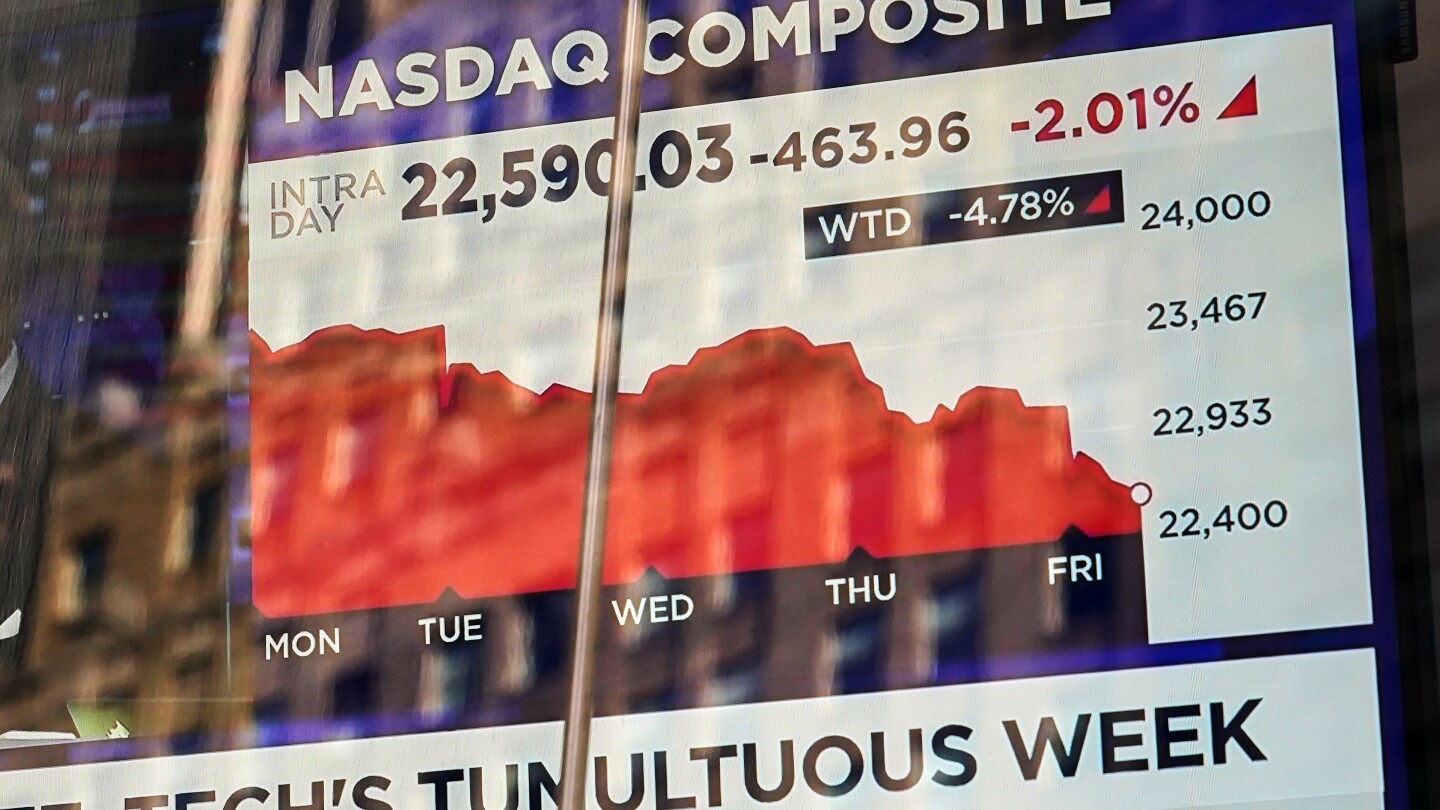
The previous day on Wall Street saw a robust recovery, with technology stocks leading the rebound. The S&P 500 climbed 1.5%, the Dow Jones Industrial Average rose 0.8%, and the tech-heavy Nasdaq composite rallied 2.3%. Nvidia was the standout performer, surging 5.8% after being among the leaders of last week’s market decline.
However, several health insurers faced pressure amid uncertainty about whether Washington will extend expiring healthcare tax credits—a key sticking point in negotiations that has contributed to the longest government shutdown in U.S. history.
Berkshire Hathaway slipped 0.4% following comments from CEO Warren Buffett, who warned shareholders that many other companies would likely outperform Berkshire in coming decades due to the conglomerate’s massive size. The 95-year-old investing legend is set to step down in January.
Corporate earnings continue to influence market sentiment, with approximately 80% of S&P 500 companies that have reported results for the summer quarter exceeding analysts’ profit expectations, according to FactSet. Strong earnings performance has been crucial for companies to justify their elevated stock prices following the rally since April.
In commodity markets, U.S. benchmark crude oil fell 31 cents to $59.82 per barrel, while Brent crude, the international standard, dropped 29 cents to $63.77 per barrel.
As markets navigate these cross-currents, investors remain focused on the resolution of the U.S. government shutdown, potential Federal Reserve interest rate cuts, and whether the technology sector’s valuations can be sustained by fundamental performance.
Fact Checker
Verify the accuracy of this article using The Disinformation Commission analysis and real-time sources.

6 Comments
The Senate’s vote to end the government shutdown is a positive step, but the markets seem cautious. Tech valuations and volatility remain key concerns for investors.
The mixed reactions across global markets suggest investors are navigating the latest developments with a measured approach. Maintaining sentiment will be crucial going forward.
Agreed. Ongoing uncertainty around technology stocks and their valuations seems to be weighing on investor confidence at the moment.
This news highlights the complex and interconnected nature of global markets. Investors will need to stay nimble and adapt to the evolving landscape.
It’s interesting to see the divergence between the European and Asian markets in their responses to the US government reopening. Market analysts will be closely watching for any long-term trends.
The potential for a parallel to the dot-com bubble is certainly a concern that investors will need to monitor closely. Prudence and caution seem warranted in the current environment.