


Listen to the article
As tensions mount along the Iran-Iraq border, families find themselves cut off from loved ones, their connections severed by intensifying military presence and disrupted telecommunications.
In Iraq’s Kurdish region, Yaser Fattahi anxiously awaits brief, precious calls from his mother in Iran. A trained nurse who fled Iran in December after treating wounded anti-government protesters, Fattahi now relies on an elaborate system to maintain contact with his family.
“The calls last a minute or two,” Fattahi explained from Sulaymaniyah in Iraq’s Kurdish region. “She tells me to take care of myself, and that they are okay.”
These connections require his cousin to travel perilously close to the border, where he can catch an Iraqi cell signal. Using two phones—one with an Iraqi SIM card and another connected to Iranian networks—the cousin briefly bridges the gap between mother and son.
Four days have passed since their last conversation, leaving Fattahi constantly checking his phone, his concern growing with each passing hour.
The border between Iran and northern Iraq’s Kurdish region has historically been relatively porous, characterized by family connections, trade, and smuggling operations. Recent escalations have transformed this once-vibrant boundary zone into a militarized frontier, with Iranian forces significantly bolstering their presence to prevent incursions by Iranian Kurdish militant groups.
Those who venture near the border seeking cell signals risk being shot, according to local activists. Others resort to smuggled Starlink connections, paying exorbitant prices just to maintain contact with loved ones.
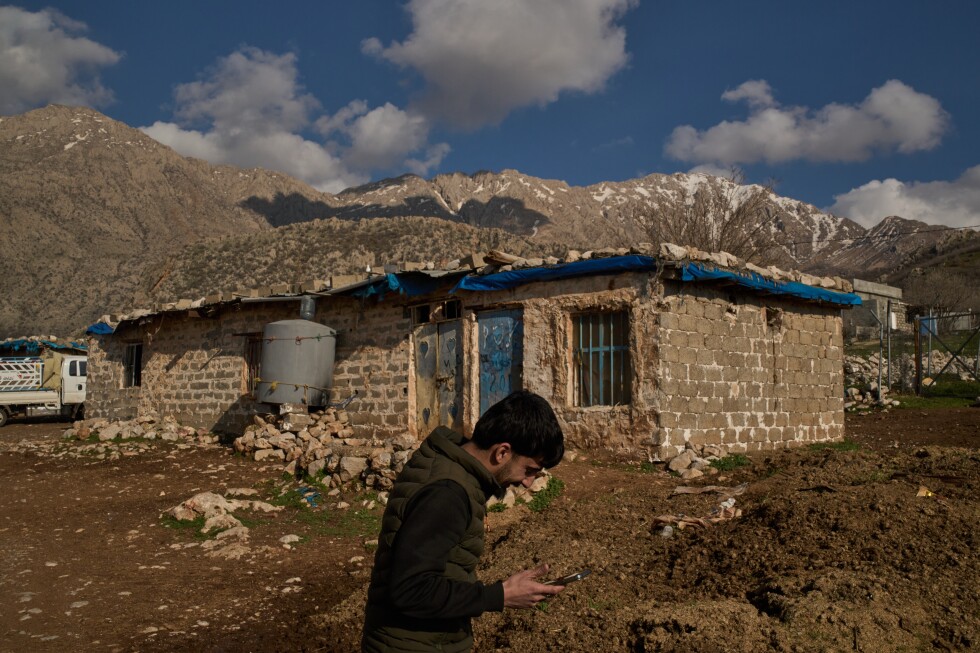
In the mountainous Iraqi district of Byara, family traditions that once spanned the border have been abruptly halted. Nyan Fayaq, a 25-year-old law student, helped prepare an iftar meal during Ramadan while thinking about relatives in the Iranian city of Saqqez whom she hasn’t been able to reach for over a month.
Born in Iran but raised in Iraq following her parents’ divorce, Fayaq reconnected with her Iranian uncles after 18 years. Now that tenuous connection has been severed again.
“They have electricity, gas and water, but everything has become very expensive,” she said, referencing economic impacts of the conflict.
An Iranian Kurdish man working in Iraq, who requested anonymity, recently returned to his hometown of Merivan to bring his wife to safety in Iraq. He reports that Iranian security forces have moved out of their bases—many reportedly destroyed by airstrikes—and into schools and gyms, against local residents’ wishes.
The conflict has also paralyzed the work of kolbars—cross-border smugglers who transport goods across Iran’s western provinces. Operating in a legal gray zone, these porters risk death from border guards, harsh weather, and treacherous terrain to deliver cigarettes, electronics, and clothing. They sometimes also help people cross the border, particularly Iranian Kurds without passports or asylum-seekers hoping to reach Europe.
Bilal Osman, a 25-year-old kolbar continuing a family tradition passed down through generations, recounts the dangers of his profession. “Sometimes a lot of soldiers are stationed along the border. If they see us, they shoot, beat us, or throw stones. Our life is hard, but this is how we make money to feed our families,” he explained.
Since the war began, his work has come to a standstill. Near Halabja, he tends to his mules and waits for word from Iranian kolbars that never comes.
“The kolbars simply can’t cross. We are always ready, but the borders are tightly controlled,” Osman said. According to him, Iranian forces have “brought cameras for each spot, increased soldiers from five to thirty at each location, and now even place soldiers between checkpoints.”
Shiwa Hassanpour, an activist with the human rights monitor Hengaw Organization based in Iraq’s Kurdish region, reports that people have been shot merely for approaching the border, as Iranian forces suspect them of espionage.
Gathering information from inside Iran has become increasingly challenging. Locals depend on costly virtual private networks (VPNs) to report events and send videos, slowing the flow of news. Hassanpour herself has been unable to contact her family for over three weeks.
She describes a dramatic increase in Islamic Revolutionary Guard deployments across Iran’s Kurdish region, with a sharp rise in mobile checkpoints, vehicle searches, and violence against civilians—particularly after Iranian Kurdish opposition groups announced a coalition.
The financial burden of maintaining contact is substantial. Using a VPN costs approximately $25, while communicating with relatives abroad can cost up to $50—amounts beyond the means of most residents. Some pay premium rates for access to smuggled Starlink connections.
According to Hassanpour, Iran has targeted cell towers operated by Iraqi telecommunication companies near the border and ordered security forces to shoot anyone approaching these areas. Authorities have also reportedly arrested people caught with VPN apps, accusing them of espionage.
Meanwhile, Fattahi continues his vigil, waiting for news from his mother. Their infrequent calls, often distorted by static and wind, provide minimal but essential reassurance.
“It’s hard to hear her,” he said. “But it’s enough.”
Fact Checker
Verify the accuracy of this article using The Disinformation Commission analysis and real-time sources.

8 Comments
This is a heartbreaking situation for families caught in the crossfire of geopolitical tensions. The disruption of basic communication channels must be extremely distressing. I hope the border situation de-escalates soon so people can reconnect with their loved ones.
This is a heartbreaking example of how geopolitical tensions can tear apart communities and disrupt people’s daily lives. I feel for the families separated by the military presence and severed communications. Restoring those basic connections should be a priority.
Agreed, the human toll is the most tragic part of this situation. Families shouldn’t have to resort to such risky measures just to briefly speak with loved ones.
This is a complex geopolitical situation, but the disruption to basic communication and freedom of movement for local residents is deeply troubling. I hope the authorities on both sides can work to restore normalcy and allow families to reconnect.
It’s concerning to see how the military buildup and conflict along the Iran-Iraq border is impacting civilian life and severing family connections. The elaborate workarounds people have to use to stay in touch are a stark reminder of the human toll of these tensions.
You’re right, the human impact is the most tragic part of this. Families shouldn’t have to resort to such risky measures just to briefly speak with each other.
The breakdown in telecommunications and ability to travel freely across the Iran-Iraq border must be incredibly isolating and distressing for the people living there. Maintaining family ties and access to medical care during this conflict seems extremely challenging.
The impact on civilians trying to maintain family connections across the Iran-Iraq border is truly saddening. I hope the authorities can find ways to restore basic communication channels and free movement for local residents caught in the middle of this conflict.