


Listen to the article
Venezuela and Guyana Face Off at World Court Over Resource-Rich Territory
Venezuela vigorously defended its claim to the disputed Essequibo region at the International Court of Justice on Wednesday, arguing that the mineral-rich territory was fraudulently taken from it during the colonial era and should be resolved through a 1966 agreement rather than international court proceedings.
During hearings at The Hague, Venezuela’s representative Samuel Reinaldo Moncada Acosta rejected the court’s jurisdiction in the case, claiming it was “erroneously imposed” in a 2020 decision. He emphasized that Venezuela considers the 1966 Geneva Agreement the proper framework for resolving the territorial dispute with neighboring Guyana.
“Guyana presents itself as the true, legitimate heir to British and Dutch territories, but the reality is that it is the beneficiary of colonial dispossession, formalized through fraudulent arbitration,” Moncada told the court. “The Geneva Agreement seeks to correct this century-old injustice.”
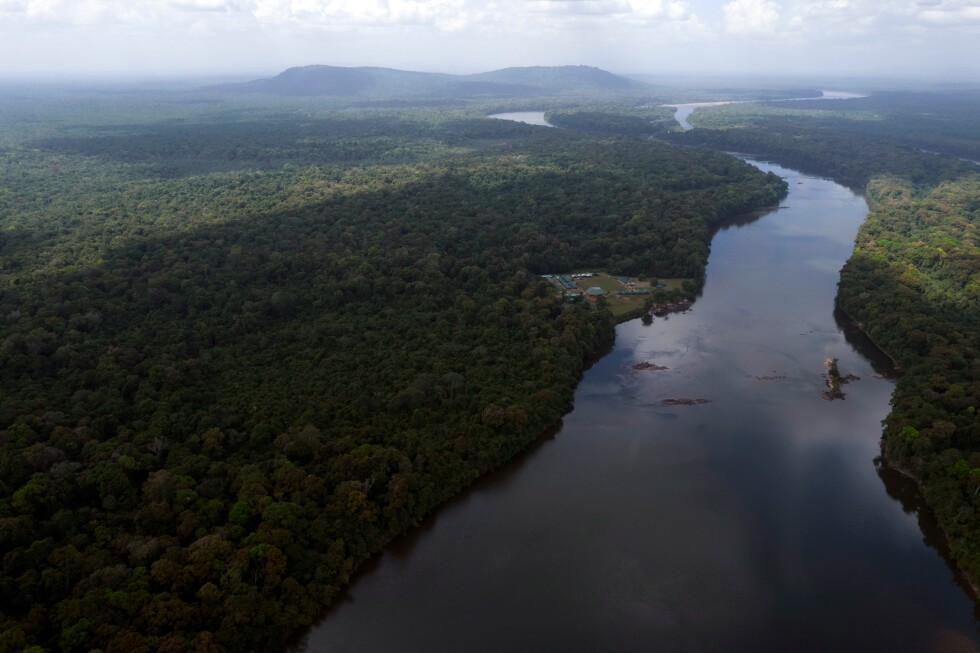
The territorial dispute centers on the Essequibo region, which spans approximately 160,000 square kilometers (61,800 square miles) and represents about 70% of Guyana’s current territory. The area is rich in natural resources, including gold, diamonds, and timber, and lies adjacent to significant offshore oil deposits discovered in recent years by ExxonMobil and its partners.
Guyana has rapidly transformed from one of South America’s poorest nations to potentially one of its wealthiest on a per capita basis due to these oil discoveries, making the territorial dispute increasingly consequential for both countries’ economic futures.
The roots of the conflict date back to the 19th century. In 1899, arbitrators from Britain, Russia, and the United States drew a border along the Essequibo River that largely favored what was then British Guiana (now Guyana). The United States represented Venezuela during these proceedings, as Venezuela had previously severed diplomatic relations with Britain.
Venezuela has long maintained that this 1899 decision was fraudulent, arguing that the American and European arbitrators conspired to deprive Venezuela of its rightful territory. Venezuela contends that the region has been part of its territory since the Spanish colonial period.
The dispute gained renewed attention in 1966 when Guyana gained independence from Britain and the Geneva Agreement was signed to establish a framework for resolving the territorial claim. Venezuela argues this agreement effectively nullified the earlier arbitration.
Guyana’s foreign minister, Hugh Hilton Todd, opened the week-long hearings on Monday by emphasizing the significance of the dispute for his nation, describing it as “a blight on our existence as a sovereign state from the very beginning.”
The case has taken on greater urgency in recent years as Venezuela has become increasingly assertive about its claim, especially after the discovery of massive oil reserves offshore Guyana. In December 2023, Venezuelan President Nicolás Maduro held a referendum in which voters overwhelmingly supported declaring the Essequibo region part of Venezuela, raising regional tensions.
International observers are closely watching the proceedings, as the dispute has implications not only for the two countries involved but also for regional stability and international energy markets. Major oil companies with interests in Guyana’s offshore fields, including ExxonMobil, Hess, and CNOOC, are monitoring developments closely.
The International Court of Justice, the United Nations’ highest court, is expected to take several months to issue its final ruling in the case, which will be legally binding on both parties. However, concerns remain about enforcement mechanisms should either country reject the court’s decision.
As the hearings continue through the week, legal experts note that the case represents a complex intersection of historical colonial boundaries, international law, and modern resource politics in a region increasingly significant to global energy markets.
Fact Checker
Verify the accuracy of this article using The Disinformation Commission analysis and real-time sources.

8 Comments
As an energy and mining analyst, I’m closely watching this case. The Essequibo region likely contains significant natural resources like gold, diamonds, and other valuable minerals. Whoever controls this territory will have a major economic advantage.
It will be interesting to see if the World Court decides it has jurisdiction over this dispute, or if they rule it should be settled through the 1966 Geneva Agreement process.
This is a complex geopolitical issue with economic implications. Venezuela is clearly trying to regain control of territory it believes was unjustly taken. Guyana will fight hard to retain the Essequibo region that it has administered for decades.
This territorial dispute goes back centuries. It’s complicated with colonial-era agreements and claims. Curious to see how the World Court rules on the jurisdiction and merits of Venezuela’s case against Guyana.
The resource-rich Essequibo region is clearly a valuable piece of real estate. No wonder both countries are vigorously defending their claims.
The facts and history behind this territorial dispute seem murky. Both countries appear to have valid arguments and concerns. Hopefully the World Court can help bring clarity and a peaceful resolution to this long-running conflict.
Venezuela’s claim that the Essequibo region was ‘fraudulently taken’ during the colonial era raises some valid historical concerns. However, Guyana has controlled the territory for decades and developed it. This will be a tough case to resolve.
The Geneva Agreement from 1966 seems like a reasonable framework to try and resolve this longstanding territorial dispute between the two countries.