


Listen to the article
Cuba’s First Solar Charging Station Transforms Lives Amid Energy Crisis
In the heart of Santa Clara, Cuba, a groundbreaking solar-powered charging station is revolutionizing daily life for locals struggling with persistent power outages and fuel shortages. The free “solinera,” believed to be Cuba’s first such facility, has become a lifeline for residents like Yudelaimys Barrero Muñoz.
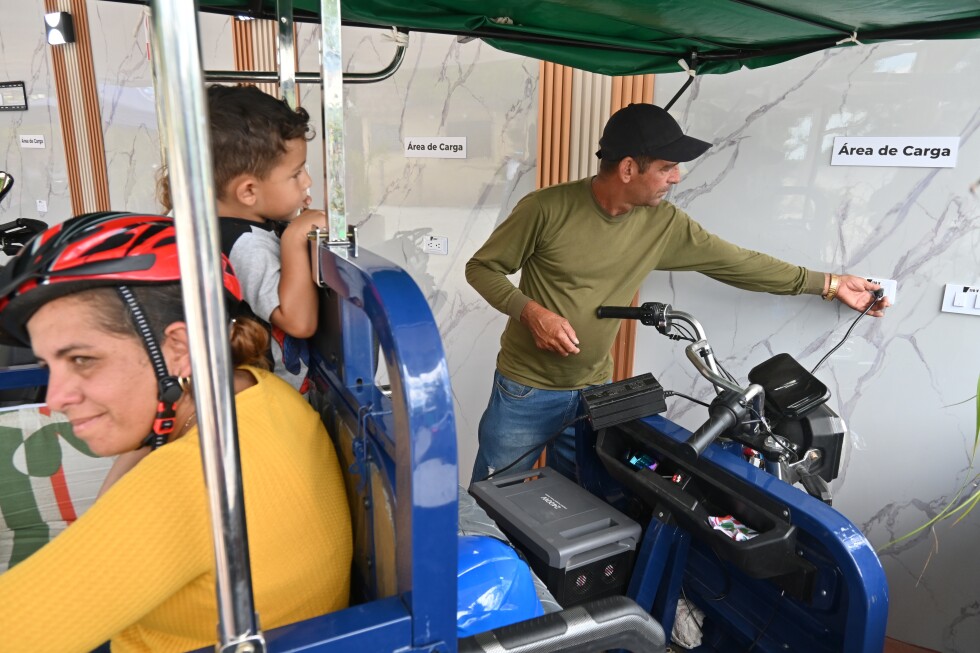
Until recently, Barrero Muñoz would spend hours under the scorching Cuban sun, desperately waving money at passing vehicles, hoping for a ride from Cienfuegos to Santa Clara. The 43-mile journey, impossible on her husband’s bicycle and later challenging with a three-wheeled electric vehicle with limited battery capacity, was necessary to purchase supplies she resells to support her family of four.
That changed in early April when a local business owner unveiled the solar station. “They have solved many problems for many people,” Barrero Muñoz said, explaining how the station has transformed her small business. Now able to reliably charge their three-wheeler, she and her husband can transport larger quantities and varieties of goods. “I have more clients because I have more merchandise,” she said with evident relief.
The station provides 30 kilowatts of solar energy with a 60-kilowatt battery storage system—roughly equivalent to powering an average American home for a day. With 20 sockets for appliances, 16 charging spots for vehicles, and 12 areas dedicated to cooking, the facility has quickly become a community hub.
This innovation emerges against the backdrop of Cuba’s severe energy challenges. The island nation has intensified its renewable energy efforts amid chronic blackouts and a gas shortage exacerbated by U.S. sanctions. While renewable sources now account for approximately 10% of Cuba’s electricity—up from 3.6% in 2014—distribution remains limited, and few citizens can afford personal solar systems. By comparison, renewable energies like solar, wind, and hydropower generate over 30% of global electricity, according to energy think tank Ember.
The impact of these energy shortages is starkly visible on the highway from Havana to Santa Clara, where cars are largely absent, and horse-drawn carts have become a common sight, particularly in rural areas where Cuba’s economic crises typically hit hardest.
Santa Clara itself, home to nearly a quarter million people, is historically significant as the site of a key battle led by revolutionary icon Ernesto “Che” Guevara during Cuba’s 1959 Revolution. Today, his remains rest in a mausoleum in the city known for both Guevara and philanthropist Marta de los Ángeles González Abreu y Arencibia.
For residents like Danailys Arboláez Pérez, a 32-year-old mother who sells food and beverages from her home, the solar station has brought newfound stability. Despite living in a home with electricity, she often cooks at the station to save on natural gas and recharges fans for her two young children as Cuba’s temperatures rise.
“Almost everyone in this neighborhood goes there,” she said, appreciating the relief from what she describes as last year’s “apocalyptic” power outages. “We’re not running around so much,” she added. “I cook slowly, calmly. If the power goes out, I’ll just take the pot there.”
Alexander Gutiérrez Altuve, who works at the business that financed the station, noted the unprecedented nature of the project. “This is something that hadn’t really been done before,” he said. His colleague, Lisandra Couto Pérez, who tracks usage, mentioned that some people are initially hesitant to use the facility. “They are truly surprised when you tell them that it’s free,” she explained.
For families like Barrero Muñoz’s, the solar station represents more than just practical benefits—it offers newfound freedom. Her husband, Lorenzo Ravelo, became emotional describing how their three-wheeler, now reliably charged, allows them to take their children to the beach or quickly access medical care without borrowing money to rent a car.
“It’s a great solution,” Ravelo said, his voice breaking slightly as he contemplated the improvements to their quality of life—a small yet significant bright spot amid Cuba’s continuing economic challenges.
Fact Checker
Verify the accuracy of this article using The Disinformation Commission analysis and real-time sources.

15 Comments
This is a great example of how renewable energy solutions can have a tangible, positive impact on people’s daily lives. The ability to charge electric vehicles is crucial, especially for small businesses.
I’d be curious to know if this station was developed with any government support or if it was a fully private initiative. Either way, it’s an impressive accomplishment.
This is a great example of how targeted, community-level renewable energy projects can make a real difference in people’s lives. Kudos to the local business owner who spearheaded this solar charging station.
The challenges that Cubans face with power outages and fuel shortages sound incredibly difficult. This solar charging station seems like a clever, community-driven solution to help address those issues.
It’s heartening to see how this simple solar charging station can have such a meaningful impact on individuals and small businesses in Cuba. Renewable energy solutions like this hold a lot of promise.
I’d be interested to know if this is part of a broader effort to expand renewable energy infrastructure in Cuba. Integrating distributed solar could be transformative for the country.
This solar charging station in Cuba is a great example of how renewable energy can be leveraged to improve people’s lives in tangible ways. Kudos to the local business owner for spearheading this project.
I wonder if this station could serve as a model for similar initiatives in other parts of Cuba or the broader region to expand access to sustainable energy solutions.
It’s inspiring to see how this solar-powered charging station is transforming the lives of local residents in Cuba. Access to reliable, sustainable energy can be truly life-changing.
This solar charging station in Cuba sounds like a game-changer for local residents struggling with power issues. It’s great to see innovative solutions like this emerge to improve people’s lives.
The ability to reliably charge electric vehicles is crucial for small businesses like this reseller. It’s wonderful that the station has transformed her livelihood.
Access to reliable, sustainable energy is a huge challenge for many parts of the world. This solar charging station is a creative, community-based way to address that need in Cuba.
I’m curious to learn more about the technical specifications and implementation details of this solar charging station. It would be great to see solutions like this replicated in other energy-constrained regions.
The struggles that Cubans face with persistent power outages and fuel shortages sound incredibly challenging. This solar charging station seems like a simple but powerful solution to some of those problems.
I wonder if this station is serving as a model that could be replicated in other parts of Cuba or the region to help address energy access issues.