


Listen to the article
End of an Era: U.S. Mints Final Penny After 230 Years
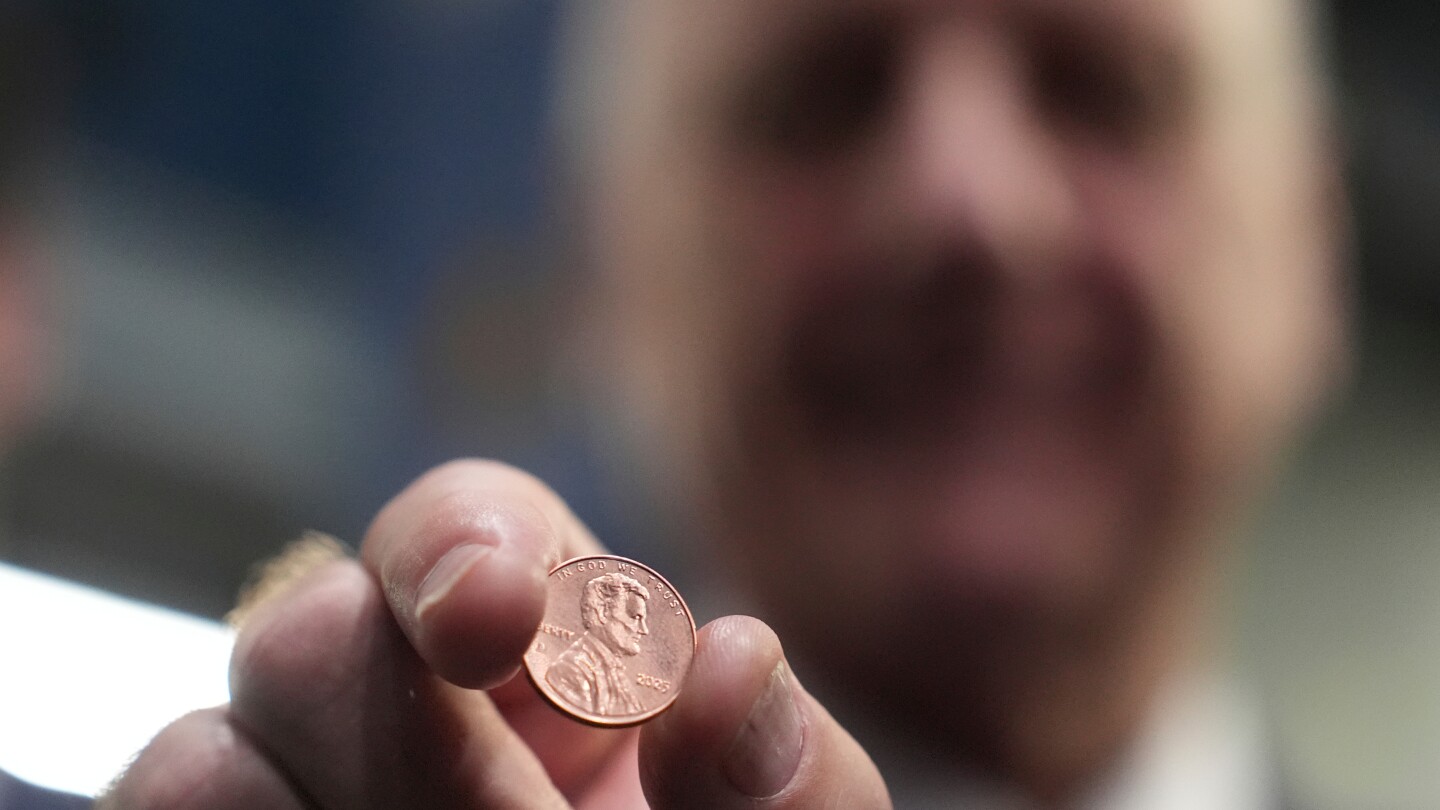
The U.S. ended production of the penny Wednesday, bringing to a close a 230-year chapter in American currency history. At a ceremony in the Philadelphia Mint, Treasurer Brandon Beach ceremoniously struck the final one-cent coins, which will now become collector’s items.
“God bless America, and we’re going to save the taxpayers $56 million,” Beach declared before pressing the button that created the last pennies. The event was marked by a mix of solemnity and celebration, with mint workers applauding after the final coins emerged from the press.
The decision to halt penny production comes after years of debate about the coin’s practicality. When first introduced in 1793, a penny had significant purchasing power, able to buy a biscuit, a candle, or candy. Today, the coin has become nearly worthless in practical terms, yet ironically costs almost four cents to manufacture.
Most penny production had already ended over the summer, according to mint officials, making Wednesday’s event largely ceremonial. The last few pennies will be auctioned off, likely fetching prices far beyond their face value from collectors and history enthusiasts.
“It’s an emotional day,” said Clayton Crotty, a 15-year employee at the mint. “But it’s not unexpected.”
The penny’s demise was ordered by President Donald Trump, who cited the wasteful economics of continuing to produce a coin that costs more than twice its face value to manufacture. “For far too long the United States has minted pennies which literally cost us more than 2 cents,” Trump wrote in an online post in February. “This is so wasteful!”
While the production has ended, the billions of pennies already in circulation will remain legal tender indefinitely. The last U.S. coin to be discontinued was the half-cent in 1857, according to Beach.
The penny’s phaseout has created some challenges in the marketplace. In recent weeks, as supplies dwindled, some retailers struggled to adapt without clear government guidance on handling transactions. Some businesses rounded prices down, while others pleaded with customers for exact change. More creative establishments offered incentives like free drinks in exchange for penny collections.
“We have been advocating abolition of the penny for 30 years. But this is not the way we wanted it to go,” said Jeff Lenard of the National Association of Convenience Stores last month, reflecting frustration with the abrupt transition.
Proponents of eliminating the coin have long pointed to potential cost savings, faster retail transactions, and precedents set by other countries. Canada, for instance, stopped minting its penny in 2012, though the U.S. coin has far deeper cultural significance.
Despite the economic rationale, many Americans maintain a sentimental attachment to pennies, seeing them as lucky charms or collectibles. Ironically, some banks began rationing supplies as the end neared, creating temporary shortages of a coin that had been produced in staggering quantities—over the last century, about half the coins made at U.S. mints were pennies.
While the penny’s production cost made it a clear target for elimination, other coins remain surprisingly expensive to produce as well. The nickel costs nearly 14 cents to make, while the quarter costs nearly 15 cents. The dime is relatively economical at less than 6 cents per coin.
Frank Holt, an emeritus professor at the University of Houston who has studied coin history, views the penny’s demise as a cultural loss beyond mere economics.
“We put mottoes on them and self-identifiers, and we decide—in the case of the United States—which dead persons are most important to us and should be commemorated,” Holt said. “They reflect our politics, our religion, our art, our sense of ourselves, our ideals, our aspirations.”
As the presses fall silent on America’s smallest denomination, the penny joins the pantheon of discontinued currency—artifacts that once facilitated daily commerce but ultimately couldn’t withstand changing economic realities.
Fact Checker
Verify the accuracy of this article using The Disinformation Commission analysis and real-time sources.

10 Comments
It’s the end of an era for the humble penny. While it’s been a staple of American currency for over two centuries, the economic realities have finally caught up with it. I wonder how this will impact cash transactions going forward.
Absolutely. The penny has become more of a nuisance than a useful denomination in recent decades. This move will simplify cash handling and transactions, even if it’s a nostalgic loss for some.
The end of the penny is a bittersweet moment. While it’s an outdated denomination, the penny has been part of American currency for over two centuries. I wonder what new coin or alternative will emerge to fill this void.
Farewell to the penny, a coin that’s outlived its usefulness. With production costs exceeding its face value, it’s understandable that the US Mint has decided to pull the plug on this long-running denomination.
The end of the penny is truly the end of an era in American currency history. While pennies have become largely impractical, it’s still a symbolic moment to see production come to a close after over 230 years.
Interesting to see the US Mint finally pulling the plug on penny production. At four cents to manufacture, it made little financial sense to continue. Curious to see how collectors and enthusiasts respond to the final batch.
I agree, the penny has become increasingly obsolete over the years. The high production costs versus its low purchasing power made it an obvious target for phasing out.
The demise of the penny is an intriguing development. While it may be a symbolic loss, the practical realities of its diminished purchasing power and high production costs clearly outweighed the benefits of keeping it in circulation.
Kudos to the US Mint for making the pragmatic decision to end penny production and save taxpayers millions. It will be interesting to see how the final batch of pennies is received by collectors and the public.
I agree, this is a long-overdue move. The penny has become increasingly irrelevant in modern commerce, so it makes sense to discontinue production and focus resources elsewhere.