


Listen to the article
U.S. Launches Major Crackdown on Southeast Asian Cyber Scam Networks
U.S. officials have unveiled a comprehensive operation targeting Southeast Asian cyberscam networks, describing it as part of a “new theater of war” against Chinese transnational organized crime under the Trump administration, U.S. Attorney Jeanine Pirro announced Friday.
The initiative, spearheaded by a newly formed Scam Center Strike Force, has imposed sanctions on 29 individuals and companies allegedly operating from Cambodia, including a prominent lawmaker. Criminal charges have also been filed against two Chinese nationals involved in similar operations in Myanmar.
As part of the crackdown, authorities have issued a warrant to shut down a major recruitment channel on Telegram and frozen hundreds of millions of dollars in illicit assets, Pirro revealed during a virtual press conference connecting Washington officials with journalists across Asia.
Cybercrime has experienced explosive growth across Southeast Asia in recent years, with operations in Cambodia and Myanmar generating enormous profits from victims worldwide. According to the Federal Bureau of Investigation, Americans lost nearly $21 billion to cyber-enabled crimes and online scams in 2025 alone.
These criminal enterprises are deeply intertwined with human trafficking networks. Foreign nationals, often recruited with false promises of legitimate employment, find themselves forced to work in near-slavery conditions running romance and cryptocurrency scams.
The newly established Scam Center Strike Force combines resources from Pirro’s U.S. Attorney’s Office for the District of Columbia, the Department of Justice’s Criminal Division, the FBI, and the U.S. Secret Service.
Among the most significant targets is Kok An, a Cambodian senator and businessman labeled by the Treasury Department as a “scam center kingpin.” The department’s Office of Foreign Assets Control has imposed sanctions against Kok An and his associates for allegedly defrauding American citizens of millions of dollars. These measures include blocking his U.S.-based assets and prohibiting American entities from conducting business with him.
When approached for comment, Cambodian Senate spokesperson Chea Thyrith noted, “His Excellency Kok An is a Cambodian Senator elected by elections, and as a senator, he has parliamentary immunity,” adding that only U.S. officials could elaborate on the sanctions. The Associated Press was unable to reach Kok An or his representatives directly.
This marks at least the second instance of a Cambodian senator facing U.S. sanctions. In 2024, Washington sanctioned another prominent tycoon, Ly Yong Phat, over alleged connections to forced labor, human trafficking, and online scam operations.
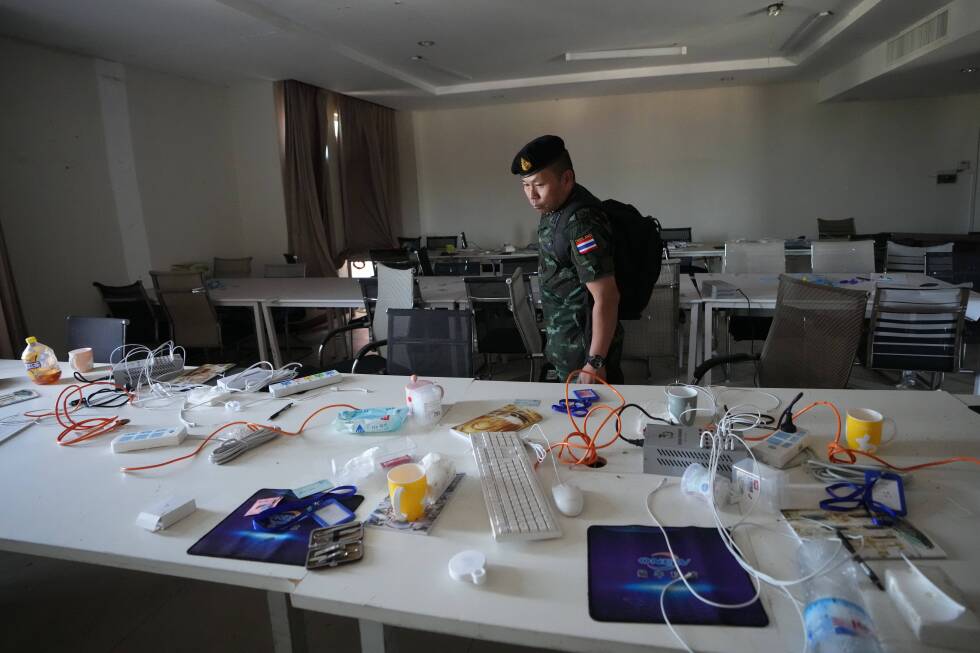
The investigation gained momentum in November when FBI agents deployed to Thailand accessed extensive evidence seized from an abandoned scam center in Myanmar. The trove included more than 8,000 phones and 1,500 computers, providing crucial intelligence for the operation.
This evidence led to wire fraud conspiracy charges against Chinese nationals Huang Xing Shan and Jiang Wen Jie, who managed the Myanmar compound before attempting to reestablish operations in Cambodia. Both individuals are currently detained in Thailand for immigration violations, with U.S. authorities pursuing their extradition.
Cambodia has recently shown increased willingness to address these illicit operations. In March, Cambodian lawmakers unanimously passed legislation specifically targeting online scam operations with penalties of up to life imprisonment, following a government pledge to shut down all such centers by the end of April.
The country’s shifting approach was further demonstrated in January when Cambodia extradited alleged scam kingpin Chen Zhi, founder of Prince Holding Group, to China. This occurred despite U.S. authorities having sought his custody following an indictment for allegedly operating a massive scam network.
Industry analysts note that this coordinated international response represents a significant escalation in tackling a criminal ecosystem that has exploited technological vulnerabilities and weak regulatory frameworks in developing economies. The transnational nature of these operations has made enforcement particularly challenging, requiring unprecedented cooperation between affected countries.
As digital fraud continues evolving in sophistication, this crackdown signals growing recognition that combating cyber-enabled crime requires both technological solutions and traditional law enforcement approaches across international boundaries.
Fact Checker
Verify the accuracy of this article using The Disinformation Commission analysis and real-time sources.

12 Comments
Appreciate the US taking this threat seriously and launching a comprehensive initiative to target these Southeast Asian cybercriminal networks. Protecting consumers from fraud should be a top priority.
Agreed, the sheer scale of losses to American victims underscores the urgent need for action. Kudos to the authorities for their efforts to disrupt these lucrative scams.
Good to see the US cracking down on these Southeast Asian cyberscam operations. Cybercrime is a serious issue that needs to be addressed globally. Curious to learn more about the scale of these criminal networks and how they’re being shut down.
Absolutely, it’s important to disrupt these transnational organized crime groups and their online fraud schemes. Freezing illicit assets is a good way to disrupt their operations.
Interesting to see the US government take on this ‘new theater of war’ against Chinese-linked cybercrime. Combating these scams that prey on vulnerable people worldwide is an important priority.
I agree, the scale of the losses to American victims is staggering. Glad to see stronger enforcement and international cooperation to crack down on these cybercriminal networks.
Curious to see how effective this crackdown will be in the long run. Cybercrime is notoriously difficult to police, but taking down major recruitment channels and seizing assets is a step in the right direction.
True, disrupting the underlying infrastructure and money flows is key to dismantling these elaborate scam operations. Ongoing vigilance and international coordination will be essential.
Interesting move by the US to frame this as a ‘new theater of war’ against Chinese organized crime. Curious to see how this crackdown unfolds and what impact it has on the broader cybercrime landscape.
Yes, the geopolitical framing is noteworthy. It will be important to monitor whether this initiative leads to lasting disruption of these scam operations or just temporary setbacks.
Glad to see the US government cracking down on these transnational cyberscams originating in Southeast Asia. It’s an important step in combating the growing threat of cross-border cybercrime.
Absolutely, the charges against Chinese nationals involved in similar operations in Myanmar show the global reach of these criminal networks. Disrupting their infrastructure is crucial.