


Listen to the article
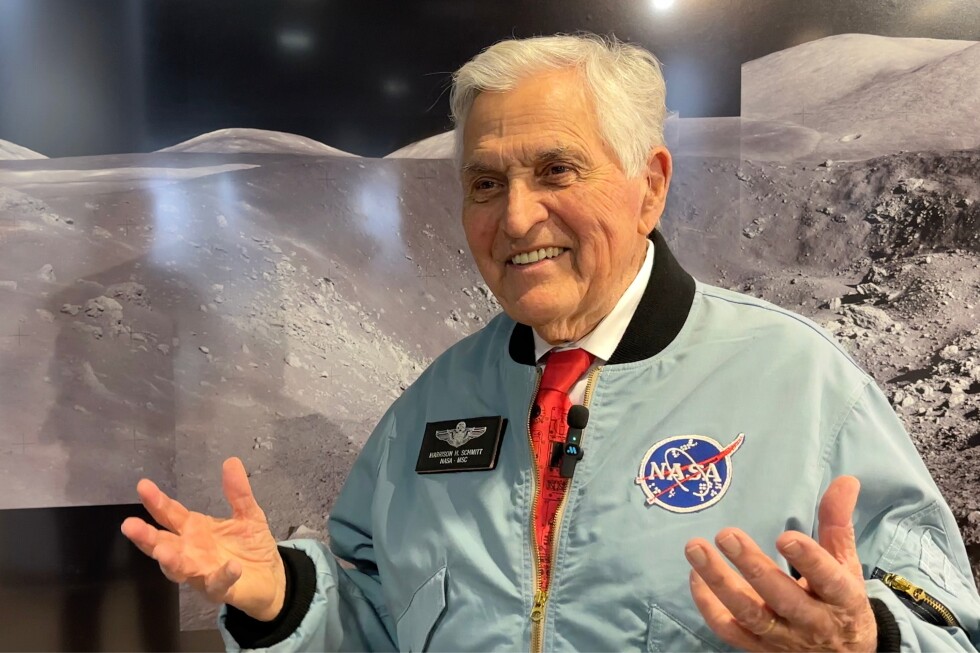
In 1972, as Apollo astronauts Harrison “Jack” Schmitt and Eugene Cernan explored the lunar surface collecting samples, Schmitt voiced a challenge to future generations: “Let’s see them leave footsteps like these someday.” More than five decades later, at age 90, Schmitt—one of only four living Apollo moonwalkers and the first scientist to set foot on the moon—watched with excitement as the Artemis II crew launched on their historic lunar flyby mission.
Schmitt’s unique perspective as both an astronaut and a field geologist made him instrumental in answering fundamental questions about the moon’s origin and its relationship to our solar system. During a recent interview with The Associated Press, he shared insights on establishing lunar bases, harvesting lunar resources, and humanity’s future in space exploration.
The former U.S. senator from New Mexico emphasized the strategic importance of establishing a permanent presence on the moon. “A lunar base makes a lot of sense and it always has for a lot of reasons,” Schmitt explained. “One is geopolitical. Probably the most important one is a geopolitical presence in deep space—and in preparation for going on to Mars.”
Beyond politics, Schmitt highlighted the practical advantages of lunar operations. The moon serves as both a training ground and a resource hub that could significantly reduce the costs of Mars missions. “The new generation has to gain experience—psychologically as well as practically about how you work in deep space,” he noted, praising the Artemis II mission for giving ground crews real-world experience beyond simulations.
During Apollo 17, Schmitt’s geological expertise was crucial in exploring the Taurus-Littrow Valley, a region deeper than the Grand Canyon. This three-dimensional landscape offered unique research opportunities not available on previous missions. “Having a field geologist like myself on board meant that we should be more efficient at gathering samples that had a meaningful aspect to our further understanding of the origin of the moon, its relationship to the Earth and, it turns out, also its relationship to the history of the sun,” Schmitt said.
The lunar surface has recorded 4.5 billion years of solar system history, serving as what Schmitt calls “a library of knowledge” about cosmic evolution. His recent research revealed that increased solar activity coincided with an explosion of oceanic life on Earth approximately half a billion years ago. “The oceans may have been and almost certainly were warming to that more active sun and life likes warmth,” he explained, noting how this period saw not only an increase in the quantity of life forms but also greater biodiversity.
Schmitt pointed to a sample of titanium-rich basalt lava collected from the moon as evidence of valuable lunar resources. This titanium concentration attracts elements like hydrogen and helium—particularly helium-3, an isotope rare on Earth but abundant on the lunar surface. “Helium-3 is going to be, I think, ultimately very, very important in the production of energy,” Schmitt predicted, adding that it could revolutionize quantum computing and cancer therapy while offering “a possibility of having nuclear energy without nuclear waste.”
This potential energy source has geopolitical implications, with Schmitt acknowledging that “China is interested in it, we’re interested in it.” He characterized helium-3 as “a big actor” in what he describes as “a new space race, a new Cold War” primarily between the United States and China.
Reflecting on his experiences working in the lunar environment, Schmitt described the relative ease of movement in one-sixth Earth’s gravity. “Walking around was like being a kid again… if you fell you didn’t fall very hard and you certainly didn’t cry about it,” he recalled. Despite the necessity of pressure suits, Schmitt found the moon “a very comfortable environment to be in.”
Regarding potential long-term lunar habitation, Schmitt was optimistic while acknowledging challenges. “Living on the moon is going to be very good,” he said, though he noted that radiation protection remains a significant concern for permanent settlements. Mars missions present additional complexities that may require advanced propulsion systems like fusion rockets.
When asked about the possibility of extraterrestrial life, Schmitt offered a measured response. “The technical potential statistically is very high that you could have had similar kind of conditions develop elsewhere in the universe,” he said, though he expressed skepticism about alleged UFO sightings. “If they’re really so advanced they could be here, they’d communicate better than they have.”
Schmitt remains enthusiastic about returning to space, saying he would gladly venture back to the moon or to Mars—with one condition: his wife Teresa would accompany him. Looking toward future exploration, he emphasized the importance of youth and mathematics education in advancing space technology, noting how commercial innovation has transformed approaches to deep space exploration since the Apollo era.
Fact Checker
Verify the accuracy of this article using The Disinformation Commission analysis and real-time sources.

8 Comments
Schmitt’s emphasis on the geopolitical significance of a lunar base is thought-provoking. With China and other nations also pursuing lunar exploration, establishing a permanent American presence on the moon could have far-reaching strategic implications.
The Artemis program represents an exciting new era of space exploration, and it’s inspiring to see the passion and expertise of Apollo-era astronauts like Schmitt guiding the way forward.
Absolutely. Schmitt’s unique perspective as both a scientist and an astronaut will be invaluable as we work to answer fundamental questions about the moon and develop the technologies necessary for long-term lunar habitation.
It’s remarkable that Schmitt, one of only a few remaining Apollo moonwalkers, is still actively involved in and advocating for lunar exploration. His insights will be crucial as we chart the next chapter of space exploration.
Absolutely. Leveraging the knowledge and experience of these pioneering astronauts is key to ensuring the success of future lunar missions and establishing a sustainable presence on the moon.
Schmitt’s comments on the strategic importance of a lunar base are compelling. Maintaining a geopolitical presence in deep space while preparing for Mars will be critical for the United States and its allies.
Exciting to see the Artemis missions carrying on the legacy of the Apollo program. Schmitt’s unique perspective as both an astronaut and geologist will be invaluable as we expand our presence on the lunar surface.
Agreed. Establishing a permanent lunar base is a crucial stepping stone towards future Mars exploration. The geopolitical implications are also significant.