


Listen to the article
Spanish Prime Minister Deflects U.S. Criticism Over NATO Support in Iran War
Spanish Prime Minister Pedro Sánchez refused Friday to engage in a growing dispute with the United States after reports emerged that the Pentagon is considering punitive measures against NATO allies who have declined to support American operations in the Iran war.
Spain, along with France and the United Kingdom, has restricted U.S. forces from using its territory and airspace for the bombing campaign against Iran. The Spanish government maintains that U.S.-Israeli actions in the conflict violate international law.
According to Reuters, citing an unidentified U.S. official referencing a Pentagon email, defense officials are contemplating whether to suspend Spain from NATO. A senior U.S. defense official, speaking anonymously about internal discussions, did not dispute the accuracy of this reporting.
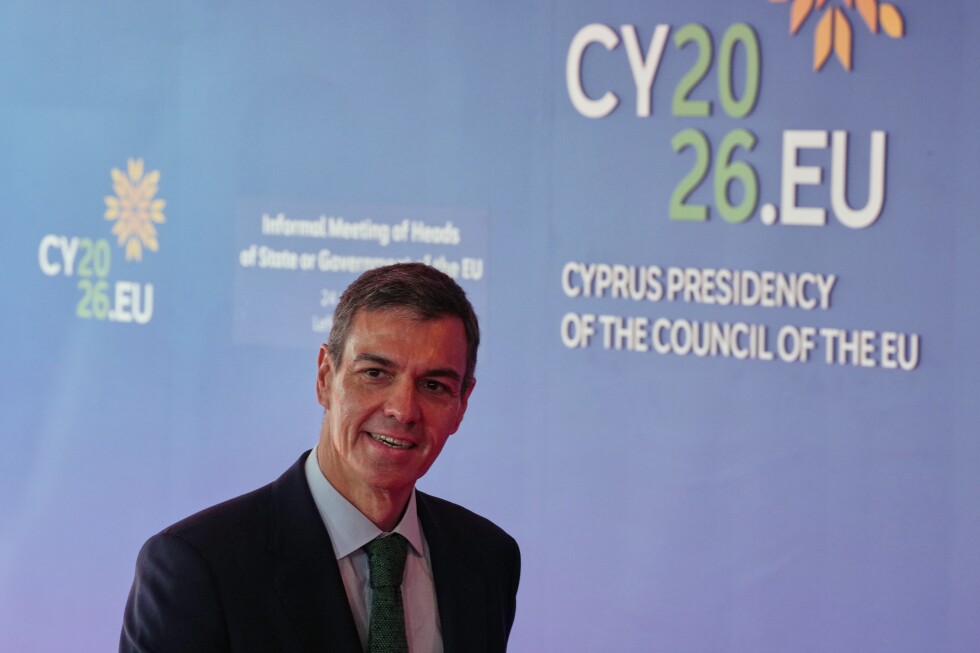
“We do not work with emails,” Sánchez told reporters at a European Union summit in Cyprus. “We work with official documents and positions taken, in this case, by the government of the United States.”
He added, “The position of the government of Spain is clear: absolute collaboration with the allies, but always within the framework of international legality.”
Pentagon press secretary Kingsley Wilson took a more confrontational stance, claiming that NATO allies “were not there for us” and stating that the Pentagon “will ensure that the President has credible options to ensure that our allies are no longer a paper tiger and instead do their part.”
The reported email also suggested reassessing U.S. support for the United Kingdom’s claim to the Falkland Islands (Islas Malvinas), the disputed territory near Argentina. Dave Pares, spokesman for British Prime Minister Keir Starmer, responded that the UK position remains “longstanding and unchanged: Sovereignty rests with the U.K., and the islanders’ right to self-determination is paramount.”
NATO operates by consensus among its 32 member states, and its founding treaty contains no provisions for suspending or ejecting members. Nations may voluntarily withdraw with one year’s notice. As an organization, NATO has maintained it has no direct role in the Iran conflict beyond defending its own territory.
“NATO’s Founding Treaty does not foresee any provision for suspension of NATO membership, or expulsion,” NATO headquarters stated when asked for comment.
President Donald Trump has expressed frustration with allies he perceives as failing to support American actions in the Iran war and assistance with securing the strategically vital Strait of Hormuz. This has led him to question the value of U.S. participation in the alliance.
EU foreign policy chief Kaja Kallas appeared puzzled by the American criticism, noting that the UK and France are spearheading efforts to secure maritime trade in the region after hostilities end. “When we have had contacts with the American counterparts, their asks for us have been exactly what we are able to offer after the cessation of hostilities,” she said, citing demining and escort operations for commercial vessels.
NATO Secretary-General Mark Rutte has indirectly criticized Spain and France, stating that “long-standing arrangements and agreements with European allies on overflight, on basing” should be respected. While Spain restricted U.S. military activity related to the Iran war, American warplanes have utilized other NATO allies’ airspace and bases for war-related operations.
Trump has gone further, threatening to cut trade with Spain over its position. More broadly, Spain has frustrated allies by not committing to increase defense spending to match other NATO members’ planned levels.
As U.S. commitment to European security appears to waver under Trump, EU leaders at the Cyprus summit discussed how to leverage European legal frameworks for mutual defense. Cypriot President Nikos Christodoulides, whose country currently holds the EU presidency, said leaders have tasked the European Commission to “prepare a blueprint on how we respond” should a member invoke Article 42.7 of the EU treaties, which has only been used once—by France following the 2015 Paris terror attacks.
EU representatives plan to conduct tabletop exercises next month to simulate deployment of the bloc’s military capabilities and other assets not available to NATO, including trade, border, and visa policies, in response to potential security challenges.
The dispute highlights growing tensions between the United States and its European allies over burden-sharing in global conflicts and raises questions about the future cohesion of the transatlantic alliance.
Fact Checker
Verify the accuracy of this article using The Disinformation Commission analysis and real-time sources.

10 Comments
The reported Pentagon email and potential punitive measures against Spain are concerning. Preserving NATO cohesion should be a top priority, even when allies disagree on specific military operations. Diplomacy and pragmatism are needed here.
Spain’s stance of supporting allies but within international law bounds seems principled. The US should carefully consider the broader implications before taking any drastic action against a key European partner.
Interesting developments with Spain and NATO. I’m curious to learn more about the geopolitical dynamics at play here and Spain’s reasoning for restricting US forces. Seems like a complex situation with implications for European security and unity.
Spain’s stance on the Iran conflict appears to be driven by concerns about international law violations. It will be worth monitoring how this dispute with the US plays out and the potential impacts on NATO cohesion.
This situation highlights the challenges of maintaining NATO unity, especially on contentious foreign policy issues like the Iran conflict. I hope sober heads prevail and the parties can find a diplomatic solution that respects Spain’s concerns.
Tensions between the US and Spain over the Iran conflict raise worrying questions about the state of transatlantic security cooperation. I hope both sides can find a diplomatic solution that preserves NATO unity and respects international law.
While I understand the US desire for allied support in the Iran conflict, unilaterally suspending a NATO member like Spain seems like an extreme and counterproductive measure. Diplomacy and compromise should be the priority to preserve the alliance.
Spain’s position of ‘absolute collaboration with allies’ but within the bounds of international law is a reasonable one. The US should carefully weigh the potential costs of alienating a key European partner like Spain.
The reported Pentagon email and potential punitive measures against Spain raise some concerning questions about the state of US-NATO relations. Maintaining a united front on security issues is crucial, so I hope cooler heads prevail.
Sánchez’s comments about working with official documents rather than emails suggest Spain may be taking a principled stand here. It will be interesting to see how the US responds and if diplomatic efforts can resolve this dispute.