


Listen to the article
U.S. markets reacted cautiously Monday following news that Federal Reserve Chair Jerome Powell has been served with subpoenas by the Department of Justice. The development marks a significant escalation in the ongoing tension between President Donald Trump and the central bank.
While U.S. futures declined, with the S&P 500 dropping 0.6%, the Dow Jones Industrial Average falling 0.5%, and the Nasdaq composite slipping 0.9%, Asian markets showed resilience, with most indices advancing during their trading sessions.
The investigation reportedly centers on Powell’s testimony regarding the Fed’s $2.5 billion renovation of two office buildings, which Trump has criticized as excessive. This comes at a politically sensitive time, as Powell’s term as chair is set to end in May, with Trump administration officials signaling that a potential replacement could be named this month.
In a brief interview with NBC News on Sunday, Trump denied any knowledge of the investigation into Powell. When questioned if the probe was intended to pressure Powell on interest rates, Trump stated, “No. I wouldn’t even think of doing it that way.”
Market sentiment in Asia remained positive despite the U.S. developments. Hong Kong’s Hang Seng gained 1.2% to 26,547.64, while the Shanghai Composite index jumped 1% to 4,163.11, bolstered by reports that Chinese leaders are preparing additional economic stimulus measures. Tokyo markets were closed for a holiday, but the U.S. dollar remained stable against the Japanese yen at 158.02 yen.
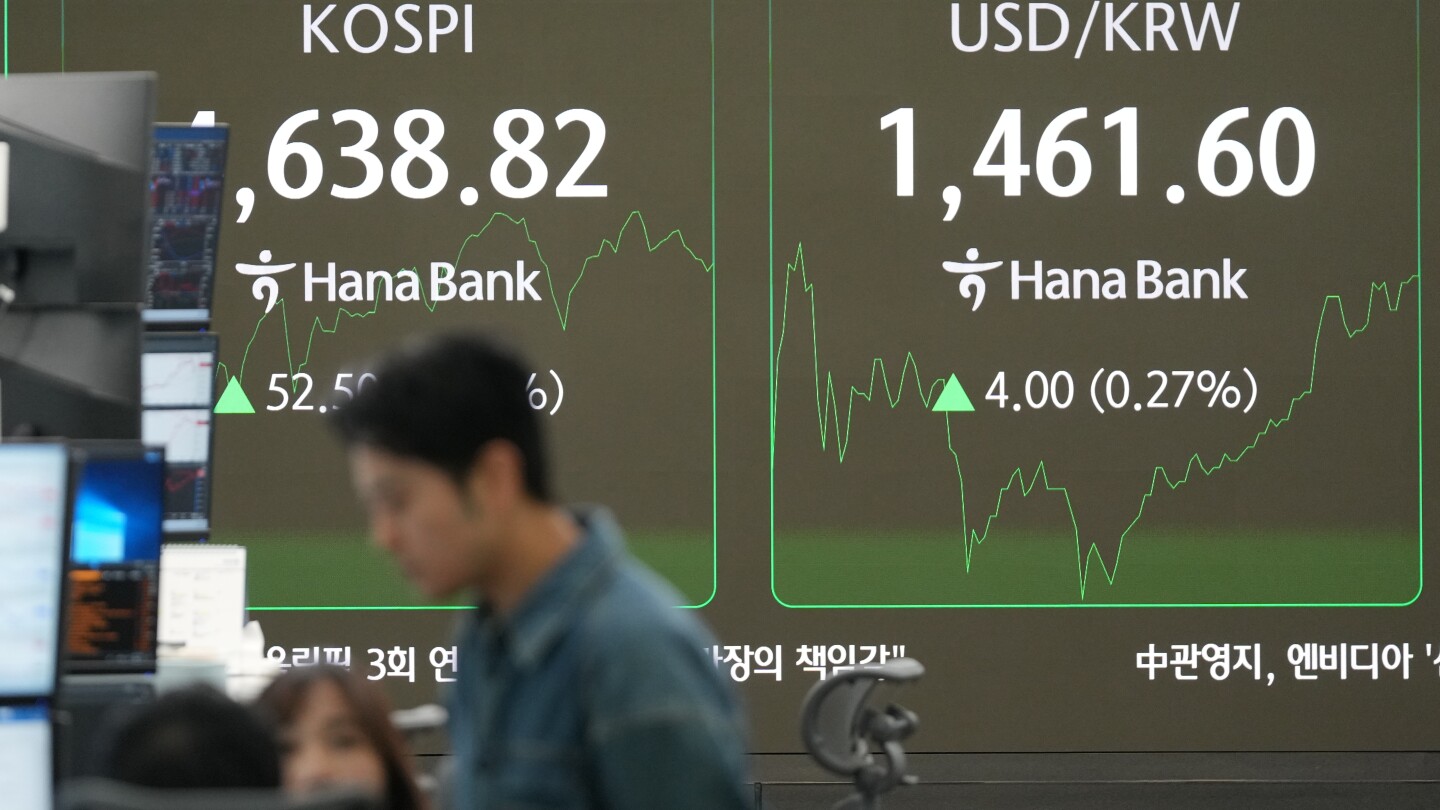
South Korea’s Kospi added 0.8% to 4,624.79, Australia’s S&P/ASX 200 gained 0.5% to 8,759.40, and Taiwan’s Taiex rose 0.9%, reflecting the broader strength in Asian equities.
The uncertainty surrounding the Fed chair comes just days after U.S. stocks hit record highs. On Friday, the S&P 500 climbed 0.6% to 6,966.28, the Dow Jones Industrial Average added 0.5% to 49,504.07, and the Nasdaq composite gained 0.8% to close at 23,671.35.
These gains followed a mixed U.S. jobs report, which showed employers hired fewer workers in December than economists expected, though the unemployment rate improved. The report reinforced the idea that the U.S. job market may be in what analysts call a “low-hire, low-fire” state, potentially avoiding a recession while allowing for gradual economic adjustment.
Investors are now turning their attention to upcoming economic data, with U.S. inflation reports at both consumer and wholesale levels due Tuesday and Wednesday respectively. These figures will be crucial for market participants assessing the Federal Reserve’s next moves on interest rates.
In the corporate arena, power company Vistra surged 10.5% after signing a 20-year deal to provide electricity from three of its nuclear plants to Meta Platforms, highlighting the growing trend of tech giants securing long-term energy contracts to power their AI initiatives.
Homebuilders and related companies also saw significant gains after Trump announced a plan to lower mortgage rates through the purchase of $200 billion in mortgage bonds, similar to previous Fed strategies. Builders FirstSource jumped 12%, while major homebuilders Lennar, D.R. Horton, and PulteGroup rose 8.9%, 7.8%, and 7.3% respectively.
These positive moves helped offset General Motors’ 2.7% decline following the announcement that it would take a $6 billion hit to its results for the last quarter of 2025 related to its pullback from electric vehicles. This follows $1.6 billion in charges from the previous quarter, reflecting weakening demand for EVs amid fewer tax incentives and relaxed fuel-emission regulations.
In commodities, precious metals showed strength, with gold rising 1.9% and silver jumping 6.4%, as investors sought safe-haven assets amid the uncertainty. Copper gained 1.4%, while oil prices remained relatively stable, with U.S. benchmark crude adding 8 cents to $59.20 per barrel and Brent crude increasing 9 cents to $63.43 per barrel.
The euro strengthened slightly against the dollar, climbing to $1.1671 from $1.1635 late Friday, as currency markets processed the implications of the developing situation at the Federal Reserve.
Fact Checker
Verify the accuracy of this article using The Disinformation Commission analysis and real-time sources.

14 Comments
This saga underscores the challenges facing central banks in maintaining credibility and independence, especially in politically charged environments. It will be crucial for the Fed to remain steadfast and continue making data-driven decisions, despite the external pressure it may face.
Well said. The Fed’s ability to withstand political interference and focus on its dual mandate of price stability and full employment is paramount. Preserving its institutional integrity should be the top priority, regardless of the outcome of this particular investigation.
While the DOJ investigation into Powell and the Fed’s spending is certainly newsworthy, I’m more interested in how this might impact the central bank’s policy decisions going forward. Will the political pressure cause the Fed to be more cautious or aggressive in its approach to interest rates and inflation? That’s the key question for investors to watch.
That’s a great point. The real crux of the matter is how this situation affects the Fed’s ability to make independent, data-driven decisions on monetary policy. Investors will be closely monitoring any signs that political considerations are unduly influencing the central bank’s actions.
The divergence between US and Asian markets is intriguing. It suggests global investors may be differentiating between domestic political risks in the US versus the underlying economic fundamentals. This could be a sign of greater maturity in Asian markets as they increasingly decouple from American influence.
That’s an insightful observation. The relative resilience of Asian equities points to a maturing investment landscape that is less beholden to the whims of US politics. It will be interesting to see if this trend continues and whether it signals a broader shift in global market dynamics.
The divergence in market reactions between the US and Asia is intriguing. It suggests that global investors are evaluating the fundamentals more than just the political drama unfolding in Washington. This could be a sign of increased sophistication and maturity in emerging markets, which are less swayed by the noise from American politics.
Absolutely. The fact that Asian markets have been able to shrug off the US political turmoil and focus on the underlying economic conditions is a positive sign. It indicates that global capital is becoming less beholden to the whims of American policymakers and more attuned to local and regional dynamics.
The resilience of Asian markets in the face of this US political drama is noteworthy. It suggests investors there may be more focused on fundamentals and the broader economic outlook rather than getting caught up in the Washington noise. Curious to see if this divergence between US and Asian equities continues.
That’s an insightful observation. Asian markets seem to be taking a more detached, pragmatic view compared to the US. It will be interesting to monitor if this trend holds or if the US drama ultimately spills over and impacts global sentiment.
Interesting development with the DOJ investigation into Powell and the Fed’s spending. I wonder if this is politically motivated or if there are legitimate concerns about the renovation costs. Either way, it will be important to see how this plays out and how it impacts the Fed’s policies going forward.
You raise a good point. The political backdrop here certainly adds an extra layer of complexity. It will be crucial to get to the bottom of the facts and understand if there are genuine issues with the spending or if this is more about Trump’s ongoing feud with the Fed.
I’m a bit skeptical of Trump’s claim that he wouldn’t use this investigation to pressure Powell on interest rates. Given their history, it’s hard to take the president’s word at face value on this. Regardless of the merits, the mere perception of political interference could undermine the Fed’s credibility.
I agree, Trump’s denials don’t carry much weight given the long-running tensions between him and Powell. Even if the investigation is legitimate, the optics are poor and could erode public trust in the Fed’s independence.