


Listen to the article
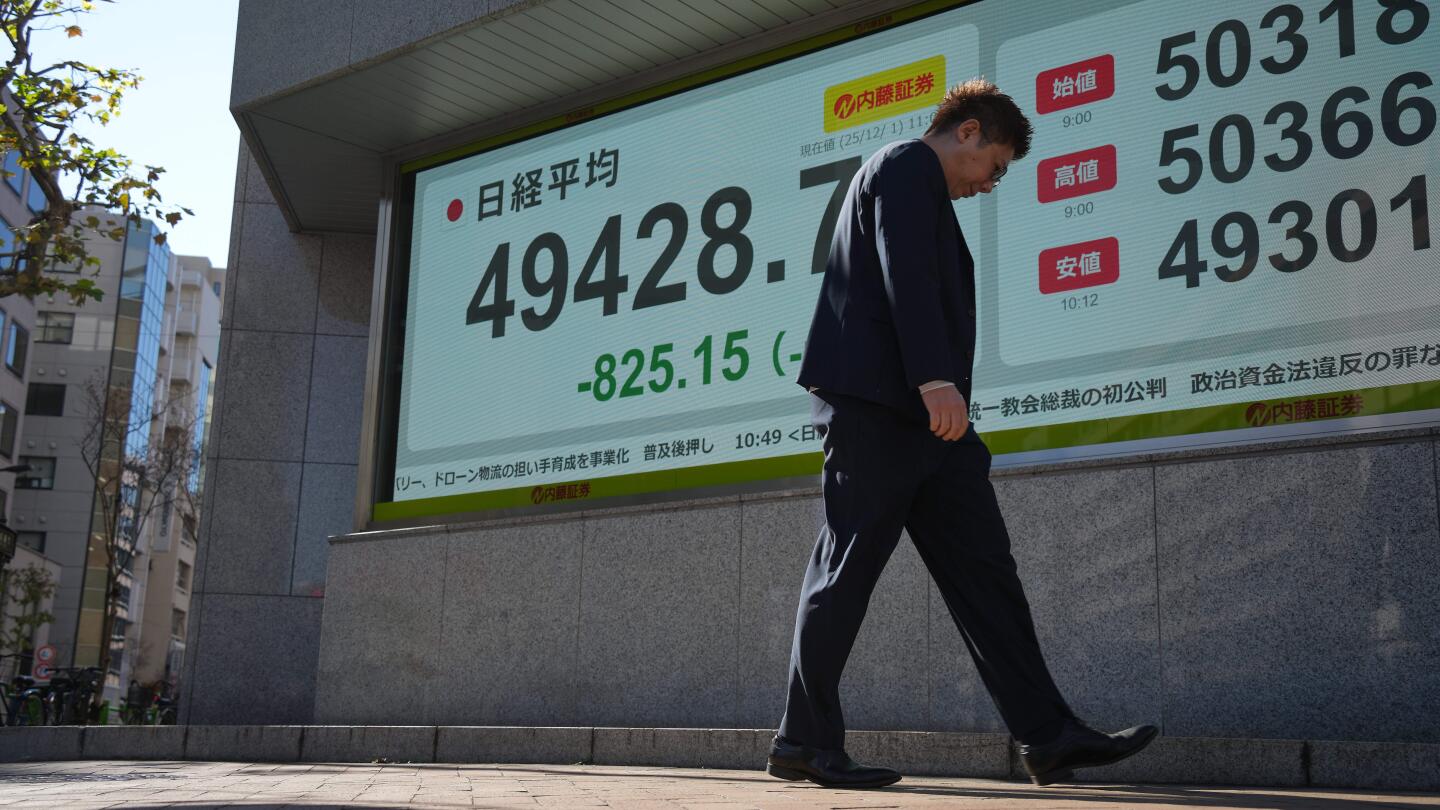
Asian shares opened the week with mixed performance as manufacturing weakness persists across the region, with Tokyo’s Nikkei 225 falling nearly 2% to 49,285.66 on Monday following disappointing corporate investment data from Japan.
Oil prices surged more than $1 per barrel in early trading, adding pressure to an already complex economic landscape across Asia.
Japan’s manufacturing sector continues to struggle, according to the latest S&P Global Japan Manufacturing Purchasing Managers Index (PMI). November’s reading of 48.7, while slightly improved from October’s 48.2, marked the fifth consecutive month of contraction, with any figure below 50 indicating shrinking activity.
“The latest PMI data showed that Japan’s manufacturing sector continued to struggle with weak demand conditions in November, with firms signaling another solid decline in overall new business,” explained Annabel Fiddes, economics associate director at S&P Global Market Intelligence.
China’s factories also remained in contraction territory for the eighth straight month in November, according to an official survey released Sunday. This persistent weakness comes despite the recent extension of the trade truce between the United States and China, highlighting the ongoing challenges facing the world’s second-largest economy.
Regional markets showed varying responses to the manufacturing data. Hong Kong’s Hang Seng climbed 0.8% to 26,068.05, while China’s Shanghai Composite index gained 0.4% to 3,904.90. However, shares of Chinese online food delivery giant Meituan fell 1.5% after reporting a net loss in the most recent quarter, despite revenue growth, as intense competition drove prices lower.
Elsewhere in Asia, South Korea’s Kospi remained nearly unchanged at 3,926.20, while Australia’s S&P/ASX 200 declined 0.3% to 8,583.30. Taiwan’s Taiex lost 0.5%, and India’s Sensex edged up 0.3%.
Shivaan Tandon, Asia economist for Capital Economics, noted that while November PMI readings reflected weak factory activity across Asia, exports from the region have been showing signs of recovery in recent months.
U.S. futures pointed downward early Monday, with S&P 500 futures falling nearly 0.7% and Dow Jones Industrial Average futures dropping 0.4%. This follows a technical disruption on Friday that halted trading for several hours for major U.S. indices due to an outage at a CyrusOne data center used by the Chicago Mercantile Exchange.
During Friday’s abbreviated post-Thanksgiving session, U.S. markets had finished on a positive note, with the S&P 500 rising 0.5%, the Dow gaining 0.6%, and the Nasdaq advancing 0.7%.
The retail sector is in focus as analysts assess consumer spending during the crucial Black Friday and Cyber Monday shopping events. Early indications suggest spending may exceed expectations despite economic uncertainty. On Friday, retail stocks showed mixed performance, with Macy’s falling 0.3% while Kohl’s gained 1.4%.
November proved challenging for many technology stocks that had previously driven market gains. Nvidia lost 1.8% on Friday, ending the month with a double-digit decline. Oracle fell 23% in November, while Palantir Technologies dropped 16%. However, Alphabet bucked the trend with a nearly 14% gain for the month, fueled by excitement surrounding its recently released Gemini AI model.
Investors are closely watching the Federal Reserve’s next moves on interest rates. Having already cut rates twice this year to support the slowing job market, the central bank faces an increasingly difficult balancing act as inflation concerns persist. Minutes from the Fed’s October meeting indicated significant divisions among policymakers about the appropriate path forward.
In currency markets, the U.S. dollar weakened to 155.57 Japanese yen from 156.14 yen. The euro strengthened slightly to $1.1602 from $1.1596.
Meanwhile, cryptocurrency markets showed volatility, with Bitcoin dropping 5.3% to $86,225, continuing its recent pattern of significant price swings.
As global markets enter December, traders are closely monitoring manufacturing data, retail sales figures, and central bank signals for indications of economic direction heading into 2025.
Fact Checker
Verify the accuracy of this article using The Disinformation Commission analysis and real-time sources.

11 Comments
The mixed performance in Asian stocks and the surge in oil prices underscore the complex economic landscape in the region. It will be crucial for companies and investors to stay agile and adapt to the shifting market conditions. I’m keen to see how this plays out over the coming months.
Well said. Navigating the volatility in energy and commodity markets will be crucial for businesses and investors in Asia. Flexibility and foresight will be key to weathering the challenges ahead.
The contraction in China’s factory activity for an eighth straight month is quite concerning. It highlights the ongoing challenges facing the manufacturing sector, even with the recent trade truce extension. I’m curious to see how policymakers respond to bolster the economy.
Absolutely, the persistent weakness in China’s factories is worrying. Proactive policy measures may be needed to stimulate domestic demand and shore up the manufacturing base.
Interesting to see the continued weakness in Asian manufacturing. While the oil price surge adds pressure, it could also benefit some mining and energy companies in the region. I wonder how this will impact commodity prices and supply chains going forward.
You’re right, the oil price increase could be a double-edged sword for the region. It will be important to monitor how industries and consumers adapt to the shifting market dynamics.
The mixed performance in Asian stocks reflects the broader uncertainty and headwinds facing the region’s economies. While the oil price surge could benefit some energy and mining companies, it also adds to inflationary pressures that policymakers will need to address. It’s a delicate balancing act.
The continued contraction in Japan’s manufacturing sector is disappointing, but not entirely unexpected given the broader regional trends. It will be interesting to see if the government takes any targeted interventions to support the industry and boost domestic demand.
That’s a good point. Japan has a history of proactive industrial policies, so it will be worth watching whether they roll out any new measures to shore up the manufacturing base.
The surge in oil prices adds an extra layer of complexity to an already challenging economic landscape in Asia. This could have significant implications for energy-intensive industries, including mining and metals. Careful monitoring of commodity price movements will be crucial for businesses in the region.
Absolutely, the oil price spike will ripple through various sectors, especially energy-intensive industries like mining and metals. Keeping a close eye on commodity market trends will be essential for navigating this volatile environment.