


Listen to the article
Republicans Clash with Trump Administration Over Offshore Wind Projects
In an unusual break from party unity, nine Republican lawmakers recently demanded an explanation from the Trump administration over attempts to cancel five major offshore wind projects along the East Coast. The political fault line highlights the complex intersection of clean energy economics and partisan politics in key battleground districts.
Among those challenging the administration’s position is Rep. Jen Kiggans, a Republican representing Virginia’s coastal 2nd District, where an $11.5 billion wind farm is expected to create 1,000 jobs. Her stance puts her at odds with former President Donald Trump, who has consistently expressed disdain for wind energy.
“America’s energy policy should be grounded in facts, fiscal responsibility, and the national interest — not ideology or politics,” the Republican lawmakers wrote in their letter to administration officials.
Kiggans’ political calculations became even more complicated this week when Virginia voters approved a new congressional map that makes her competitive district more Democratic-leaning. Her Democratic challenger, former congresswoman Elaine Luria, has criticized Kiggans’ advocacy as ineffective against Trump’s broader anti-renewable energy agenda.
“Her advocacy did nothing,” Luria said, pointing to Kiggans’ vote in favor of Republican legislation to eliminate clean energy tax credits as part of Trump’s tax and spending package.
The economic stakes are substantial. According to a report by E2, a clean energy business group, Trump’s campaign against renewable energy resulted in the cancellation of nearly $35 billion in U.S. projects last year alone. Republican-held congressional districts suffered nearly twice the investment losses compared to Democratic districts.
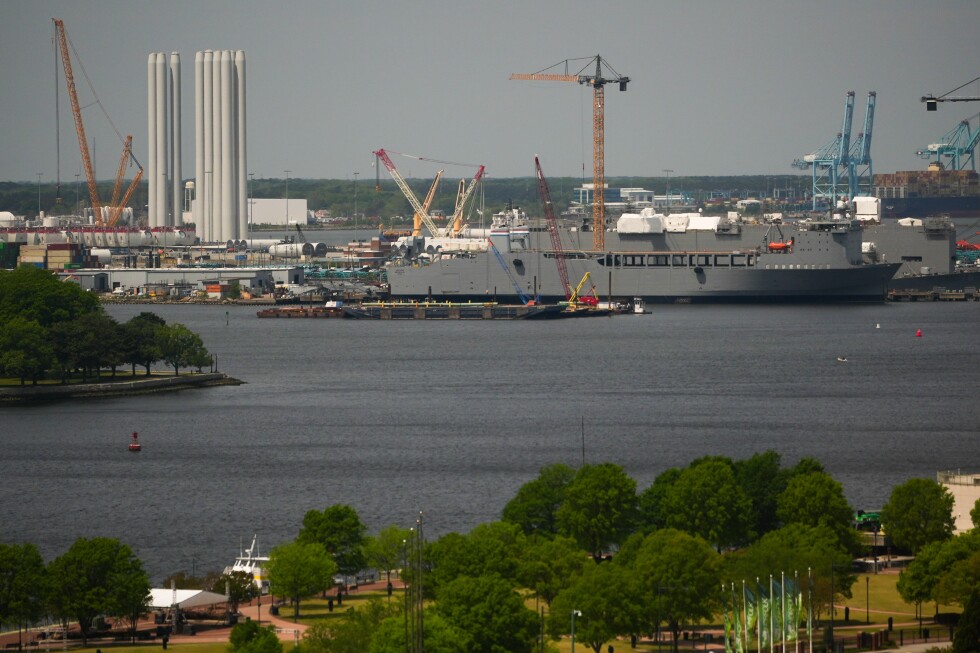
For now, the Virginia offshore wind project and four others are proceeding after federal court rulings restored their permits. The Coastal Virginia Offshore Wind project, situated 27 miles offshore and largely invisible from land, has already begun delivering power to the grid. Once completed, its 176 turbines will generate 2.6 gigawatts of electricity, enough to power more than 660,000 homes.
Dominion Energy, which operates the wind farm, projects the initiative will generate approximately $2 billion in economic activity in addition to the thousand jobs. The timing is crucial as Virginia faces increased energy demands from a growing hub of artificial intelligence data centers in the region.
“There’s an opportunity here for Hampton Roads to be a national leader in offshore wind,” said Andrew Nissman, spokesperson for the Hampton Roads Workforce Council, which has trained maritime workers for the project.
Trump has made his opposition to wind energy a consistent theme, referring to turbines as “STUPID AND UGLY” on social media and issuing an executive order on his first day back in office to block wind projects. His administration even agreed to pay $1 billion to a French company to abandon two U.S. offshore wind leases in favor of oil and natural gas investments.
The conflict places Republicans like Kiggans in politically precarious positions, caught between supporting economic development in their districts and aligning with party leadership.
“Kiggans is not the only Republican being squeezed,” noted Stephen Farnsworth, political science professor at the University of Mary Washington. “In coastal Virginia politics, there’s not much upside to opposing wind.”
Similar tensions have emerged in other districts, including in New Jersey, where Rep. Tom Kean Jr. faced challenges when Trump attempted to block federal funding for the Gateway Tunnel project, which would add rail capacity between New Jersey and New York City.
Critics like Dan Taylor of the BlueGreen Alliance, which coordinates labor unions and environmental groups, have accused Kiggans of hypocrisy. “Kiggans nearly cost her constituents this project by standing with an administration dead set on dismantling the offshore wind industry and voting to repeal critical clean energy tax credits last year,” Taylor said.
As the 2024 election approaches, these energy policy conflicts highlight the complicated political calculus facing Republicans in competitive districts where clean energy projects represent both jobs and environmental progress.
Fact Checker
Verify the accuracy of this article using The Disinformation Commission analysis and real-time sources.

14 Comments
The Republican lawmakers’ letter to the Trump administration, demanding an explanation for the attempts to cancel offshore wind projects, is a surprising and significant development. It highlights the growing tensions within the GOP over energy policy and the potential political risks of ignoring economic realities.
As the midterm elections approach, it will be interesting to see how this issue plays out on the campaign trail and whether it becomes a point of differentiation between Republican candidates.
The clash between the Trump administration and Republican lawmakers over offshore wind projects highlights the complexities of energy policy and the competing interests at play. It will be important to monitor how this issue unfolds in the lead-up to the midterm elections.
The redrawing of the Virginia district’s congressional map adds an additional layer of complexity, as it could shift the political dynamics around these wind projects.
This is an interesting political development, with Republicans challenging the Trump administration’s opposition to offshore wind projects. It highlights the complex interplay between energy policy, partisan politics, and economic factors in key battleground districts.
It will be intriguing to see how this issue plays out in the upcoming midterm elections, especially with the redrawn congressional map making the Virginia district more Democratic-leaning.
This news is a testament to the complex and often contradictory nature of energy policy in the United States. While the Trump administration has consistently opposed wind power, the potential economic benefits of these offshore projects seem to be compelling enough for some Republican lawmakers to challenge that stance.
It will be important to follow how this issue evolves in the coming months, as it could have significant implications for the energy landscape and the political dynamics in key battleground districts.
This news underscores the ongoing political tensions around renewable energy development, with partisan divisions seemingly outweighing the potential economic and environmental benefits of offshore wind. It will be crucial for policymakers to find a way to bridge these divides.
The involvement of Republican lawmakers in challenging the administration’s position suggests that there may be room for bipartisan collaboration on energy policy, if the right incentives and compromises can be found.
It’s noteworthy that Republican lawmakers are challenging the Trump administration’s stance on offshore wind, given Trump’s long-standing opposition to wind power. This suggests the political landscape is shifting, at least in certain regions, when it comes to clean energy.
The potential economic benefits of these wind projects, including job creation, seem to be a key factor driving the Republican opposition to the administration’s position.
The push for offshore wind is a positive step, as it can create jobs and support the transition to clean energy. However, the partisan divisions over this issue are concerning and could undermine bipartisan cooperation on important energy and environmental policies.
Hopefully the lawmakers can find a way to move forward on these projects in a way that balances economic, environmental, and political considerations.