


Listen to the article
Salvador Perez and Royals Lead MLB in Automated Ball-Strike Challenge Success
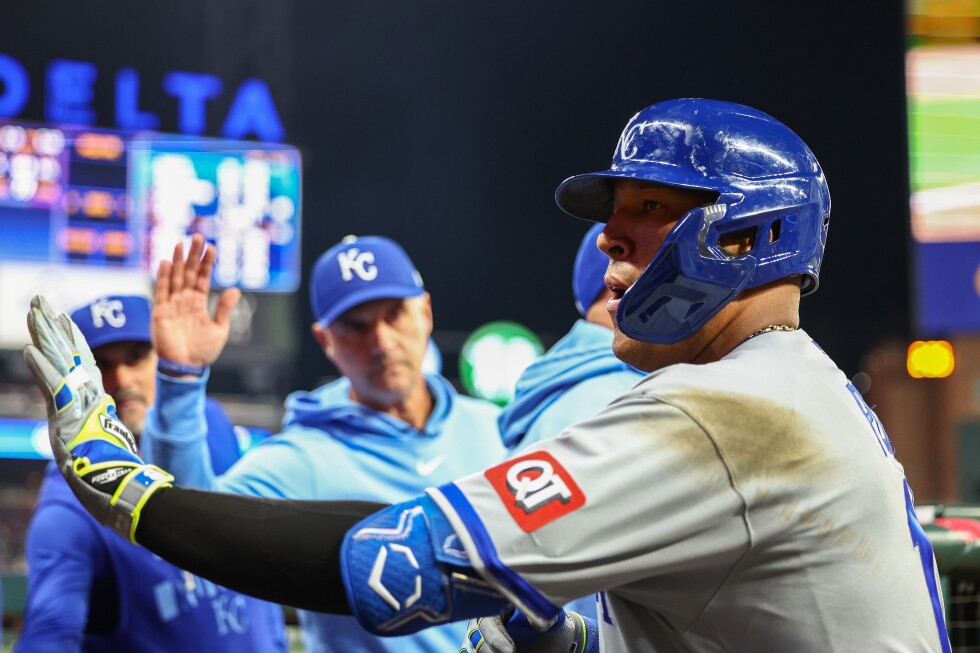
Salvador Perez and the Kansas City Royals have emerged as early leaders in baseball’s new technological frontier, posting a perfect record with the recently implemented Automated Ball-Strike System (ABS) during its first weekend of use in Major League Baseball.
Perez, the Royals’ veteran catcher, has established himself as the most successful challenger thus far with a flawless 4-0 record when appealing umpires’ ball and strike calls. His success exemplifies the strategic advantage that experienced catchers may hold in the new system, which allows players to challenge calls they believe are incorrect.
“I don’t know if I like it or not,” Perez said about the new challenge system. “I don’t want the umpire to look bad.”
The data after the opening weekend shows a clear advantage for catchers, who succeeded on 59 of 92 challenges (64%), compared to batters who won just 33 of 78 appeals (42%). This disparity suggests catchers, who have the best view of the strike zone besides the umpires themselves, may have a tactical edge in the new system.
Among batters, San Francisco’s Heliot Ramos and Cincinnati’s Eugenio Suárez stand out as the only players with perfect 2-0 records on challenges. Suárez demonstrated particular confidence in the system by successfully appealing consecutive pitches. Meanwhile, Los Angeles Angels superstar Mike Trout has shown an early aptitude for the system, going 3-1 on his challenges.
Not all players have found success with the new technology. Atlanta’s Ronald Acuña Jr., one of baseball’s premier talents, went 0-2 on his challenge attempts, highlighting that even elite players are adjusting to the strategic aspects of when to challenge calls.
Team success rates have varied dramatically. The Royals (4-0) and Arizona Diamondbacks (3-0) have perfect records, while the Houston Astros (0-6) and St. Louis Cardinals (0-3) have yet to win a challenge. The Cincinnati Reds’ batters have been particularly successful, going 6-0 on challenges, while Atlanta’s hitters are 0-4.
The implementation of the ABS system marks a significant shift in how baseball’s strike zone is adjudicated. The technology uses 12 Hawk-Eye cameras positioned around the stadium that can measure whether any part of the baseball crosses the strike zone with remarkable precision—about one-sixth of an inch accuracy.
Managers are developing strategic approaches to maximize their challenge opportunities. Philadelphia Phillies manager Rob Thomson, whose team went 4-3 on challenges, explained their methodology: “1-1 counts. Counts that are going to end the at-bat. Those are big challenge times.”
Chicago White Sox manager Will Venable elaborated on his team’s approach: “We have guidelines that we think are strategic and give us a good idea of when we want to challenge. A mid-at-bat challenge is different than a potential strikeout or walk.”
The system has already created some tension. Minnesota’s Derek Shelton became the first manager ejected for arguing an ABS-related issue when he was tossed on Sunday during a game against Baltimore after complaining that Orioles pitcher Ryan Helsley waited too long to signal for a review.
Umpire C.B. Bucknor had a particularly difficult experience with the new system during Cincinnati’s 6-5, 11-inning win on Saturday, when six of eight challenges against his calls were successful. All six overturned calls involved strikes being changed to balls.
Some baseball insiders are already suggesting refinements to the system. Milwaukee manager Pat Murphy questioned the current standard: “I kind of believe there’s going to be a change with the percentage of the ball that’s touching. When the ball just nicks it, should that be a strike?”
Through the first weekend, teams averaged 3.7 challenges per game, with an overall success rate of 53.7%. As players, managers, and umpires continue to adapt to this technological revolution in baseball’s most fundamental interaction, strategies will undoubtedly evolve as the season progresses.
Fact Checker
Verify the accuracy of this article using The Disinformation Commission analysis and real-time sources.

25 Comments
Exploration results look promising, but permitting will be the key risk.
Good point. Watching costs and grades closely.
The early ABS success of Perez and the Royals is quite impressive. The data showing catchers’ higher challenge success rate highlights how this new technology is reshaping baseball strategy and gameplay. It will be fascinating to see how teams and players adapt over the course of the season as the ABS system becomes more integrated.
The Royals and Perez are off to a strong start with the ABS system. It makes sense that experienced catchers would have an edge in challenging calls, given their intimate knowledge of the strike zone. Interested to see if this gives certain teams a strategic advantage early on.
I wonder if the high success rate for catchers will lead to any adjustments or tweaks to the ABS system over time. Maintaining fairness and consistency will be key as it gets implemented across the league.
Nice to see insider buying—usually a good signal in this space.
Good point. Watching costs and grades closely.
Nice to see insider buying—usually a good signal in this space.
Kudos to Perez and the Royals for their early success with the ABS system. The data showing catchers’ higher challenge success rate makes sense, but it will be worth monitoring to see if that holds up or if batters find ways to adapt. Either way, the new technology is certainly shaking up the game in its initial rollout.
The cost guidance is better than expected. If they deliver, the stock could rerate.
The data on challenge success rates is quite fascinating. It highlights how the new ABS technology is disrupting traditional baseball dynamics, at least in the early going. Curious to see how this impacts game strategy and the overall fan experience going forward.
You make a good point. The catchers’ advantage could create some interesting wrinkles in how the game is played, with teams potentially emphasizing the catcher position more. It will be an interesting storyline to follow as the season progresses.
Interesting to see how the Automated Ball-Strike system is impacting the game so far. Veteran catchers like Perez seem to have an advantage in challenging calls, given their perspective on the strike zone. Curious to see how this new technology evolves over the season.
The data showing catchers’ success rate on challenges is quite telling. It’ll be important for batters to adapt and learn how to best leverage the new system as well.
Silver leverage is strong here; beta cuts both ways though.
Good point. Watching costs and grades closely.
Good point. Watching costs and grades closely.
Nice to see insider buying—usually a good signal in this space.
Uranium names keep pushing higher—supply still tight into 2026.
Good point. Watching costs and grades closely.
It’s intriguing to see how the new ABS system is already impacting in-game dynamics, with catchers seemingly having a distinct advantage in challenging calls so far. I wonder if this will lead to any adjustments or rule changes down the line to ensure more parity. Definitely an interesting development to keep an eye on.
If AISC keeps dropping, this becomes investable for me.
Good point. Watching costs and grades closely.
Production mix shifting toward Business might help margins if metals stay firm.
Good point. Watching costs and grades closely.