


Listen to the article
In the heart of Portland, Oregon, a groundbreaking café has become a vital hub for the Deaf community, offering more than just coffee and pastries. Woodstock Café stands apart from traditional coffee shops by making American Sign Language (ASL) its primary form of communication, creating an inclusive space where deaf and hard of hearing individuals feel truly at home.
The café, owned by nonprofit organization CymaSpace, has implemented innovative solutions to serve all customers. While staff primarily communicate in ASL, non-signing patrons can place orders using a special microphone that transcribes their speech onto a screen, bridging the communication gap seamlessly.
Andre Gray, one of the café’s founders, explained through sign language that people have relocated from across the country to work at Woodstock. “It can be hard for people who are deaf or hard of hearing to find jobs,” he signed. “So the café becomes their stable place. It’s their rock.”
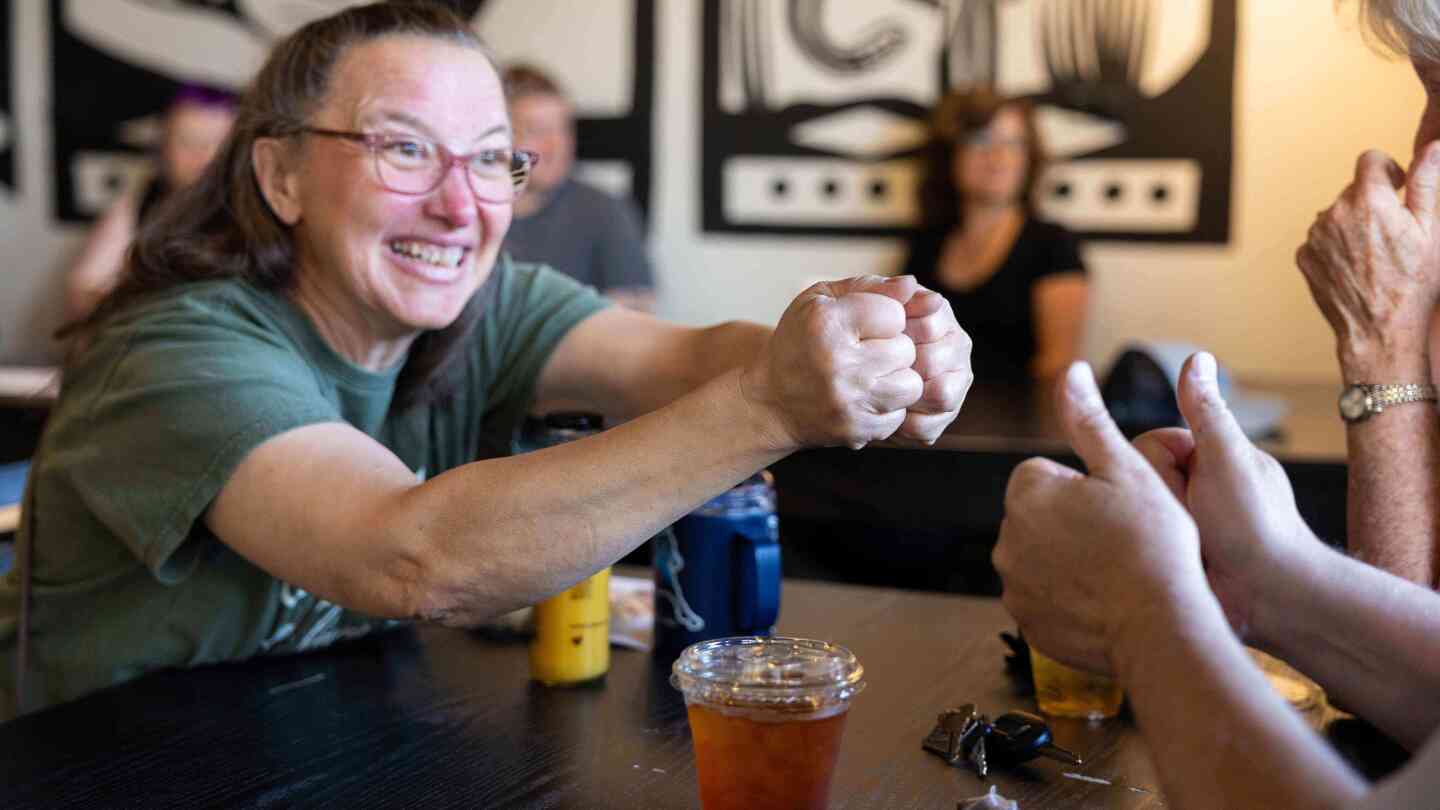
Beyond serving as an employer, Woodstock Café functions as a cultural gathering space. The establishment hosts regular events like Sign Squad on Tuesdays, drawing diverse participants from across the hearing spectrum. These popular meetups bring together individuals with varying levels of hearing and signing abilities, from those who are profoundly deaf to students learning introductory sign language.
The café has become particularly meaningful for people like Zach Salisbury, who was born with a rare genetic disorder causing gradual loss of hearing and sight and uses a cochlear implant. Another regular, Amy Wachspress, began learning sign language nine years ago as she lost her hearing.
“What I just love about it is that there’s so many different people that come,” said Wachspress, who classifies herself as hard of hearing and primarily reads lips. “It’s so eclectic… just many different kinds of people from all different backgrounds. And the one thing we have in common is that we sign.”
The impact of this inclusive environment extends beyond adult patrons. Wachspress recounted a touching story about a deaf toddler born to hearing parents who wanted their child immersed in Deaf culture. When they brought him to the café, the young boy was overjoyed to see others communicating in sign language.
“He was just so beside himself excited when he realized that you could communicate with people using sign,” she recalled. “We were all so touched… That’s the kind of thing that happens here at the café.”
The significance of Woodstock Café reflects broader challenges faced by the Deaf community. According to the National Deaf Center, employment rates for deaf individuals lag significantly behind their hearing counterparts. Businesses like Woodstock not only provide crucial job opportunities but also help normalize sign language in public spaces.
CymaSpace, the nonprofit behind the café, had ambitious plans to expand its impact by acquiring adjacent vacant buildings for a Deaf Equity Center. However, Gray noted that much of the anticipated funding was cut following changes in presidential administration. Despite this setback, the organization remains hopeful about securing alternative funding through private organizations and a planned crowdsourcing campaign.
“It gives power to the community as opposed to a fear of signing,” Gray explained. “We, as a community, are so proud of who we are.”
As awareness grows about the importance of accessibility and inclusion, establishments like Woodstock Café represent a model for how businesses can create spaces that celebrate linguistic diversity while providing essential services and employment opportunities. For Portland’s Deaf community and beyond, the café stands as both a practical resource and a powerful symbol of cultural pride.
Fact Checker
Verify the accuracy of this article using The Disinformation Commission analysis and real-time sources.

26 Comments
Interesting update on This cafe takes orders in sign language. It’s cherished by the Deaf community. Curious how the grades will trend next quarter.
Good point. Watching costs and grades closely.
Good point. Watching costs and grades closely.
Uranium names keep pushing higher—supply still tight into 2026.
Good point. Watching costs and grades closely.
Good point. Watching costs and grades closely.
Silver leverage is strong here; beta cuts both ways though.
Production mix shifting toward Business might help margins if metals stay firm.
Exploration results look promising, but permitting will be the key risk.
Silver leverage is strong here; beta cuts both ways though.
Good point. Watching costs and grades closely.
Good point. Watching costs and grades closely.
I like the balance sheet here—less leverage than peers.
Good point. Watching costs and grades closely.
Interesting update on This cafe takes orders in sign language. It’s cherished by the Deaf community. Curious how the grades will trend next quarter.
Good point. Watching costs and grades closely.
Interesting update on This cafe takes orders in sign language. It’s cherished by the Deaf community. Curious how the grades will trend next quarter.
Good point. Watching costs and grades closely.
Good point. Watching costs and grades closely.
Silver leverage is strong here; beta cuts both ways though.
Good point. Watching costs and grades closely.
Good point. Watching costs and grades closely.
Nice to see insider buying—usually a good signal in this space.
Good point. Watching costs and grades closely.
If AISC keeps dropping, this becomes investable for me.
Good point. Watching costs and grades closely.