


Listen to the article
Space Enthusiasts Look Forward to Historic Moon Missions and Celestial Events in 2026
The moon and sun will share cosmic prominence in 2026, with landmark human and robotic lunar missions coinciding with spectacular solar eclipses throughout the year.
For the first time in over 50 years, astronauts will journey to the lunar vicinity as part of NASA’s Artemis program. Commander Reid Wiseman will lead a crew of three Americans and one Canadian on a 10-day mission that will loop around the moon’s far side. While they won’t land on the lunar surface, Wiseman notes the mission could yield valuable geological observations of previously unseen lunar regions.
“There’s a good chance we’ll be the first to lay eyeballs on large swaths of the lunar far side that were missed by the Apollo astronauts,” Wiseman explained, highlighting the scientific value of these observations for identifying future landing sites.
The renewed interest in lunar exploration extends beyond NASA. Amazon founder Jeff Bezos plans to launch a prototype of Blue Origin’s lunar lander early in the year. This demonstration version of Blue Moon will stand 26 feet tall, surpassing the height of the Apollo-era landers, with the crewed version expected to reach nearly twice that size.
Several private companies are also targeting lunar landings in 2026. Astrobotic Technology and Intuitive Machines will attempt to deliver scientific payloads to the lunar surface, while Firefly Aerospace—the only private entity to achieve a successful moon landing thus far—will aim for the far side. Meanwhile, China plans an ambitious mission to the south polar region, deploying both a rover and a “hopper” designed to jump into permanently shadowed craters in search of ice deposits.
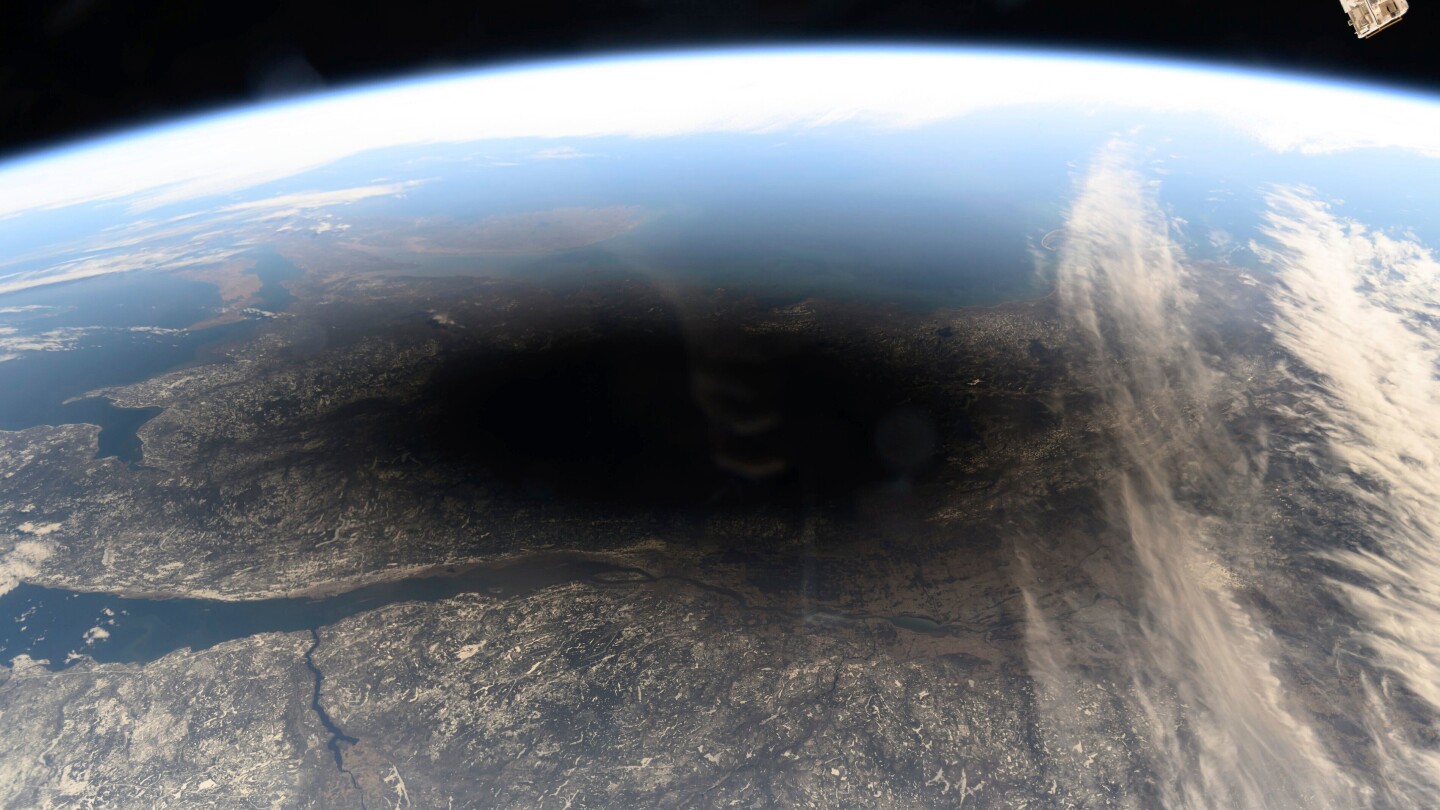
Celestial watchers will be treated to multiple eclipses throughout the year. A total solar eclipse on August 12 will begin in the Arctic and cross Greenland, Iceland, and Spain, offering viewers 2 minutes and 18 seconds of totality. This follows a February 17 ring-of-fire eclipse visible primarily from Antarctica, with partial views from South Africa and parts of South America. A total lunar eclipse will occur two weeks after February’s solar eclipse, with a partial lunar eclipse rounding out the year’s eclipse season in late August.
Planetary alignments will offer another visual treat. On February 28, six of the solar system’s eight planets will parade across the sky in an impressive lineup. Mercury, Venus, Jupiter, and Saturn should be visible to the naked eye shortly after sunset, while Uranus and Neptune will require binoculars or telescopes. A nearly full moon will join the display alongside Jupiter. Mars, absent from this February lineup, will participate in another six-planet parade in August, with Venus being the only planet missing from that event.
Supermoons—full moons that appear larger and brighter when the moon is closer to Earth in its elliptical orbit—will grace the night skies three times in 2026. The first occurs on January 3, coinciding with a meteor shower, though the bright moonlight may obscure the fainter meteors. The second and third supermoons won’t arrive until November 24 and December 23, with the Christmas Eve supermoon passing within 221,668 miles of Earth—the closest lunar approach of the year.
The aurora borealis and australis may continue to make appearances at unusual latitudes, though perhaps not as frequently as in recent years. Solar activity is expected to begin declining as the 11-year solar cycle moves past its peak, but space weather forecasters anticipate valuable new data from recently launched observatories.
“2026 will be an exciting year for space weather enthusiasts,” said Rob Steenburgh of the National Oceanic and Atmospheric Administration, noting how new spacecraft will help scientists “better understand our nearest star and forecast its impacts.”
Even interstellar visitors will make news, as comet 3I/Atlas—recently discovered passing through our solar system from interstellar space—will approach Jupiter in March before gradually departing our cosmic neighborhood. Scientists expect to identify more such interstellar objects as detection technology improves.
“I can’t believe it’s taken this long to find three,” said NASA’s Paul Chodas, who has been studying potential interstellar objects since the 1980s. “The chance of catching another interstellar visitor will increase” as observation capabilities advance.
Fact Checker
Verify the accuracy of this article using The Disinformation Commission analysis and real-time sources.

10 Comments
The alignment of these high-profile space events in 2026 is really quite remarkable. It should create a lot of buzz and excitement around space travel and astronomy, which can only be a good thing for inspiring the next generation of explorers.
Absolutely. Getting the public engaged and invested in these missions is crucial for sustaining long-term momentum in space exploration. This convergence of milestones is a great opportunity to capture people’s imaginations.
Exciting times ahead for lunar exploration! Glad to see astronauts returning to the moon after all these years. Wonder what new scientific insights the Artemis mission will uncover on the far side. And Blue Origin’s lunar lander demo is an interesting development too.
Indeed, the resurgence of interest in the moon is really encouraging. Can’t wait to see what new discoveries and milestones emerge from these upcoming missions.
I wonder what kind of geological observations the Artemis crew might make on the lunar far side. Hopefully they can shed light on the formation and evolution of that mysterious region of the moon.
Good point. The far side has long been a blind spot, so any new data from this mission could significantly advance our understanding of the moon’s composition and history.
The solar eclipses coinciding with the Artemis mission are a nice added bonus. Those must-see celestial events will surely capture the public’s imagination and drive even more enthusiasm for space exploration.
Absolutely. The ability to observe the sun and moon in such dramatic fashion will be a real treat for astronomers and the general public alike.
Bezos’ Blue Origin lunar lander seems like a bold move, aiming to surpass the scale of the Apollo era vehicles. I’m curious to see how it performs in its prototype test flights and if it can compete with NASA’s Artemis lander plans.
Yes, the private space race is heating up with companies like Blue Origin vying to play a major role in future lunar exploration. It will be interesting to see how the different approaches and technologies compare.