


Listen to the article
Crowds swarmed the expansive showroom floors on the second day of CES in Las Vegas, encountering thousands of robots, AI companions, health longevity technology, wearables, and more as companies unveiled their latest innovations.
The day began with Siemens President and CEO Roland Busch delivering a keynote address that detailed how customers are leveraging artificial intelligence to transform their businesses. In a significant moment, Nvidia CEO Jensen Huang joined Busch on stage to announce an expanded partnership aimed at launching a new AI-driven industrial revolution that will reimagine all aspects of manufacturing, production, and supply chain management.
Lenovo closed the day with a visually striking presentation featuring several tech industry luminaries. The company’s CEO Yang Yuanqing was joined by Nvidia’s Huang, AMD CEO Lisa Su, and Intel CEO Lip-Bu Tan to showcase how Lenovo’s AI platforms can enhance personal experiences through wearables, business operations via enterprise platforms, and interactions with the world.
As one of the technology industry’s premier annual gatherings, CES offers companies of all sizes the opportunity to display products slated for market release this year. Several innovations captured particular attention during the second day.
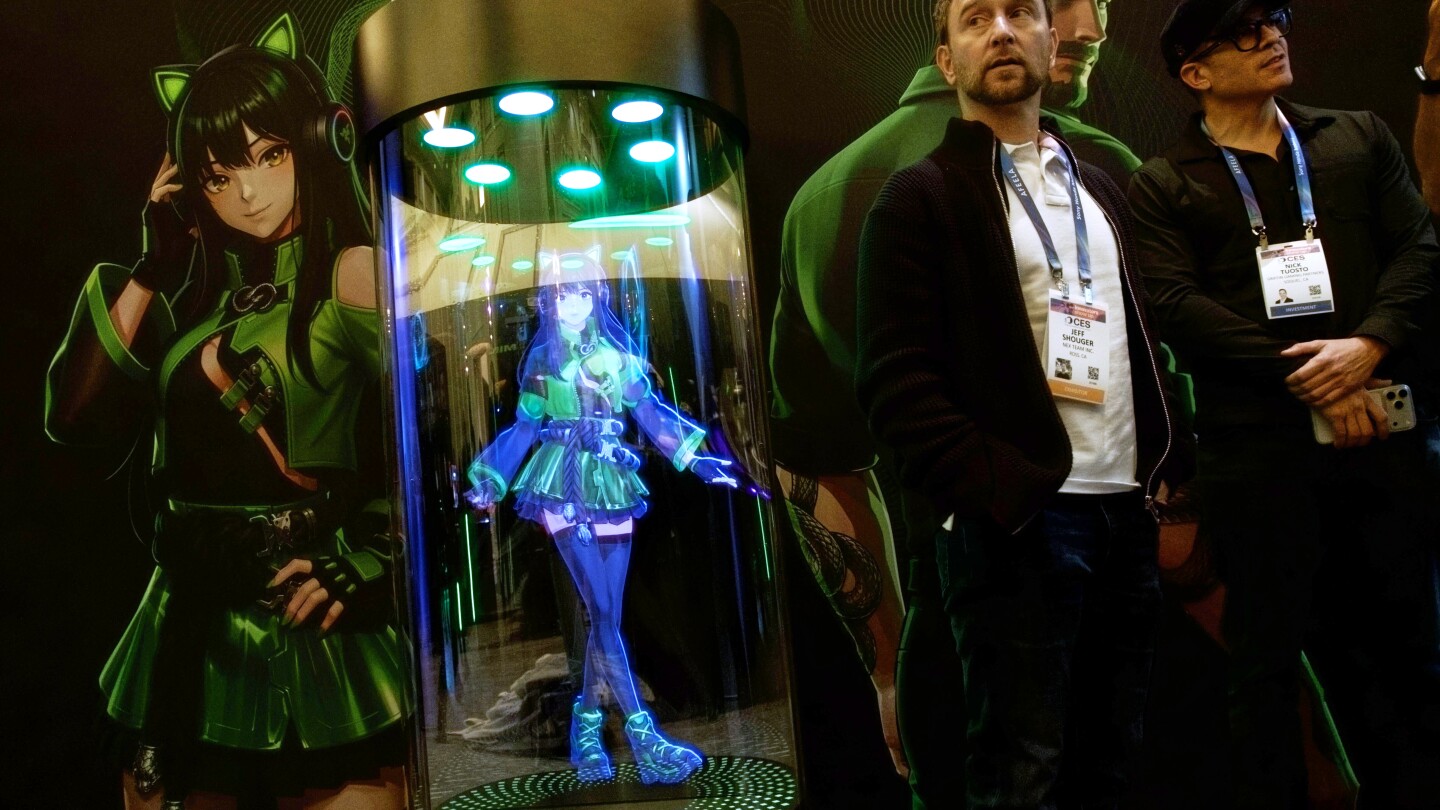
Gaming technology company Razer, known for its attention-grabbing hardware like haptic seat cushions and tri-screen laptops, expanded beyond its traditional gaming focus by demonstrating two AI-powered prototypes. The first is an over-ear gaming headset that doubles as a general-purpose assistant, while the second is an AI desk companion capable of providing gaming advice and helping organize users’ lives.
This holographic companion, named Project Ava, has evolved from an on-screen AI assistant launched last year into a physical form housed in a small glass tube that sits near a computer. The animated sprite features built-in speakers and a camera to observe its surroundings. Both devices are AI-agnostic, allowing users to choose their preferred AI model. During demonstrations, the headset (Project Motoko) ran on OpenAI’s ChatGPT, while Project Ava utilized xAI’s Grok. Razer expects both products to hit the market later this year.
Airport operations may soon see a dramatic transformation, as Oshkosh Corporation debuted a fleet of autonomous airport robots designed to optimize what the company calls “the perfect turn” – the tightly choreographed process that follows a plane’s landing. These robots can handle fueling, cleaning, cargo management, and passenger transitions.
According to CEO John Pfeifer, the technology aims to reduce delays without compromising safety while maintaining operations during severe weather conditions that challenge human crews. Testing is already underway with major airlines, with initial deployment likely at major hub airports such as Atlanta or Dallas within the next few years.
Chinese robotic vacuum manufacturer Roborock introduced an innovative vacuum that sprouts chicken-like legs to climb stairs and clean steps along the way. Though the Saros Rover moved somewhat slowly during demonstrations, Roborock claims it will navigate almost any stairwell design, including spiral staircases. No release date has been announced for this still-in-development product.
Health technology also featured prominently, with Withings unveiling its Body Scan 2 smart scale. Far exceeding the capabilities of typical bathroom scales, this $600 device measures 60 different biomarkers in just 90 seconds, including heart age, vascular age, and metabolism by analyzing data from the user’s feet and hands.
The scale, slated for spring release, provides a nerve health score and measures changes in electrodermal activity. It pairs with a subscription app priced at $10 monthly or $100 annually to deliver personalized health advice and trajectory tracking, aiming to help users monitor their health and reverse harmful habits.
In the energy sector, Commonwealth Fusion Systems, Nvidia, and Siemens announced a collaboration to accelerate nuclear fusion development through artificial intelligence. Commonwealth Fusion Systems is constructing a prototype fusion power plant called SPARC in Massachusetts, which is approximately 70% complete. The partnership will create a “digital twin” simulation of the physical machine to speed up progress.
CEO Bob Mumgaard explained that this approach will compress years of manual experimentation into weeks of understanding. SPARC serves as a prototype for the company’s planned ARC power plant, which aims to connect to the power grid in the early 2030s using powerful magnets to create fusion conditions. The installation of the first high-temperature superconducting magnet represents a significant milestone in the project’s development.
Fact Checker
Verify the accuracy of this article using The Disinformation Commission analysis and real-time sources.

10 Comments
CES always showcases the latest advancements in consumer and industrial technology. Glad to see a focus on AI-driven industrial transformation, which could have significant impacts on mining, energy, and other resource-intensive sectors.
The AI-powered industrial revolution showcased at CES is an exciting development. Integrating these technologies into resource-intensive industries like mining, metals, and energy could drive major efficiency and sustainability improvements.
The collaboration between tech leaders like Nvidia, AMD, Intel, and Lenovo is promising for accelerating innovation in enterprise AI platforms and consumer wearables.
It will be interesting to see how these AI-powered solutions impact productivity, automation, and the user experience across different applications.
Innovations in manufacturing, supply chain, and AI-enhanced experiences are crucial for industries like mining to boost efficiency, sustainability, and competitiveness. Looking forward to seeing how these CES announcements evolve.
Exciting to see the continued advancements in AI and manufacturing technology showcased at CES. Reimagining production and supply chains with AI could drive major efficiency gains across industries.
I’m curious to learn more about the specific AI applications Siemens and Nvidia are developing to transform manufacturing.
Glad to see technology leaders coming together to drive innovation in areas like wearables, enterprise AI, and smart manufacturing. These advancements could have wide-ranging implications for the mining and energy sectors.
The partnership between Siemens and Nvidia sounds promising for accelerating AI in industrial settings. Curious to learn more about the specific use cases and benefits they’re targeting.
Integrating AI into manufacturing and supply chains could unlock significant productivity gains and cost savings. Will be interesting to see the real-world impacts.