


Listen to the article
Syria Introduces New Currency to Stabilize Post-Assad Economy
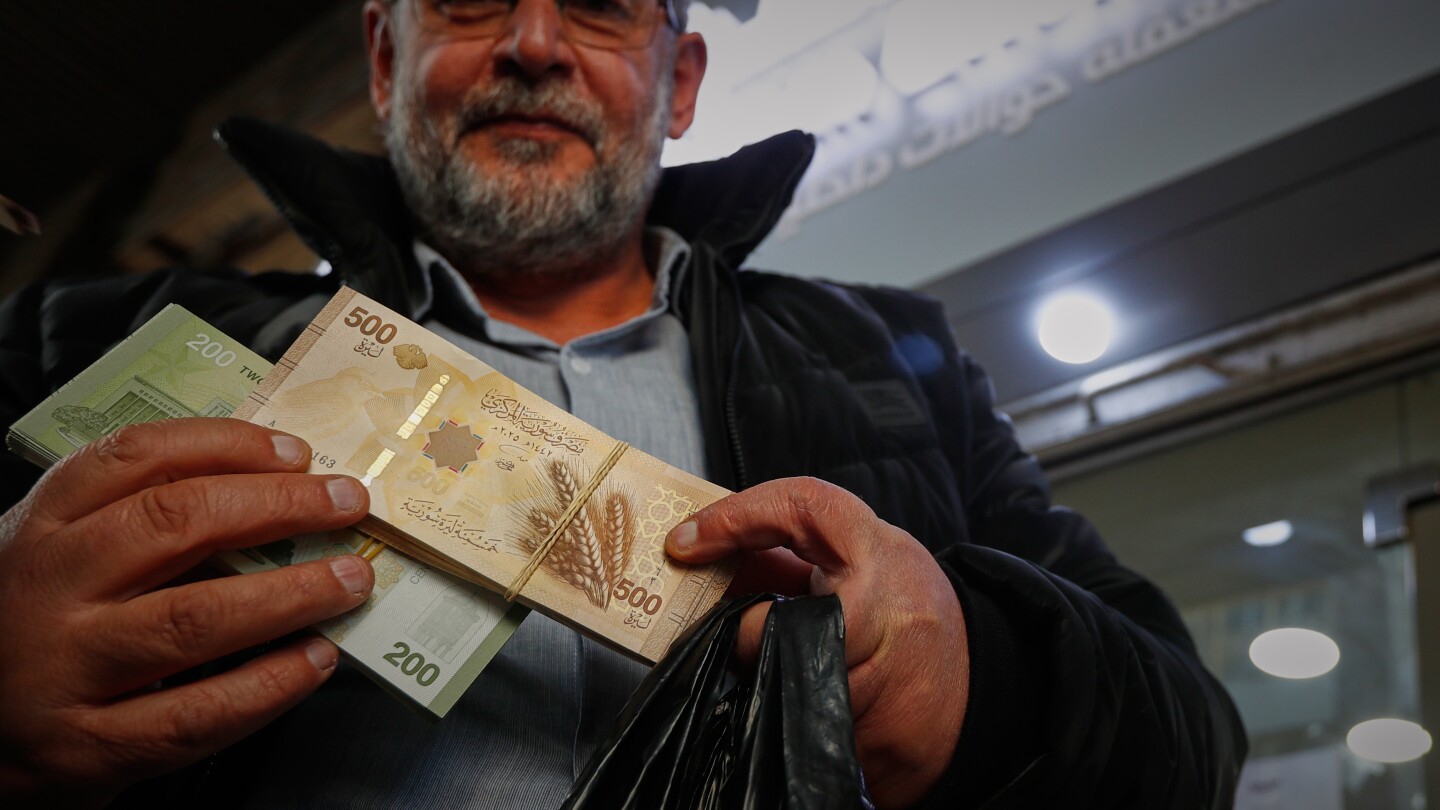
Syria began circulating new currency notes on Saturday as part of broader economic reforms aimed at stabilizing the nation’s economy following the fall of Bashar Assad’s government last year.
The currency reform, authorized by a decree from President Ahmad al-Sharaa, involves redenominating the Syrian pound by removing two zeros from its nominal value. This means 100 Syrian pounds in the old currency will now equal one Syrian pound in the new system.
Central Bank Governor Mokhles Nazer announced on social media platform X that after months of preparation, the exchange of old banknotes for new ones officially commenced Saturday morning. The transition will follow a timetable established by the central bank, with designated exchange centers handling the conversion process.
Under the new currency system, the largest denomination has changed from 5,000 Syrian pounds to 500 pounds. The old banknotes, some featuring images of former president Bashar Assad and his father Hafez Assad, will be gradually phased out of circulation.
Currency exchange shops in Damascus were trading the U.S. dollar at 11,800 Syrian pounds for the old banknotes on Saturday. This represents a dramatic depreciation from mid-March 2011, when Syria’s conflict began and the dollar was worth just 47 Syrian pounds.
The currency reform comes as Syria attempts to recover from a seismic political shift. In December 2024, insurgent groups led by Hayat Tahrir al-Sham, headed by al-Sharaa, marched into Damascus, ending the Assad family’s 54-year rule over the country. Since then, the new authorities have been working to rehabilitate an economy devastated by more than a decade of civil war, international isolation, and Western sanctions.
Economic experts see the currency redenomination as both practical and symbolic. Practically, it simplifies transactions by reducing the number of zeros needed in everyday purchases. Symbolically, it represents a break from the economic policies of the previous regime while attempting to restore confidence in the national currency.
The international community has responded to the political transition with cautious optimism. The United States and European Union have removed most sanctions imposed during Assad’s rule, potentially opening pathways for foreign investment and economic recovery. International financial institutions have also signaled willingness to engage with Syria’s new government, provided certain governance reforms continue.
Syria’s economy faces tremendous challenges beyond currency stability. Years of conflict destroyed significant infrastructure, displaced millions of citizens, and decimated productive sectors like agriculture and manufacturing. Oil production, once a mainstay of the economy, remains well below pre-war levels, with many facilities damaged or under uncertain control.
The currency reform comes amid a broader package of economic measures introduced by the new government, including efforts to combat corruption, restructure public finance, and attract expatriate investment. However, analysts caution that sustainable economic recovery will require not just technical reforms but also political stability and improved security conditions throughout the country.
For ordinary Syrians, who have endured years of economic hardship with soaring inflation and collapsing purchasing power, the currency reform represents a tangible, if modest, step toward normalcy. Many citizens, however, remain skeptical about rapid improvement in living conditions after years of broken promises and economic decline.
As the currency transition proceeds in coming weeks, international observers will be watching closely to see whether this monetary reform signals the beginning of genuine economic recovery or merely a cosmetic change in a country still facing profound structural challenges.
Fact Checker
Verify the accuracy of this article using The Disinformation Commission analysis and real-time sources.

10 Comments
This currency redenomination is a necessary but risky move for Syria. Successful implementation could help stabilize prices and transactions, but mismanagement could worsen the economic chaos. Careful planning and transparency from the central bank will be critical.
Removing the Assad family imagery from the currency is a symbolically important step, though the practical economic impact will depend on broader reforms. I hope Syria can use this transition to build trust and lay the groundwork for sustainable recovery.
Well said. Symbolic gestures can go a long way, but real economic progress requires substantive policy changes. Syria faces a daunting task, but getting the currency right could be an important building block.
Interesting to see Syria take this step to stabilize its economy after years of turmoil. Redenominating the currency and phasing out old bills could help restore confidence and normalcy. It will be important to monitor how this transition plays out on the ground.
You make a good point. Restoring economic stability is critical for Syria’s recovery, though the transition may face challenges. Careful implementation and transparency from the central bank will be key.
I’m curious to see how the Syrian public reacts to these new banknotes and the transition process. Phasing out the old bills featuring Assad imagery could be a symbolic break from the past, but managing public confidence will be crucial.
That’s a good point. The visual changes to the currency could have strong psychological and political implications for Syrians. Effective public communication will be vital to ensure a smooth adoption of the new money.
Currency reforms are always tricky, especially in a country emerging from conflict. Syria will need to carefully manage the logistics of exchanging old for new bills to avoid chaos or profiteering. Transparent implementation and clear timelines will be essential.
This currency reform is a bold move by the new Syrian government as it seeks to rebuild the economy. Removing zeros from the nominal value could simplify transactions and help curb hyperinflation, but the success will depend on broader economic policies.
Agreed. Addressing the root causes of Syria’s economic woes, like the war damage and international sanctions, will be just as important as the currency changes. It’s a complex challenge, but an essential one for the country’s recovery.