


Listen to the article
Major League Baseball’s automated strike zone technology is poised to transform the game, with some pitchers and batters finding themselves winners and others losers when the system debuts Wednesday night in San Francisco.
Toronto Blue Jays pitcher Kevin Gausman was surprised to learn he ranked among the top beneficiaries of human umpires’ judgment over the past decade, receiving 709 called strikes on pitches actually outside the strike zone.
“I would have thought maybe I was top 20 maybe, but top five is kind of crazy,” Gausman said. “I guess the book is kind of still out. We’ll see what happens and how we have to adjust.”
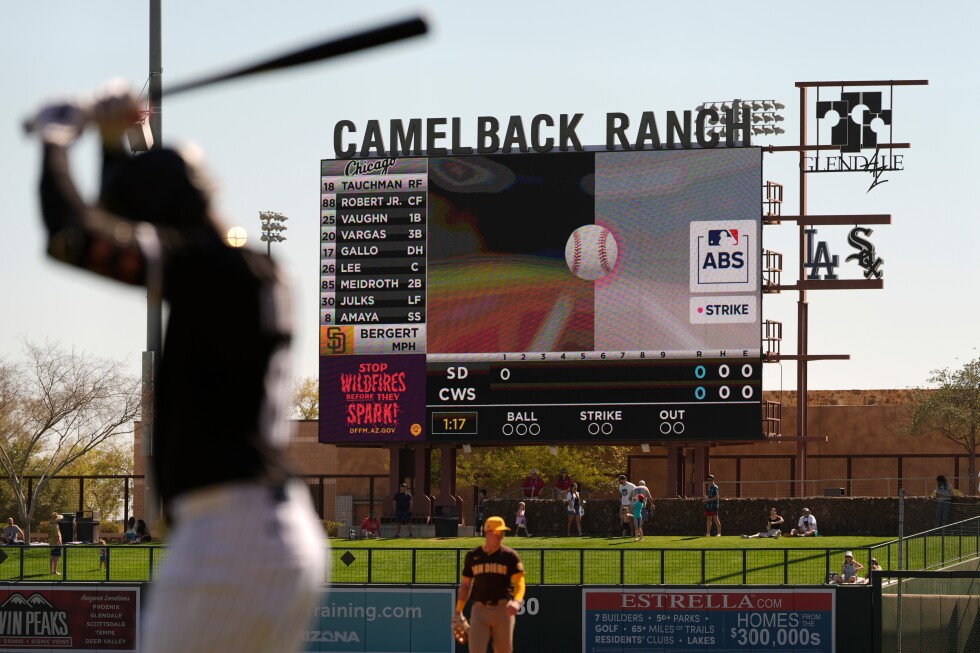
The Automated Ball-Strike System (ABS) utilizes Hawk-Eye technology with 12 cameras that can measure pitch location with remarkable precision – about one-sixth of an inch accuracy. The system will make its regular-season debut when the New York Yankees face the San Francisco Giants.
MLB Statcast data reveals Chicago Cubs pitcher Kyle Hendricks led all pitchers with 777 called strikes on pitches that should have been balls over the past decade. Philadelphia’s Aaron Nola (747), Gausman and Zach Davies (709 each), and Kyle Gibson (697) round out the top five beneficiaries.
“I guess that’s a good thing because you make balls look like strikes,” Nola reflected. “There’s going to be some maybe good and bad to it, but I think in big situations and big games, that’s going to help out a lot. We’ve seen over the years our side lose games on a bad call.”
On the batting side, Los Angeles Dodgers star Mookie Betts has been the most disadvantaged player, receiving 714 called strikes on pitches outside the zone. Eugenio Suárez (684), José Ramírez (657), Paul Goldschmidt (656), and Aaron Judge (653) follow on that unfortunate list.
“He knows the strike zone as well as anyone and it does seem that he gets the short end of a lot of calls,” Dodgers manager Dave Roberts said of Betts. “He’s a guy I certainly would trust to challenge a call.”
Conversely, some pitchers have been hurt by missed calls, with Washington’s Patrick Corbin leading pitchers with 470 instances where pitches in the strike zone were called balls. Chris Sale (461), Nola (460), Carlos Rodón (450), and Yu Darvish (442) complete that top five.
The implementation of ABS comes after years of testing in the minor leagues. Players who experienced the system in Triple-A, like Nola during his injury rehabilitation last August, have mixed reactions.
“We’re just going to have to see what the umpires do,” Nola said, “if they’re really going to be that tight as they were down there.”
Three-time Cy Young Award winner Justin Verlander, beginning his 21st MLB season with Detroit, points out a fundamental change in how strikes are called: “All umpires always had like — they give a little bit here, they’re a little tight there. You know this as a hitter and a pitcher. But it’s all because of the way they set up and they see certain areas better than others. And now they’re put in a situation where they have to call this theoretical zone, instead of creating their own strike zone that they’re probably much more consistent at.”
Teams have been preparing players by using ABS during batting practice and displaying ball/strike decisions on scoreboards. The system will operate differently than previous Statcast calculations, measuring the strike zone at the middle of home plate rather than the front, and basing the vertical boundaries on a batter’s height.
The potential impact on game outcomes is significant. Historically important missed calls like umpire Richie Garcia’s ball call on Mark Langston’s 2-2 pitch to Tino Martinez in the 1998 World Series opener – which led to Martinez hitting a grand slam on the next pitch – could be reversed under the new system.
When asked if he wished ABS had been available back then, Garcia simply responded: “I’d rather take the grief.”
MLB tracking shows umpire accuracy has improved in recent years, with only 1.6% of pitches outside the zone called strikes in 2023, down from 4.2% when tracking began in 2008. Similarly, only 2.1% of pitches in the zone were incorrectly called balls last year.
As baseball enters this new technological era, pitchers who thrived on getting calls just beyond the edge of the plate will need to adapt, while batters with strong plate discipline may finally see their patience rewarded with more accurate calls.
Fact Checker
Verify the accuracy of this article using The Disinformation Commission analysis and real-time sources.

6 Comments
As a fan, I’m excited to see how the new automated strike zone changes the game dynamics. It’s bound to create some surprising outcomes.
Fascinating how the automated strike zone could disrupt the game. I’m curious to see how pitchers and batters will adapt their strategies. Will we see some unexpected winners emerge?
It’s intriguing that some pitchers have benefited greatly from human umpires’ judgment over the years. I wonder how they’ll need to adjust their approach now that the Hawk-Eye system will be so precise.
The precision of the Hawk-Eye system is impressive, but I wonder how it will affect the more nuanced aspects of pitching and batting. There could be some unintended consequences.
I appreciate the data showing how much more lenient the human umpires have been on certain pitchers. I imagine the transition to the automated system could be quite a challenge for them.
The top beneficiaries of the human strike zone make for an interesting list. I’m eager to see if any of them can maintain their success or if the new tech will level the playing field.