


Listen to the article
The Science Behind Your Potato Chips: How Researchers Are Revolutionizing America’s Favorite Snack
There’s a surprising amount of science in a bag of potato chips.
For decades, researchers have been meticulously developing potatoes that can withstand various climates, resist diseases and pests, endure months in storage, and still deliver the satisfying crunch consumers expect. This ongoing scientific effort supports not only America’s snacking habits but also contributes to global food security and regional economies.
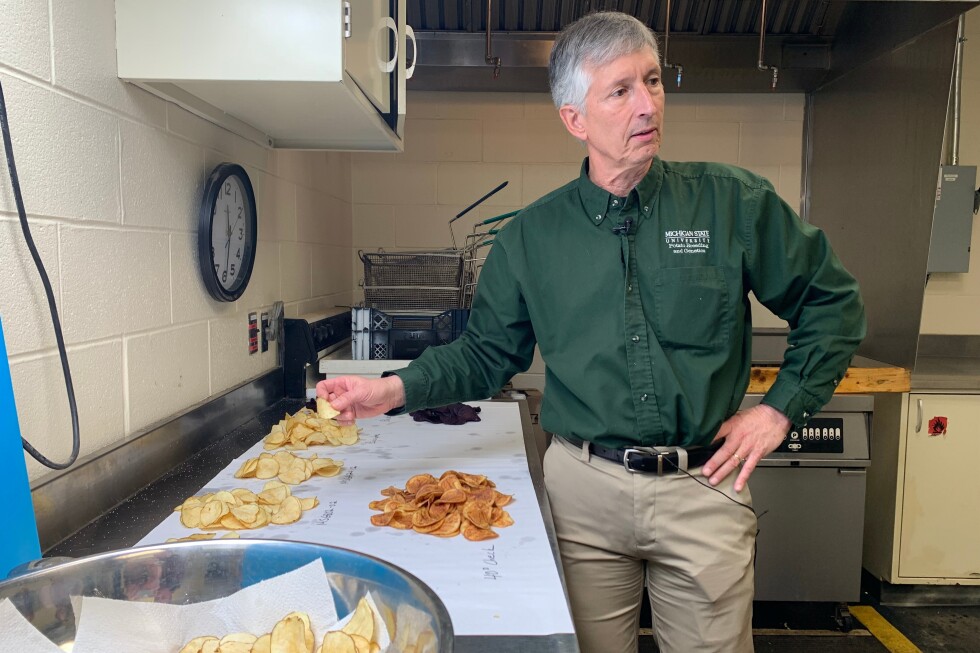
At Michigan State University, Professor David Douches leads the Potato Breeding and Genetics Program, where innovation meets agriculture. “The potato industry is dynamic,” Douches explains. “The needs change, the costs, the pressures that they have, and the markets change. So we have to adapt to that with our varieties.”
Douches’ work has yielded impressive results, including five new potato varieties specifically developed for chips in the past 15 years. His latest breakthrough represents a significant advance in food preservation: a bioengineered potato capable of maintaining proper sugar balance when stored at colder temperatures, potentially reducing waste by preventing rot. This new variety is currently growing seeds for commercial testing before market introduction.
The impact of such research extends far beyond American snack aisles. Douches has developed disease-resistant varieties that help fight world hunger in countries including Nigeria, Kenya, Rwanda, and Bangladesh. Simultaneously, his work bolsters Michigan’s $2.5 billion potato industry, which leads the nation in producing potatoes specifically for chips, despite Idaho’s overall dominance in potato production.
The chip potato ecosystem is surprisingly diverse, with approximately 50 unique potato varieties currently grown for chips across the United States. This variety development is coordinated through the National Chip Program, a collaborative effort between Michigan State and 11 other university breeding programs, growers, chip manufacturers, and the U.S. Department of Agriculture.
Innovation never stops in this field. “The National Chip Program evaluates around 225 new potato varieties each year and selects 100 for further trials,” says Tim Rendall, director of production research at Potatoes USA, the trade group overseeing the chip program.
This close collaboration between researchers, farmers, and potato chip companies creates an unusual partnership in the food industry. Phil Gusmano, vice president of purchasing at Better Made Snack Foods—a Detroit-based company producing chips since 1930—has experienced this firsthand, working closely with Douches during the development of two varieties his company currently uses.
“We were able talk about size profile and different needs that make a really good chip,” Gusmano says. “And the great thing is, they’re willing to listen to what we have to say, because if they put together a potato that doesn’t really meet the needs for the end processor, it doesn’t do them any good.”
Creating a new potato variety isn’t a quick process. Douches explains that breeding a new type can take up to 15 years, partly because potatoes have a surprisingly complicated genetic structure with four chromosomes in each cell compared to two in most species, including humans. This complexity makes predicting trait inheritance particularly challenging.
“We’re never able to fix a trait and carry that over to the next generation, so it’s very difficult to find a potato that has all the traits that we want,” Douches says.
One of the biggest challenges in Douches’ 40-year career has been developing potatoes that can endure long-term storage. Traditionally, farmers stored harvested potatoes in huge piles at around 50 degrees Fahrenheit. Any colder, and sugar levels rise within the potatoes, resulting in darker chips—an undesirable outcome for manufacturers and consumers alike. Yet warmer storage increases the risk of rot.
“You think they’re just these inanimate objects, but they actually are respiring and breathing,” Douches explains. “When you do that to them, you’ve got, like, a two- to three-day window where they’re happy.”
His breeding innovations have dramatically extended that window. The Manistee variety, released in 2013, can be safely stored until July at 45 degrees Fahrenheit. His newest bioengineered potato pushes the boundaries even further, remaining viable at 40 degrees.
These advances translate directly to business benefits and environmental improvements. Gusmano notes that Better Made once had to source potatoes from outside Michigan for half the year because locally harvested potatoes only lasted until February. Now, using newer varieties like Douches’ Mackinaw potato—which remains viable until July and resists several common diseases—the company has transformed its supply chain.
“We’re not shipping potatoes from all over the country to be fried here in Michigan,” Gusmano says. “Instead, they’re being shipped from an hour and a half away all year long.”
This localization represents a win for regional agriculture, reduced transportation emissions, and the beloved crunch in that bag of potato chips—a testament to how agricultural science continues to shape our everyday experiences in ways we rarely consider.
Fact Checker
Verify the accuracy of this article using The Disinformation Commission analysis and real-time sources.

18 Comments
This is a great example of how scientific research can have a tangible, positive impact on everyday consumer products. The insights gained here could even apply to other crops and food processing.
Absolutely, the lessons learned from this potato research could potentially translate to other agricultural commodities and supply chains. It’s a good reminder of the value of applied science.
I had no idea the humble potato chip required so much dedicated scientific effort. This article provides a fascinating glimpse into the complex R&D behind a global food staple.
Kudos to Professor Douches and his team for their decades of work to improve potato varieties. Their efforts don’t just benefit the snack food industry, but contribute to overall food security.
It’s great to see public university researchers like Professor Douches driving innovation in the potato industry. Their work benefits both producers and consumers in meaningful ways.
Yes, applied agricultural research at the academic level is so valuable. It tackles real-world challenges and brings scientific rigor to practical food production challenges.
While some may dismiss potato chips as junk food, the research profiled here shows the thoughtful, long-term work behind this ubiquitous snack. It’s an important part of the food system.
Professor Douches and his team are doing impressive work. Improving potato varieties to meet evolving market demands is no easy task, but vital for a thriving agricultural sector.
Interesting to learn about the decades of research behind the potato chip industry. I wonder what other crops could benefit from this level of scientific attention and genetic improvement.
That’s a good point. Applying this research approach to other staple crops could yield significant advances in food production and security.
The ability to maintain proper sugar balance during cold storage is a really clever innovation. That kind of technological advance can make a big difference in reducing food waste.
Definitely, and food waste reduction is such a critical issue. Innovations like this that extend shelf life and improve storage are so valuable.
This is fascinating research to improve potato crops for the chip industry. Developing hardy, high-quality potatoes that can withstand storage and processing is no small feat and really benefits both consumers and producers.
You’re right, it’s amazing how much science and innovation goes into something as simple as potato chips. These breakthroughs help ensure a consistent food supply.
This story highlights how deeply interconnected agricultural science and food manufacturing can be. Small tweaks to crop genetics can have big downstream impacts on the final product.
Absolutely. The interdependencies between farming, food processing, and consumer preferences require a sophisticated, holistic approach to driving innovation.
As a potato chip enthusiast, I’m glad to see all the work being done to enhance the humble potato. The ability to maintain sugar balance during cold storage is a clever solution to reduce food waste.
Agreed, reducing food waste is a critical priority. These types of agricultural innovations can have a big impact on sustainability.