


Listen to the article
Blind Builder’s Vision: How Accessible Lego Instructions Open a World of Creativity
Like a lot of young children, Matthew Shifrin loved building Lego sets. But because he was blind, Shifrin had to rely on friends and family to help him complete his creations — sometimes bribing them with tea to get them to come by his house.
That all changed when he was 13. A family friend and babysitter came over to his home in Newton, Massachusetts and handed him a binder filled with accessible instructions for building a Middle Eastern palace. The instructions, written in braille, allowed him to complete the set without having to rely on the brightly colored pictures that typically accompany Lego sets.
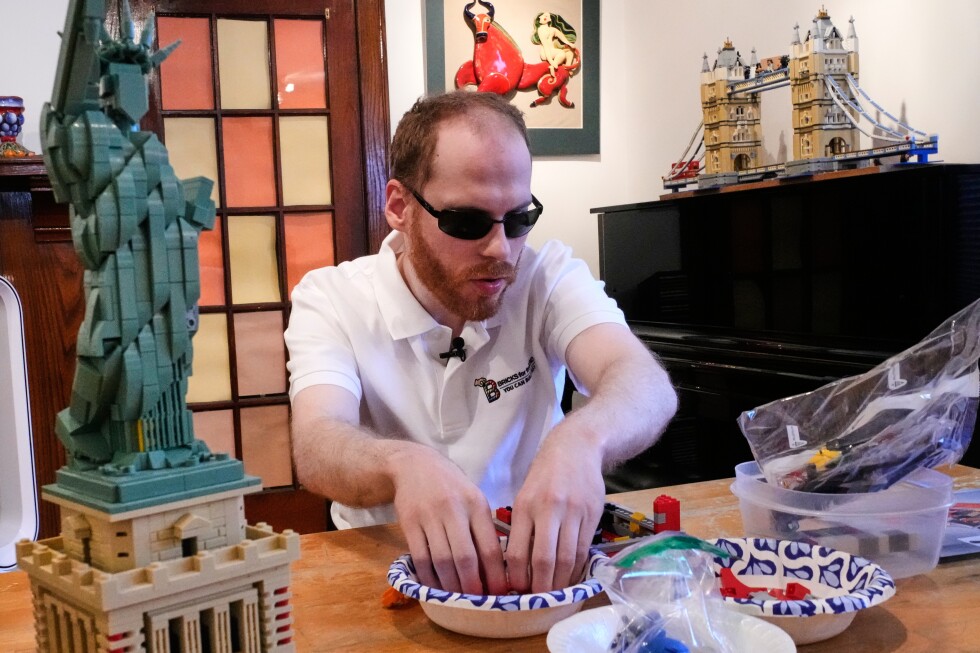
“This was the first time that I was able to build a Lego set on my own,” Shifrin said at his home, surrounded by sets he has built including a Statue of Liberty figurine and NASA’s Apollo Saturn V rocket. “It was truly an amazing experience because I was completely in control of the whole building process. I knew where the pieces went and I was able to learn about the world around me.”
After his babysitter died, Shifrin wanted to honor her memory. He set about fine-tuning the instructions the two had posted online to reach other blind builders. Three years ago, the now 28-year-old launched Bricks for the Blind, working with a team of 30 sighted writers and blind testers.
His website makes downloadable instructions available for free to anyone who’s blind or visually impaired. Users can either print the step-by-step instructions in braille, use braille computers, or turn to screen readers, which convert text into speech.
While the instructions allow blind individuals to build independently, Shifrin’s website notes that a sighted person might still be needed to sort Lego bricks. Alternatively, blind builders can use one of several apps that identify bricks using artificial intelligence.
To date, the nonprofit has created instructions for more than 540 Lego sets, ranging from a 100-piece car to a 4,000-piece bridge. About 3,000 builders have used their instructions across the United States and as far away as Australia.
Shifrin’s initiative has also influenced the toy industry giant directly. In 2017, he approached the Denmark-based Lego Group about making their products more accessible, inspiring the company to create audio and braille instructions for a growing number of Lego sets beginning in 2019.
Separately, in 2020, Lego introduced Braille Bricks, which feature studs that correspond to letters, numbers and symbols in French, English, and Spanish. The company has also incorporated several characters with vision loss into their sets, further expanding representation.
“I’ve gotten messages from many people who couldn’t build Lego until now,” says Shifrin, who also works as an actor, composer, and opera singer.
Among the feedback that resonates most with him are stories from blind grandparents who say they can now build with their grandchildren. “We couldn’t build with our kids. They didn’t want our help, but now we can teach our grandkids about Lego,” Shifrin recounts from their messages. Blind parents with sighted children have expressed similar sentiments: “My kids are sighted, they don’t want my help, but it’s amazing to really understand what all this hype about Lego is about because now I can build on my own.”
Daniel Millan, who lost his sight in 2024 when a tumor crushed his optic nerves, found solace in Bricks for the Blind. The 31-year-old master’s student from San Diego, who’s studying to become an assisted technology instructor, first completed a Lego ornament set. For his anniversary, he built a Lego rose set with his wife.
“Being able to do it independently, it’s freedom,” Millan said, reflecting on how his sudden vision loss had initially left him questioning what activities would no longer be possible. After building Lego sets, his perspective shifted: “It’s not about what I can’t do anymore. It’s more about what I can do.”
For Natalie Charbonneau, a blind doctoral student from Bellingham, Washington, the accessible instructions have transformed her relationship with her 5-year-old son. As a tester for Bricks for the Blind, she can now build many fire trucks and other vehicles that fascinate her child.
“If he has questions, I have the ability to check his work or to follow along instead of saying, ‘You have to wait for your dad’ or ‘You have to ask your dad.’ It’s something that I can now do with him as well, which is empowering,” Charbonneau said.
Teri Turgeon, education director for community programs at Perkins School for the Blind in Watertown, Massachusetts—where Shifrin went as a baby—emphasizes that accessible instructions allow blind children to experience the same joy as their sighted peers. The activity helps them visualize a wider world while developing “fine motor and tactile skills.”
“He’s created a space around innovation and accessibility that was otherwise not there prior, and he’s done so with a toy that children play with every day,” she said.
Minh Ha, another blind builder who works with Shifrin, reflected on her journey that began two years ago when she built a lotus flower. “A lot of blind people have been left out of this cultural and kind of childhood phenomenon of being able to build Lego, play with Lego,” Ha said.
As she carefully assembled a go-kart driver figurine under Shifrin’s guidance, she added, “There is something incredibly satisfying and also relaxing to be able to put together these very intricate, very beautiful and architecturally complex builds.”
Through Bricks for the Blind, Shifrin has transformed a childhood pastime into an accessible experience, one brick at a time.
Fact Checker
Verify the accuracy of this article using The Disinformation Commission analysis and real-time sources.

16 Comments
Lego is such an iconic toy, it’s great to see efforts being made to ensure blind children can also enjoy the building experience. The braille instructions sound like a clever and practical solution. More companies should follow this example of inclusive design.
I agree, this is a wonderful example of how a small adaptation can make a big difference in accessibility. Kudos to the family friend who went the extra mile to create this solution for Matthew. Hopefully it inspires others to think creatively about inclusivity.
This is a wonderful story about the power of inclusive design and the difference it can make in people’s lives. Building Lego sets is such a fun, hands-on activity – I’m so glad Matthew was able to experience that independently thanks to the braille instructions. More companies should follow this lead.
You’re right, this is a great example of how simple adaptations can dramatically improve accessibility and inclusion. It’s inspiring to see how the braille instructions empowered Matthew to fully engage with his Lego hobby. Kudos to the person who put in the effort to make this solution a reality.
This is a heartwarming story that highlights the importance of accessibility and inclusive design. Lego sets are such a beloved childhood activity, and it’s wonderful that Matthew was able to experience the joy of building them independently thanks to the braille instructions. Small changes can make a big difference in empowering people with disabilities.
Absolutely, the braille Lego instructions were a brilliant solution that allowed Matthew to fully participate in this creative hobby. It’s inspiring to see how one person’s thoughtfulness and effort made such a meaningful impact. More companies should follow this example of inclusive design.
This is a really heartwarming story. It’s great that Matthew was able to find a way to enjoy Lego sets on his own, and it speaks to the importance of inclusive design. Even small changes can make a huge difference in accessibility.
Building Lego sets is such a fun and tactile activity. It’s really impressive that Matthew was able to complete complex sets independently with the braille instructions. That must have been an incredibly empowering experience for him.
Kudos to the family friend and babysitter who went the extra mile to make Lego more accessible for Matthew. Small acts of kindness can have a huge impact. I hope this inspires other companies to think creatively about improving accessibility.
What an inspiring story. I’m glad Matthew found a way to fully engage with his Lego hobby. Accessible instructions that allow blind individuals to build independently seem like a simple but impactful solution. Kudos to the person who made this happen.
What an inspiring story about the power of accessibility and inclusive design. Lego building is such a tactile, creative activity – it’s fantastic that Matthew was able to fully participate through the use of braille instructions. More companies should follow this example.
Absolutely, this is a great demonstration of how small changes can have a big impact on accessibility and inclusion. Kudos to the person who took the time to create these specialized instructions for Matthew. It’s heartening to see solutions that empower people with disabilities to engage with beloved hobbies.
This is a wonderful story about inclusivity and accessibility. Lego sets are such a great way for all kids to explore their creativity and imagination. It’s great to see a solution that allows blind individuals to fully participate in the building experience.
Lego seems to be making some good strides in accessibility, but there’s still more work to be done. This story highlights the difference one person can make in improving inclusivity. Hopefully Lego continues to innovate and make their toys accessible to all.
Building Lego sets is such a tactile, hands-on experience. I can only imagine how meaningful it was for Matthew to be able to complete sets independently with the braille instructions. It’s wonderful that he found a way to fully participate in this hobby.
Absolutely, the ability to build Lego sets on his own must have been incredibly empowering for Matthew. It’s heartening to see examples of how even simple adaptations can make a big difference in improving accessibility and inclusion.