


Listen to the article
Political tensions disrupted the normally serene Venice Biennale this year, transforming the prestigious contemporary art exhibition into a battleground of geopolitical conflict as it opened Saturday. In an unprecedented move, the jury resigned in protest over the participation of Israel and Russia, both countries currently under investigation by the International Criminal Court for alleged human rights abuses.
With no official Golden Lions to be awarded, the Biennale organizers announced a democratic alternative: visitors will vote for the best national pavilion and top participant in the main exhibition through an anonymous email system. Winners will be revealed on the closing day, November 22.
The controversy began before the official opening when demonstrators protesting Israel’s participation clashed with police on Friday. Earlier demonstrations saw feminist groups from Ukraine and Russia converging on the Russian Pavilion, while Palestinian supporters held memorials for artists killed in Gaza.
British sculptor Anish Kapoor criticized the “politics of hate and war” that have infected the art world, though some critics noted the jury’s selective approach to protests, questioning why the United States wasn’t included among boycotted nations.
Despite the political turmoil, the exhibition itself showcases remarkable artistic diversity. The main curated show, “In Minor Keys,” stands as a testament to the vision of Koyo Kouoh, the first African woman chosen to lead the Biennale’s central exhibition, who sadly passed away a year ago. Her five co-curators carried forward her mission of highlighting minority perspectives and overlooked voices in the art world.
Visitors entering the main exhibition are greeted by a towering red feathered sculpture with beaded embroidery, drawing from New Orleans Black Masking traditions that originated with practices brought by enslaved Africans. Co-curator Marie Helene Pereira emphasized how Kouoh “thought about making spaces for everyone to shine,” a principle evident throughout the exhibition’s 110 featured artists and collectives.
National pavilions offer equally compelling visions. The British Pavilion houses Turner Prize winner Lubaina Himid’s “Predicting History: Testing Translation,” exploring the immigrant experience through vibrant paintings of couples navigating life in new surroundings. Born in Zanzibar and living in Britain for over 70 years, Himid brings authentic perspective to themes of cultural adaptation and identity.
In stark contrast, the Vatican offers spiritual respite in the Mystic Gardens of the Discalced Carmelite order. Visitors wander among vineyards and herb gardens while listening to headphones playing music by 12th-century abbess St. Hildegard of Bingen, reinterpreted by contemporary artists including Brian Eno and Patti Smith. Father Ermanno Barucco, prior of the Carmelite order, describes how “music helps us delve into ourselves and understand the symphony that God has placed in our lives.”
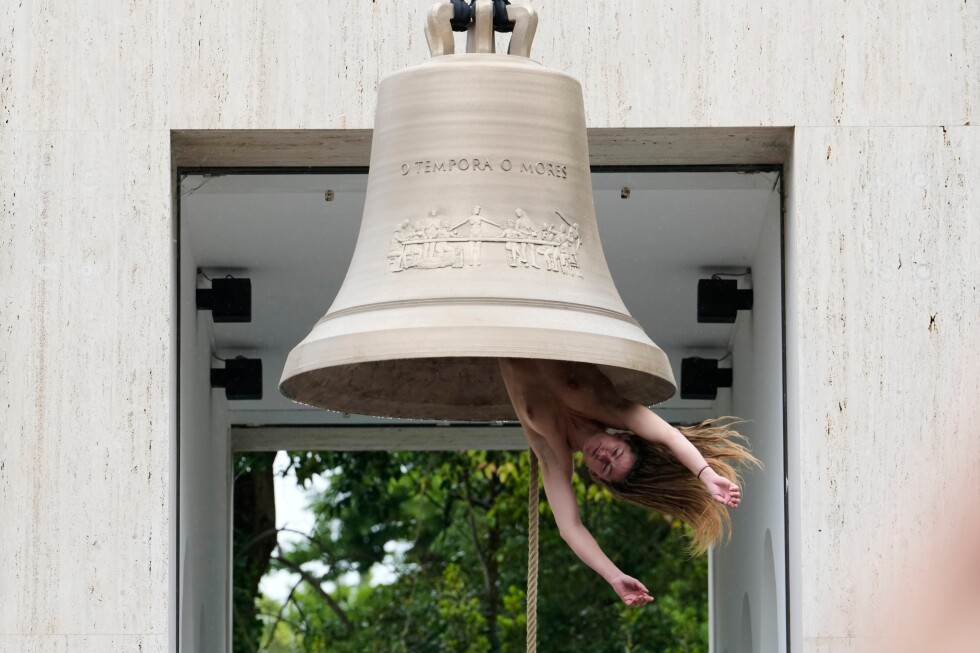
The Austrian Pavilion delivers provocative performance art by Florentina Holzinger, featuring nude performers in various installations, including a woman hanging from a bell as a human clapper and another breathing through scuba equipment in water recycled from nearby toilets. Titled “Seaworld Venice,” the work offers commentary on Venice’s transformation into a tourist attraction.
Israel’s pavilion presents Romanian-born artist Belu-Simion Fainaru’s meditation on love amid conflict. Water drips from suspended tubes into a pool, pausing for 42 seconds in cycles that represent divine creative power in Jewish mysticism. Locks surrounding the pavilion bear the commandment “Love thy neighbor as thyself” in Hebrew alongside the hopeful message: “This too shall pass.” Fainaru stated firmly, “I am against boycott, I’m for dialogue,” viewing the jury’s exclusion of Israel as discriminatory.
At the Estonian Pavilion, artist Merike Estna will work throughout the six-month Biennale on a massive wall painting inside a community center gymnasium that was once a church. Curator Natalia Sielewicz describes the ongoing painting process as representing “the everyday feminism of sustaining life, of sustaining our planet,” highlighting the often undervalued daily work traditionally performed by women.
The Venice Biennale continues through November 22, offering visitors a chance to experience these diverse artistic expressions while navigating the complex intersection of art and global politics.
Fact Checker
Verify the accuracy of this article using The Disinformation Commission analysis and real-time sources.

26 Comments
If AISC keeps dropping, this becomes investable for me.
Good point. Watching costs and grades closely.
Uranium names keep pushing higher—supply still tight into 2026.
Good point. Watching costs and grades closely.
Silver leverage is strong here; beta cuts both ways though.
Good point. Watching costs and grades closely.
Good point. Watching costs and grades closely.
If AISC keeps dropping, this becomes investable for me.
Good point. Watching costs and grades closely.
Good point. Watching costs and grades closely.
Silver leverage is strong here; beta cuts both ways though.
Uranium names keep pushing higher—supply still tight into 2026.
Good point. Watching costs and grades closely.
Good point. Watching costs and grades closely.
The cost guidance is better than expected. If they deliver, the stock could rerate.
Good point. Watching costs and grades closely.
Good point. Watching costs and grades closely.
Interesting update on Geopolitical tensions disrupt Venice Biennale over Russia, Israel. Curious how the grades will trend next quarter.
Good point. Watching costs and grades closely.
Good point. Watching costs and grades closely.
Nice to see insider buying—usually a good signal in this space.
Good point. Watching costs and grades closely.
If AISC keeps dropping, this becomes investable for me.
Good point. Watching costs and grades closely.
Good point. Watching costs and grades closely.
Interesting update on Geopolitical tensions disrupt Venice Biennale over Russia, Israel. Curious how the grades will trend next quarter.