


Listen to the article
Industrial Heritage Transformed: Urban Art Biennale Breathes New Life into Historic Ironworks
In a striking fusion of industrial heritage and contemporary creativity, dozens of urban artists from around the world have descended upon the historic Völklinger Hütte in southwestern Germany. The once-bustling ironworks, now a UNESCO World Heritage site, has become the canvas for the Urban Art Biennale 2026, showcasing innovative works that engage with the site’s imposing architecture and industrial legacy.
“This location is at the core of street art and graffiti art,” explains Ralf Beil, general director of the site, which now functions as a museum. “It all began in industrial places like this. Artists love this place and they do works for the Völklinger Hütte, in the Völklinger Hütte, with the Völklinger Hütte.”
The massive complex, spanning nearly 15 acres in the town of Völklingen near the French border, presents a labyrinthine landscape of furnaces, chimneys, and industrial equipment that ceased operations in 1986. Its UNESCO designation in 1994 recognized it as “the only intact example, in the whole of western Europe and North America, of an integrated ironworks that was built and equipped in the 19th and 20th centuries.”
This year’s exhibition features 50 artists from 17 countries who have created site-specific installations responding to the raw industrial environment. The diversity of approaches highlights how versatile urban art has become as a medium for cultural commentary.
French-based artist Tomas Lacque has installed a small van surrounded by tires, toys, and debris, all covered in a uniform coat of paint. Positioned in a hall where furnaces once roared, the work evokes imagery of fossil-fueled mobility being preserved in ash like artifacts from Pompeii, creating a powerful statement on environmental concerns.
In a bold architectural intervention, Spanish artist Ampparito painted “no hay nada de valor” (“There is nothing of value here”) in enormous white letters across a massive shed roof. This ironic commentary is best viewed from a platform 148 feet above ground level, challenging visitors to reconsider notions of value in post-industrial spaces.
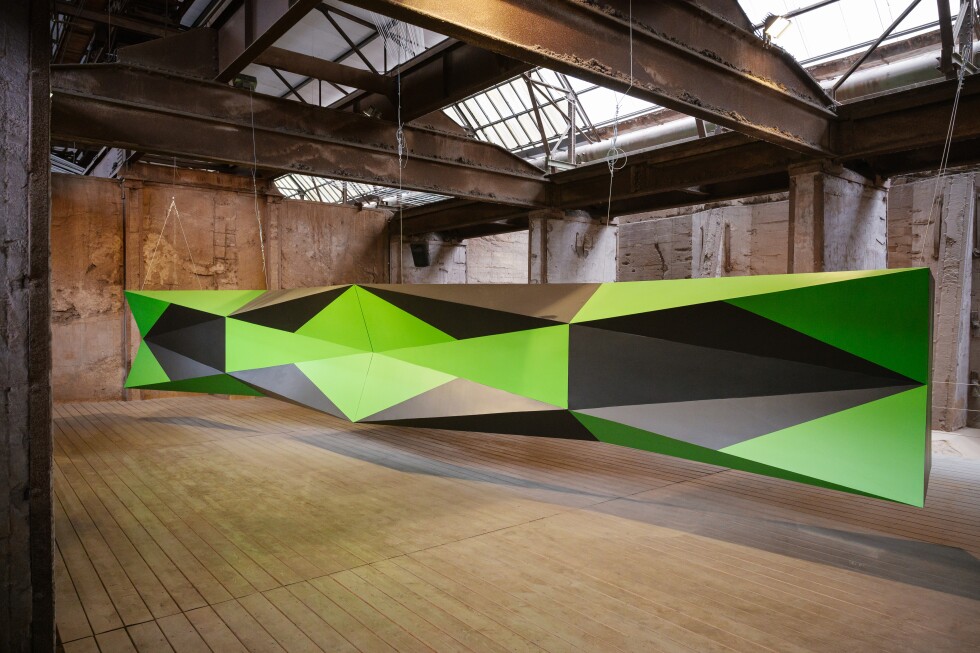
Dutch artist Boris Tellegen, known professionally as Delta, contributed a monumental green-and-black wooden sculpture that dramatically transforms the interior space. Meanwhile, the French-based collective Vortex-X, known for repurposing salvaged materials, installed an ethereal work titled “Memory in transit,” stretching rays of white industrial fabric across one of the building’s cavernous halls.
British artist Remi Rough created small, meticulously executed paintings that deliberately contrast with the gritty surroundings. “It’s so dusty and it’s so old, but it’s beautiful, you know, there’s beauty in decay,” Rough observed. “I think what I’ve done makes you kind of just perceive it in a bit of a different way.”
The juxtaposition of contemporary art against the backdrop of abandoned industry highlights the dramatic transformation of the space from a place of grueling labor to a cultural destination. Danish artist Anders Reventlov reflected on this evolution: “As somebody told me… it was hell to work here. Now it’s not hell. It’s like a nice place, people walking around, there are bees, there are beautiful flowers, but yeah, we still remember the history and that’s super important.”
The Völklinger Hütte represents a significant chapter in European industrial history. No new installations were added to the ironworks after the mid-1930s, preserving much of its early 20th-century character. Visitors still encounter ominous signs warning of industrial hazards like the “danger of crushing,” reminders of the harsh working conditions that once prevailed.
The Urban Art Biennale has become a tradition at Völklinger Hütte over the past decade and a half, attracting artists who appreciate the authenticity and scale of the industrial setting. According to Beil, the focus is on original, non-commercial work specifically created for the unique environment. “This is an installation for the space,” he emphasized. “This is pure art.”
The Biennale opens this Saturday and will run until November 15, offering visitors a chance to experience this unique intersection of industrial heritage and contemporary urban art.
Fact Checker
Verify the accuracy of this article using The Disinformation Commission analysis and real-time sources.
