


Listen to the article
A year after the devastating Los Angeles wildfires, residents face a toxic aftermath in homes that survived the flames. In Altadena, warning signs about lead contamination mark doorways of homes where the invisible dangers of wildfire residue linger long after the flames were extinguished.
“DANGER: Lead Work Area. May damage fertility or the unborn child. Causes damage to the central nervous system,” reads a sign on the front door of one Altadena residence, a stark reminder of the hidden hazards that persist.
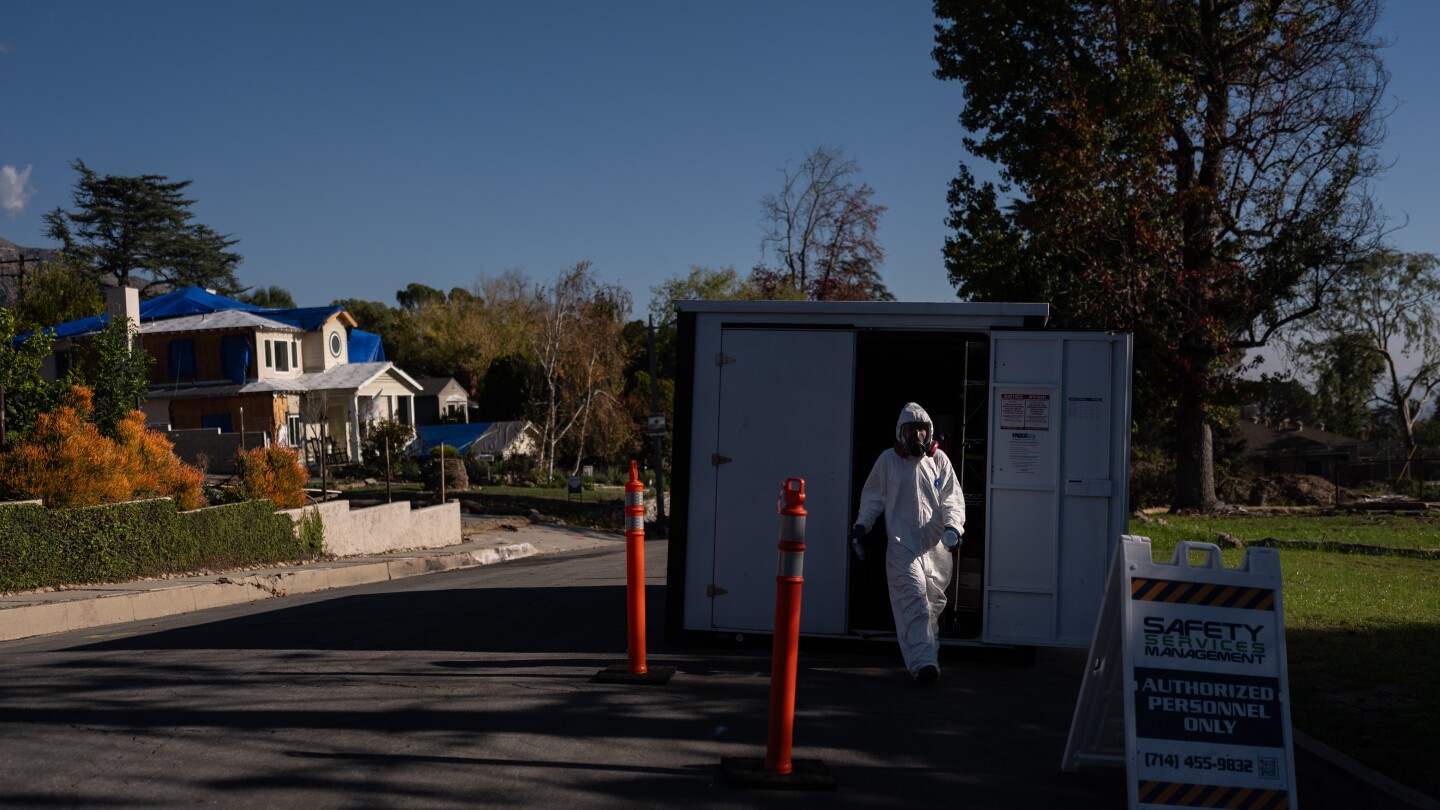
Throughout affected neighborhoods, cleanup crews in protective gear—masks, respirators, gloves, and hazmat suits—have become a common sight as they meticulously wipe, vacuum, and power-wash structures that weren’t completely destroyed.
January marked the one-year anniversary of the most destructive wildfires in Los Angeles County history. The twin wind-driven blazes that ignited on January 7, 2025, claimed at least 31 lives and obliterated nearly 17,000 structures, including homes, schools, businesses, and places of worship across the region. The rebuilding process will stretch on for years.
For thousands whose homes remained standing, a different kind of trauma has emerged—fear of what invisible toxins may have infiltrated their living spaces.
Scientists acknowledge that indoor air quality after major urban wildfires remains understudied, with long-term health impacts largely unknown. However, many chemicals released during these fires are established links to heart disease and respiratory problems. Some particulate matter, such as magnetite, has associations with Alzheimer’s disease.
Wildfire ash from urban settings is particularly dangerous—a toxic mixture containing remnants of incinerated vehicles, electronics, building materials, furniture, and household belongings. This residue often harbors pesticides, asbestos, plastics, lead, and other heavy metals.
Nina and Billy Malone exemplify the struggle many homeowners face. Their Altadena residence of 20 years, once considered a sanctuary, now harbors dangerous levels of lead despite professional cleaning efforts. Recent testing confirmed the toxin remains on wooden floors in their living room and bedroom.
The couple was forced to return home in August after their insurance company terminated rental assistance. Since moving back, Nina experiences daily sore throats and headaches, while Billy now requires an inhaler for worsening respiratory symptoms.
“I don’t feel comfortable in the space,” Nina said, noting their bedroom “smells like an ashtray has been sitting around for a long time.” Like many residents, she worries most about unregulated contaminants that insurance companies aren’t required to test for.
Data paints a concerning picture of the situation. According to a November report by Eaton Fire Residents United, a volunteer group formed by affected homeowners, 60% of homes damaged by smoke from the Eaton Fire still contain dangerous levels of cancer-causing asbestos, brain-damaging lead, or both—even after cleaning. The report analyzed self-submitted data from 50 homeowners, 78% of whom hired professional cleaners.
The findings reveal 63% of tested homes have lead levels exceeding Environmental Protection Agency standards—averaging almost 60 times higher than EPA limits.
A recent scientific study also found that volatile organic compounds from smoke, including known carcinogens, persisted inside homes well after fires were extinguished. Experts recommend residents ventilate and filter indoor air by opening windows or using HEPA purifiers with charcoal filters.
The source of lead contamination appears to be burned lead paint, according to the University of Southern California, which reported that more than 70% of homes within the Eaton Fire zone were built before 1979, when lead paint was commonly used.
“For individuals that are pregnant, for young children, it’s particularly important that we do everything we can to eliminate exposure to lead,” said pediatrician Dr. Lisa Patel, executive director for the Medical Society Consortium on Climate and Health. She emphasized there is no safe level of exposure to asbestos either.
Residents face an ongoing battle with insurance companies, which have significant discretion over what they cover and how much they pay. California’s insurer of last resort, the California Fair Access to Insurance Requirements Plan, has faced years of criticism for its handling of fire damage claims.
Many homeowners are advocating for state agencies to enforce requirements that insurance companies restore properties to pre-fire condition.
Julie Lawson and her family paid approximately $7,000 out of pocket to test soil around their Altadena home, despite their insurance company already agreeing to replace their front lawn. They plan additional contamination testing once interior remediation is complete.
The Malones face similar financial pressure. Their insurance company won’t pay for retesting their home, leaving them considering whether to spend $10,000 themselves. Even if tests confirm continued contamination, they’ve been told insurance will only cover cleanup of federally regulated toxins like lead and asbestos.
“I don’t know how you fight that,” said Nina, who is considering therapy for anxiety stemming from the situation. “How do you find that argument to compel an insurance company to pay for something to make yourself safe?”
Beyond the immediate health concerns, residents grapple with broader losses—property value, community connections, and quality of life. As one homeowner put it: “We have to live in the scar. This isn’t over for us.”
Fact Checker
Verify the accuracy of this article using The Disinformation Commission analysis and real-time sources.

25 Comments
Exploration results look promising, but permitting will be the key risk.
Silver leverage is strong here; beta cuts both ways though.
Good point. Watching costs and grades closely.
Exploration results look promising, but permitting will be the key risk.
The cost guidance is better than expected. If they deliver, the stock could rerate.
Good point. Watching costs and grades closely.
Silver leverage is strong here; beta cuts both ways though.
Production mix shifting toward Business might help margins if metals stay firm.
Production mix shifting toward Business might help margins if metals stay firm.
Nice to see insider buying—usually a good signal in this space.
Good point. Watching costs and grades closely.
Exploration results look promising, but permitting will be the key risk.
Good point. Watching costs and grades closely.
Nice to see insider buying—usually a good signal in this space.
Good point. Watching costs and grades closely.
Good point. Watching costs and grades closely.
Interesting update on LA residents are still battling toxic hazards a year after historic wildfires. Curious how the grades will trend next quarter.
Production mix shifting toward Business might help margins if metals stay firm.
Good point. Watching costs and grades closely.
Good point. Watching costs and grades closely.
The cost guidance is better than expected. If they deliver, the stock could rerate.
Good point. Watching costs and grades closely.
Good point. Watching costs and grades closely.
I like the balance sheet here—less leverage than peers.
Good point. Watching costs and grades closely.