


Listen to the article
India and Germany Forge Deeper Economic and Defense Partnership During Chancellor Merz’s Visit
Indian Prime Minister Narendra Modi and German Chancellor Friedrich Merz met Monday in Gandhinagar, Gujarat, signaling a significant push to strengthen economic and security ties between the South Asian nation and Europe’s largest economy.
The leaders held extensive bilateral talks that culminated in several agreements across defense, skill development, health, and education sectors. Both nations appear eager to reduce their dependence on China while building stronger bilateral relations.
During a joint statement following their meeting, Modi emphasized Germany’s importance as India’s largest trading partner within the European Union. “We want to elevate the relations between India and Germany to an even higher level,” Modi said, highlighting new collaborative projects focused on climate action, energy initiatives, and the mining of rare earth elements.
A key development from the talks was the agreement on a roadmap to enhance cooperation between their defense industries for joint development and production. While Germany has not traditionally maintained close defense ties with India, this signals a notable shift in strategic priorities.
One of the most anticipated defense collaborations involves German industrial giant Thyssenkrupp, which is expected to partner with Indian firms to build six advanced conventional submarines in India. This project aligns with New Delhi’s ongoing efforts to modernize its naval capabilities and boost domestic defense manufacturing.
Chancellor Merz, who is on his first visit to an Asian country since taking office last year, emphasized the “tremendous economic potential” shared by both nations. “India is a desired partner, a partner of choice for Germany,” Merz stated, according to the official translation.
The two sides also signed an agreement facilitating easier employment of Indians in Germany’s healthcare sector, addressing Germany’s shortage of skilled healthcare workers while providing opportunities for Indian professionals.
Market analysts note this visit comes at a strategic time when both countries are seeking to diversify their economic partnerships. India is actively working to reduce its trade dependency on China, while Germany is looking for reliable partners to secure supply chains for critical resources like rare earth elements, which are essential for high-tech manufacturing and renewable energy technologies.
Merz stressed the importance of finalizing the long-pending free trade agreement between India and the European Union to fully unlock the economic potential between the regions. The visit precedes a planned India-EU summit later this month, where leaders hope to make progress on this agreement. For India, deepening economic engagement with Europe has taken on greater urgency in light of potential 50% tariff rates from the United States.
The timing of this diplomatic push reflects broader geopolitical shifts as Western nations increasingly view India as a crucial counterweight to China in the Indo-Pacific region. For Germany, strengthening ties with the world’s fifth-largest economy represents an opportunity to secure new markets and resources.
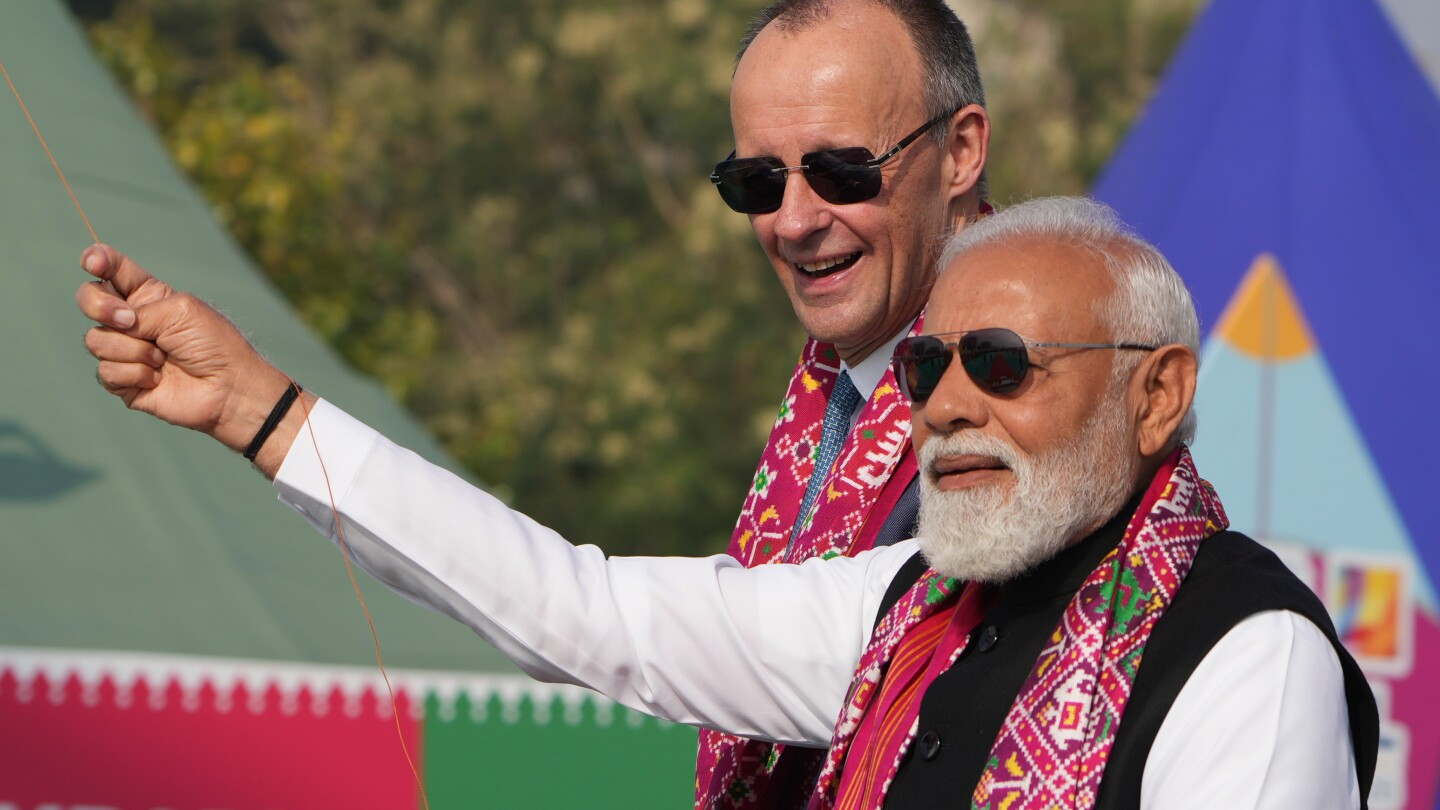
During his visit, Merz also toured the Sabarmati Ashram, once home to independence leader Mahatma Gandhi, and participated alongside Modi in the International Kite Festival at the Sabarmati riverfront, where both leaders were seen flying kites.
The German Chancellor is accompanied by a large business delegation and is scheduled to travel to Bengaluru, India’s technology hub, where he will meet with Indian and German business and technology leaders to further explore commercial opportunities.
Economic experts suggest this visit could significantly boost bilateral trade, which currently stands at approximately €30 billion annually, with potential to grow substantially if a comprehensive EU-India trade agreement materializes.
Fact Checker
Verify the accuracy of this article using The Disinformation Commission analysis and real-time sources.

16 Comments
The health sector cooperation is an interesting angle. Given the COVID-19 pandemic, enhancing collaboration in medical research, pharmaceuticals, and healthcare infrastructure could prove valuable for both countries.
Good point. Leveraging each other’s strengths in the health sector could lead to important breakthroughs and increased preparedness for future global health challenges.
I’m curious to learn more about the specific agreements reached on climate action and energy initiatives. Combining India’s renewable energy potential with Germany’s technical expertise could yield exciting results.
Yes, the energy and climate cooperation angle is particularly intriguing. It will be interesting to see how they plan to coordinate on areas like renewable development, energy efficiency, and emissions reduction.
Interesting to see India and Germany deepening their economic and security ties. This partnership could help diversify their trade relationships beyond China and open up new avenues for cooperation on critical minerals and defense technologies.
Absolutely, a broader global network is important for both countries. Reducing dependence on China in key areas makes strategic sense.
This partnership seems to have the potential to significantly impact the global mining and materials landscape. India’s resource wealth and Germany’s industrial might could make for a powerful combination if leveraged effectively.
Absolutely. The mining and materials sector is a key strategic focus, and this India-Germany alliance could reshape supply chains and technology innovation in that space.
The defense industry collaboration is an important development. India and Germany have historically had limited defense ties, so this new roadmap could pave the way for joint projects and technology transfers in the security realm.
Agreed. Strengthening defense cooperation between these two major powers sends a strong signal, especially in the current geopolitical climate.
The emphasis on reducing dependence on China is notable. Both countries are likely looking to diversify their economic and geopolitical relationships, which could have wider implications for global trade and security dynamics.
You’re right, this move reflects a broader trend of countries seeking to reduce their reliance on China, especially in sensitive areas like technology, defense, and critical minerals.
I’m curious to see how the skill development and education collaborations unfold. Sharing expertise and building human capital could have long-term benefits for both India and Germany.
Absolutely, developing a strong talent pipeline in areas like engineering, science, and technology will be crucial for realizing the full potential of this partnership.
The focus on rare earth elements is intriguing. India has significant mineral resources that could be tapped in partnership with Germany’s advanced industrial capabilities. This could boost supply chain resilience for critical raw materials.
Indeed, secure access to rare earths and other strategic minerals will be crucial as the global economy transitions to clean energy technologies.